Personalize this lesson
Adapt explanations and teaching visuals to your background and preferred voice.
Autonomous AI coding agents, data analysis copilots, and code interpreter tools execute untrusted programs generated in real time. Running generated Python, bash, or C++ code directly on host infrastructure or inside standard Docker containers presents severe operational and security hazards:
- Multi-tenant jailbreaks: Shared host kernel system calls and container escapes allow adversaries to compromise neighbor workloads or steal infrastructure credentials.
- Cold-start latency penalties: Traditional full-system virtual machines take 5 to 30 seconds to boot, destroying the responsiveness of interactive agent workflows.
- Noisy neighbor starvation: Fork bombs, runaway recursion, or memory leaks exhaust host file descriptors, process IDs, and memory pages.
- Data exfiltration and SSRF: Untrusted code can probe internal cloud metadata services (
169.254.169.254), peer microservices, or external command-and-control servers.
In Local Agent Sandboxing, we enforced process-level containment using Linux Landlock and macOS Seatbelt on single-user workstations. In this capstone, we design a cloud-scale, multi-tenant agent sandbox platform capable of hosting tens of thousands of concurrent, isolated execution runtimes with sub-15ms warm start times.
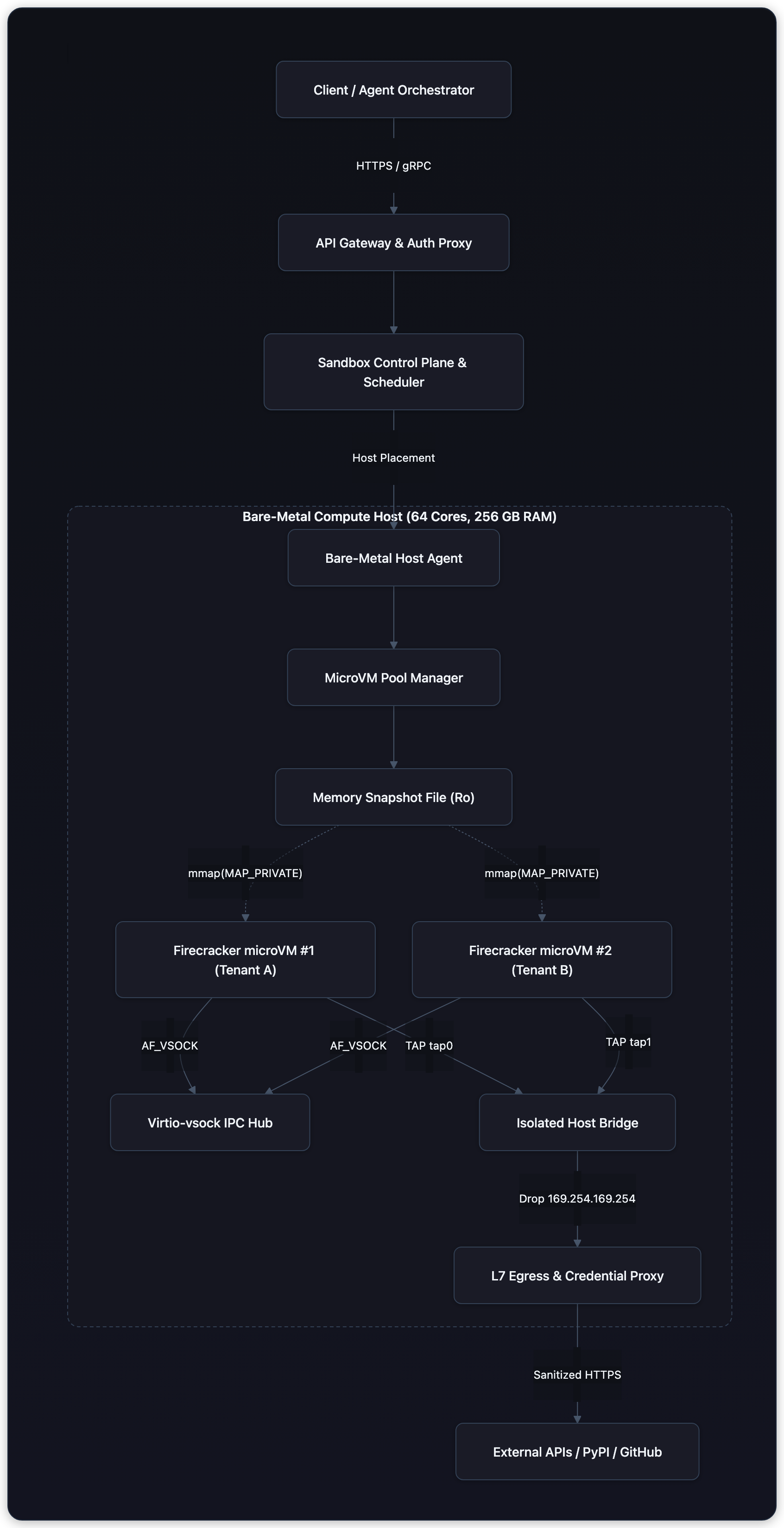
System Requirements & SLOs
Functional Requirements
- Ephemeral Code Execution: Execute arbitrary code (Python, Node.js, Shell, R) inside isolated runtimes with interactive bidirectional standard input, output, and error streaming.
- Filesystem Persistence & Scratch Space: Support uploading project files, installing arbitrary packages (
pip install,npm install), and extracting produced artifacts (charts, logs, models) upon completion. - Stateful Sessions: Allow agents to pause, inspect, and resume execution across multiple iterative reasoning turns.
- Egress Network Filtering: Provide controlled, audited external network access while strictly barring lateral host or cloud infrastructure movement.
Non-Functional Requirements & SLOs
- Warm-Start Latency: Resume and execute code in () from a pre-warmed snapshot. Cold start from a clean image in .
- Hardware-Enforced Isolation: Strong hardware virtualization boundary per sandbox instance (Linux KVM microVM), ensuring no shared kernel address space between tenants.
- High Concurrency & Density: Support 4,000+ concurrent active microVMs per 256 GB bare-metal node via Copy-on-Write (CoW) memory deduplication.
- Resource Containment: Strict per-sandbox quotas: 1 to 4 vCPUs, 512 MB to 8 GB RAM, and 5 GB disk, enforced via Linux cgroups v2 and KVM quotas.
- Zero-Trust Egress: Complete blocking of link-local cloud metadata services (
169.254.169.254) and automated injection of third-party API credentials outside the sandbox boundary.
Hardware Virtualization: Linux KVM and Firecracker Internals
Standard container engines (Docker, containerd) rely on shared Linux kernel namespaces (mount, pid, net, ipc, uts, user) and cgroups. If an untrusted script triggers a Linux kernel privilege escalation vulnerability (such as a dirty COW variant, use-after-free in io_uring, or an unpatched eBPF verifier flaw), the attacker gains kernel control over the entire physical host and all co-located tenants.
Hardware-assisted virtualization eliminates shared kernel space by placing each tenant inside an independent guest operating system.
The Linux KVM Subsystem
The Kernel-based Virtual Machine (KVM) module turns the Linux host kernel into a Type-2 hypervisor using Intel VT-x or AMD-V CPU extensions.[1] The host kernel exposes KVM via the /dev/kvm character device:
- VM Creation (
KVM_CREATE_VM): The userspace Virtual Machine Monitor (VMM) opens/dev/kvmand issuesioctl(kvm_fd, KVM_CREATE_VM, 0)to create a virtual machine file descriptor. - Memory Layout (
KVM_SET_USER_MEMORY_REGION): The VMM allocates host virtual memory (e.g., viammap) and maps it to Guest Physical Addresses (GPA) using hardware Extended Page Tables (EPT on Intel, NPT on AMD). The CPU hardware translates guest physical addresses directly to host physical addresses without host kernel intervention during normal execution. - vCPU Provisioning (
KVM_CREATE_VCPU): The VMM creates one or more vCPU file descriptors. Each vCPU is executed by a dedicated host userspace POSIX thread calling:cwhile (run_vm) { ioctl(vcpu_fd, KVM_RUN, 0); switch (run_struct->exit_reason) { case KVM_EXIT_MMIO: handle_mmio(run_struct); break; case KVM_EXIT_IO: handle_io_port(run_struct); break; case KVM_EXIT_HLT: run_vm = false; break; default: handle_unexpected_exit(run_struct); } } - VM Exits: The physical CPU switches between Host mode (VMX root) and Guest mode (VMX non-root). Whenever the guest executes privileged instructions, accesses unmapped memory-mapped I/O (MMIO), or receives host hardware interrupts, the CPU triggers a VM exit, pausing guest execution and returning control to the VMM thread.
Why Firecracker Replaced Legacy Hypervisors
Traditional general-purpose hypervisors like QEMU are designed for legacy desktop and server virtualization. QEMU contains over 1.5 million lines of C code, emulating IDE controllers, ACPI tables, PCI buses, sound cards, and PS/2 keyboards. This immense surface area represents a dangerous vector for hypervisor escape vulnerabilities.
Firecracker, developed by Amazon Web Services and open-sourced under Apache 2.0, is purpose-built for serverless functions and ephemeral multi-tenant sandboxes:
- Written in Rust: Leverages memory safety guarantees to prevent buffer overflows, double frees, and race conditions in the VMM userspace.
- Minimal Device Model: Completely removes PCI bus emulation, ACPI, and legacy peripherals. It provides only minimal paravirtualized devices implemented over MMIO:
virtio-net: High-throughput network packet transport using host TAP devices.virtio-block: Asynchronous block device I/O backed by raw files or loop mounts.virtio-vsock: Zero-network point-to-point host-guest socket communication mediated via host Unix domain sockets.virtio-balloonandvirtio-rng: Dynamic memory reclamation and cryptographic entropy injection.- Minimal serial console: MicroVM boot and kernel panic logging.
- Streamlined Footprint: A Firecracker microVM has a base memory overhead of only of host RAM and boots an uncompressed Linux kernel in under 120 ms.
Defense-in-Depth for the VMM: The Firecracker Jailer
In a multi-tenant platform, running bare Firecracker as root is unsafe. A vulnerability in the VMM's virtio emulation or KVM ioctls could yield host process execution.
Production platforms deploy each microVM wrapped by the Firecracker Jailer (jailer binary):
- Filesystem Chroot: Jails the Firecracker process inside a minimal directory tree (
--chroot-base-dir), exposing only its snapshot file, guest kernel, and Unix domain sockets. - Privilege Dropping: Switches from root to an unprivileged dedicated host user and group (
--uidand--gid) beforeexecveing the Firecracker binary. - Namespace Isolation: Allocates a dedicated Linux network namespace (
--netns) and PID namespace (--new-pid-ns) per microVM. - Cgroups v2 Limits: Configures hard CPU CFS quotas (
cpu.max) and memory limits (memory.max) before process execution. - Seccomp-BPF Containment: Compiles a strict Seccomp-BPF filter that restricts Firecracker to fewer than 35 essential Linux system calls, blocking dangerous operations (
ptrace,bpf,sys_chroot, raw sockets).
| Architectural Dimension | Traditional Containers (Docker / OCI) | Legacy VM (QEMU / KVM) | MicroVM (Firecracker / KVM) |
|---|---|---|---|
| Isolation Boundary | Shared Linux host kernel (namespaces + cgroups) | Independent guest kernel (hardware VT-x / AMD-V) | Independent guest kernel (hardware VT-x / AMD-V) |
| VMM Implementation | None (kernel namespaces directly) | lines of C | lines of Rust |
| Emulated Devices | None | Full PCI, ACPI, USB, IDE, VGA, Sound | Minimal virtio devices over MMIO |
| Cold Boot Latency | |||
| Snapshot Warm Start | Not natively supported | ||
| Per-Instance Overhead |
Sub-15ms Warm Start via Snapshotting and Copy-on-Write
Booting even an optimized Linux microVM kernel takes 100 to 150 ms. For multi-turn conversational agents that execute code incrementally during generation, a 150 ms pause per step introduces noticeable lag.
We achieve sub-15ms warm-start latency using memory and device state snapshot resume:
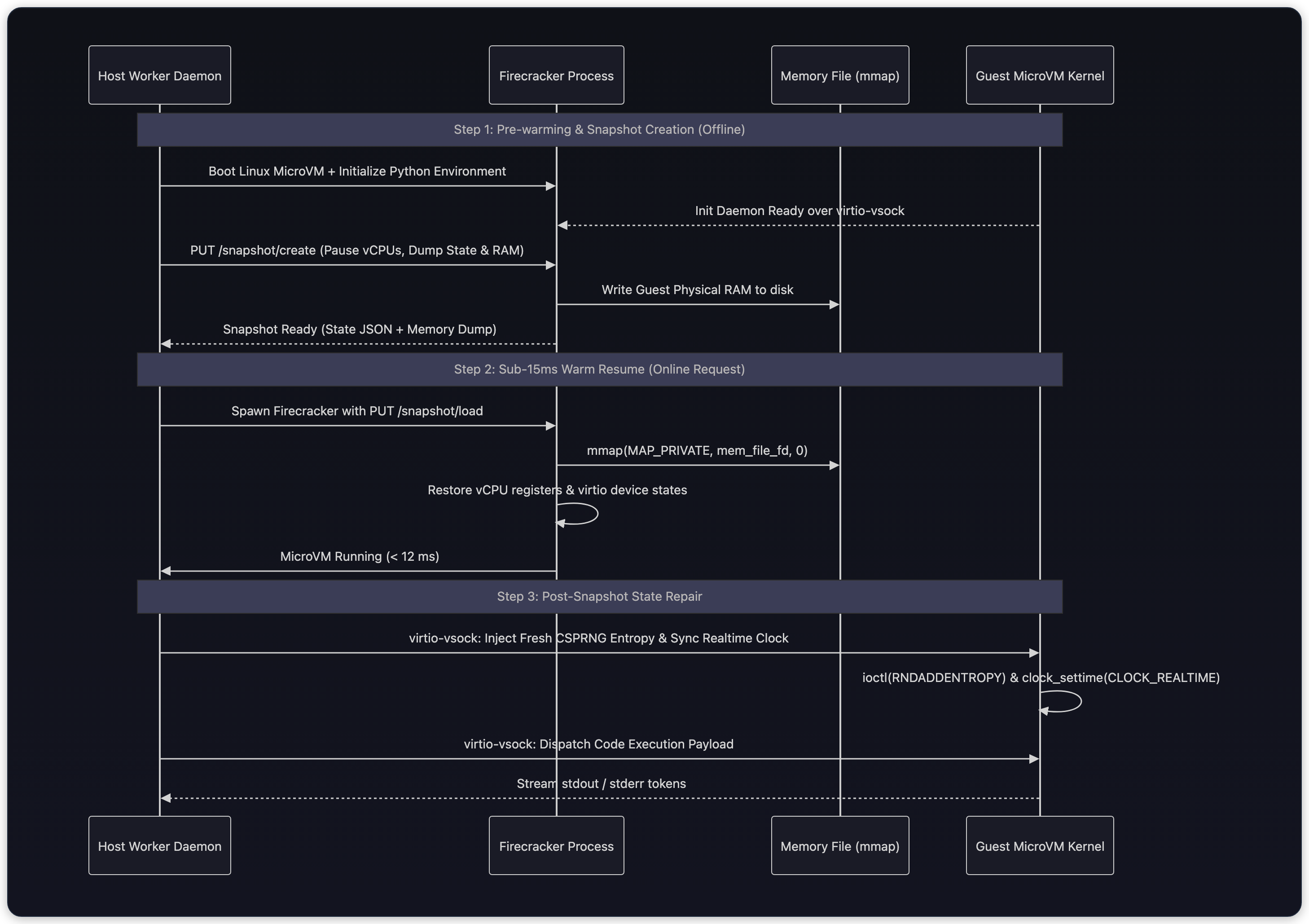
The Anatomy of a MicroVM Snapshot
A Firecracker snapshot consists of two artifacts:
- MicroVM State File: A compact JSON/binary descriptor storing the exact register contents of all vCPUs (rip, rsp, general-purpose registers, CR0/CR3/CR4 control registers, MSRs) and virtio device queue pointers.
- Guest Memory File: A raw byte dump of the guest physical RAM at the instant execution was paused.
The Restore Mechanism: File vs Uffd Backends
When a tenant request arrives, the node agent does not copy hundreds of megabytes of memory into RAM. Instead, it creates a new Firecracker process (via the Jailer) and issues a snapshot_load API call.[2]
Firecracker supports two distinct snapshot memory backends via mem_backend:
1. Local Memory Mapping (backend_type: "File")
When snapshot files are stored on local host NVMe SSDs, Firecracker maps the memory file directly into its process address space:
void *guest_mem = mmap(
    NULL,
    mem_size,
    PROT_READ | PROT_WRITE,
    MAP_PRIVATE | MAP_NORESERVE,
    snapshot_fd,
    0
);MAP_PRIVATE: Creates a Copy-on-Write (CoW) mapping. Reads directly access host kernel page cache backing the shared snapshot file. Writes do not modify the underlying snapshot file; instead, the Linux kernel allocates a fresh, private 4 KB physical page for that microVM.MAP_NORESERVE: Bypasses swap space pre-reservation, allowing dense overcommit of guest address spaces.
Because no memory pages are physically copied at launch, mmap completes in less than 2 milliseconds. The microVM resumes immediately. As guest code executes, page faults lazily pull active code pages into CPU cache.
2. Userspace Remote Streaming (backend_type: "Uffd")
In distributed fleets (such as Modal or AWS Lambda), copying 2 GB to 8 GB snapshot memory files to every host's local NVMe before launching would destroy warm-start latency.
Firecracker supports external userspace page fault handling via Linux userfaultfd (UFFD):
- Firecracker passes an open UFFD file descriptor to an out-of-process userspace daemon over a host Unix domain socket.
- The microVM is unpaused with empty guest memory mappings.
- When guest vCPU execution touches an unpopulated page, KVM traps the fault and halts the vCPU thread.
- The host kernel delivers a
UFFD_EVENT_PAGEFAULTmessage to the userspace UFFD handler daemon. - The handler fetches the requested 4 KB or 2 MB chunk from high-speed distributed NVMe caching tiers or S3 chunk stores and resolves the fault using:
c
struct uffdio_copy copy = { .dst = fault_address, .src = (unsigned long)fetched_chunk_buf, .len = page_size, .mode = 0 }; ioctl(uffd_fd, UFFDIO_COPY, ©); - The host kernel populates the page and resumes the vCPU thread seamlessly.
The Four Post-Snapshot Recovery Pitfalls
Restoring a paused operating system snapshot duplicates the exact state of memory and CPU registers across multiple independent machines. If resumed naively, catastrophic security, correctness, and networking failures occur. The platform must explicitly repair four state dimensions immediately upon unpausing:
1. Clock Drift and Monotonic Skew
The guest operating system's internal monotonic and real-time clocks are frozen at the exact millisecond the snapshot was generated. If a snapshot taken 48 hours ago is restored:
- TLS certificate validation fails immediately (
CertificateNotYetValidor expired). - OAuth tokens and HTTP connection timeouts expire instantly.
- Scheduled timers (
cron, systemd timers) fire concurrently, thrashing the CPU.
Remediation: The host agent queries the host wall clock, computes the elapsed delta, updates the KVM paravirtual clock (kvm-clock) offset via KVM ioctl, and sends an atomic clock update packet across virtio-vsock to trigger clock_settime(CLOCK_REALTIME, &now) inside the guest.
2. Entropy Duplication and CSPRNG Cloning
Linux generates random numbers for cryptographic keys, UUIDs, SSL session salts, and temporary file paths using an internal cryptographically secure pseudorandom number generator (CSPRNG, ChaCha20).
If 1,000 microVMs are restored from the same snapshot, their kernel CSPRNG states and userland seeds (e.g., Python's random and secrets module states) are identical. Every resumed instance will generate identical UUIDs, identical SSH host keys, and identical cryptographic nonces.
Remediation:
- Modern Kernels (Linux 5.18+): The host signals a Virtual Machine Generation ID (
VMGenID) ACPI notification upon snapshot resume. The guest kernel detects the generation ID change and automatically reseeds the kernel ChaCha20 CRNG and updates/proc/sys/kernel/random/boot_id. - Pre-5.18 Kernels or Immediate Defense: Before user code executes, the host injects 32 bytes of cryptographically secure random bytes from host
/dev/urandomover virtio-vsock to the guest supervisor daemon. The supervisor runs:cstruct rand_pool_info { int entropy_count; int buf_size; __u32 buf[8]; }; ioctl(urandom_fd, RNDADDENTROPY, &entropy_info); ioctl(urandom_fd, RNDRESEEDCRNG, 0); // Forces immediate ChaCha20 CRNG reseeding
3. Network Identity and MAC Address Collisions
Every snapshot contains the network interface configuration (IP address, MAC address, ARP table) of the original base VM. Firecracker restores network devices using their initially configured TAP interface names. If multiple clones attempt to create TAP devices with the same name on the same host bridge, launch fails or packet switching collapses due to MAC flapping.
Remediation:
- The Firecracker Jailer spawns each microVM clone inside an isolated Linux network namespace (
--netns). - Each namespace maintains its own private
vmtap0device with a unique link-local IP (192.168.241.2/30). - The host agent attaches a
vethpair between each sandbox netns and the host network bridge, applying 1:1nftablesmasquerade NAT for outbound Internet access.
4. Stale Child Processes and Broken Unix Sockets
Any background daemons running during snapshot creation retain open file descriptors pointing to host FIFO pipes or sockets that no longer exist on the new host node.
Remediation: The base snapshot is taken in a quiescent state: no user processes running, only a single minimal guest supervisor init daemon listening on virtio-vsock port 5000.
Filesystem Isolation: Multi-Layered OverlayFS
Sandboxed code frequently modifies the filesystem: running pip install scipy, extracting zip archives, writing temporary datasets, or building wheels. If sandboxes write directly to persistent host disks, disk I/O bottlenecks emerge, and disk space cannot be reclaimed quickly.
We implement a layered storage architecture combining read-only block devices and ephemeral OverlayFS mounts:
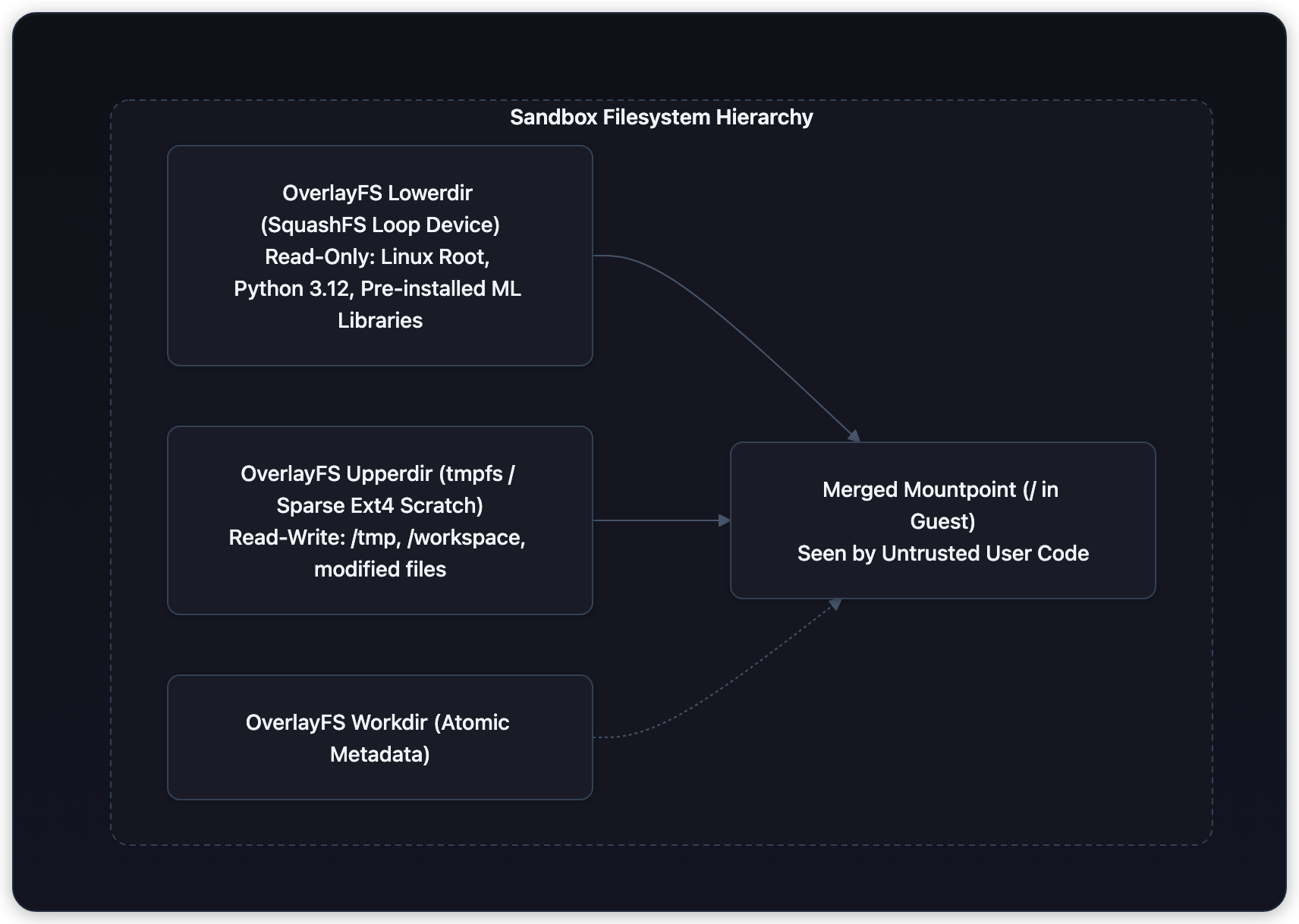
- Lowerdir (Immutable Base Image): A compressed SquashFS block image containing the base Linux distribution, standard C runtimes, Python 3.12, and 100+ standard data science packages. This base image is attached as a read-only virtio-block device (
/dev/vdb) and mounted read-only across all instances. - Upperdir (Ephemeral Scratch Layer): A small, in-memory
tmpfsmount or an ephemeral sparse block file. All file creations, edits, and package installations are written exclusively to this upper layer. - Instant Reset and Reaping: When an execution session completes, the host agent unmounts the OverlayFS layer and wipes the
upperdirdirectory.[3] Teardown completes in , leaving no residual files on the host disk and avoiding expensive garbage collection sweeps.
Host-Guest Communication: Virtio-vsock vs Network Sockets
The host must stream code payloads into the sandbox and stream back output tokens, file artifacts, and telemetry.
Using standard TCP/IP networking across virtual Ethernet bridges introduces severe drawbacks:
- Host Port Exhaustion: A Linux host has 65,535 ephemeral TCP ports. If 4,000 microVMs open multiple concurrent TCP connections for command channels, telemetry, and health checks, the host risks local port exhaustion and TCP
TIME_WAITsocket buildup. - Protocol Overhead: Packets traverse host iptables rules, network bridge queuing disciplines, guest virtio-net queues, and the guest TCP/IP stack, incurring CPU context switches and 0.5 ms to 2 ms of transit latency.
The Virtio-vsock Device Model and Host Unix Socket Mediation
Firecracker provides virtio-vsock support for hypervisor-to-virtual-machine IPC, but purposefully bypasses the host Linux kernel's vhost-vsock driver to avoid root privileges and global CID allocation conflicts.[4]
Instead, Firecracker mediates communication between AF_UNIX sockets on the host and AF_VSOCK sockets inside the guest:
-
Inside the Guest MicroVM: The supervisor init daemon binds a standard
AF_VSOCKsocket to CIDVMADDR_CID_ANYon port 5000:cstruct sockaddr_vm sa = { .svm_family = AF_VSOCK, .svm_cid = VMADDR_CID_ANY, .svm_port = 5000 }; int s = socket(AF_VSOCK, SOCK_STREAM, 0); bind(s, (struct sockaddr *)&sa, sizeof(sa)); listen(s, 128); -
Outside on the Host: Firecracker creates an
AF_UNIXdomain socket at a configured path (e.g.,/srv/jail/vm1/root/vsock.sock). When the host agent initiates a session, it connects to the Unix socket and sends a text connection command:pythonimport socket # Connect to Firecracker's host Unix domain socket sock = socket.socket(socket.AF_UNIX, socket.SOCK_STREAM) sock.connect("/srv/jail/vm1/root/vsock.sock") # Initiate channel multiplexing to guest port 5000 sock.sendall(b"CONNECT 5000\n") ack = sock.recv(32) # b"OK 1025\n" # The socket is now a transparent, raw bidirectional stream to guest port 5000 sock.sendall(b'{"action": "execute", "script": "print(42)"}\n') -
Advantages over Host Bridge Networking:
- Zero Ephemeral Port Consumption: Multiplexed over host Unix domain sockets and memory virtqueues, completely eliminating the 65,535 TCP port limit and TCP
TIME_WAITsocket buildup. - Microsecond Latency: Bypasses host iptables filters, network bridges, and TAP packet encapsulation.
- Unprivileged Host Operation: Requires no root access or
/dev/vhost-vsockkernel driver on the host.
- Zero Ephemeral Port Consumption: Multiplexed over host Unix domain sockets and memory virtqueues, completely eliminating the 65,535 TCP port limit and TCP
Zero-Trust Network Containment & Egress Proxying
Untrusted agent code often needs to query external APIs (fetching web pages, calling GitHub APIs, downloading datasets). Unrestricted network access is dangerous: malicious code could attack host cloud infrastructure, send spam, or participate in distributed denial-of-service (DDoS) campaigns.
We enforce a multi-layer zero-trust egress architecture:
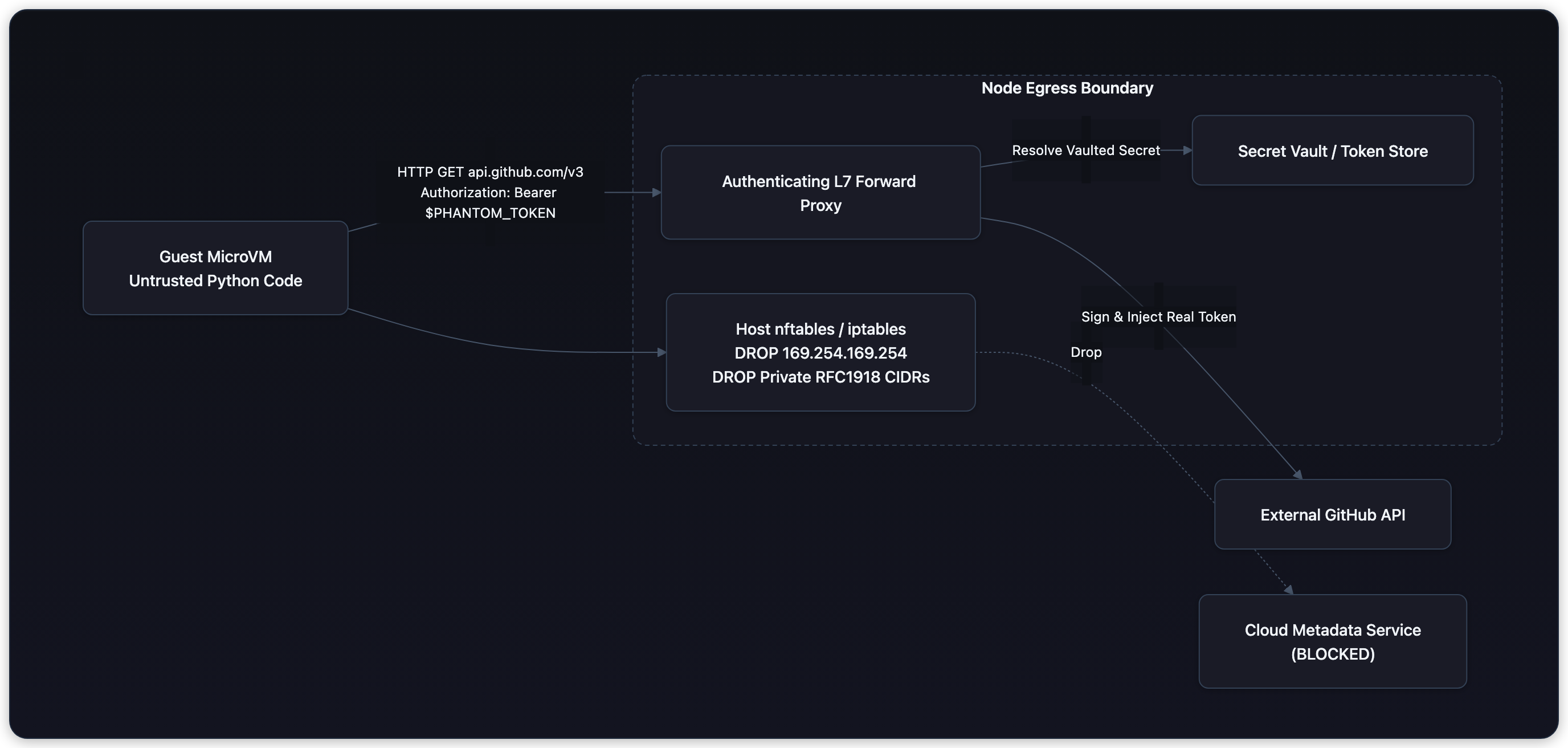
1. Blocking Cloud Metadata Services (SSRF Defense)
In cloud environments (AWS, GCP, Azure), virtual machine instances can query the link-local metadata address 169.254.169.254 (e.g., AWS IMDSv2) to obtain temporary IAM role credentials associated with the physical host node.[5] If untrusted code running inside a microVM can reach 169.254.169.254, an attacker could steal the host node's instance profile and compromise the entire cluster.
The node agent installs strict host nftables packet filtering rules before attaching any TAP device to the network bridge:
# Block all access to link-local cloud metadata
nft add rule inet filter forward iifname "tap*" ip daddr 169.254.169.254 drop

# Block lateral movement into internal VPC subnets (RFC 1918)
nft add rule inet filter forward iifname "tap*" ip daddr { 10.0.0.0/8, 172.16.0.0/12, 192.168.0.0/16 } drop
2. L7 Egress Proxy with Phantom Credential Injection
Agents often need access to private services (such as a customer's GitHub repository or database). Injecting raw personal access tokens or database passwords directly into the sandbox environment exposes those secrets to untrusted code inspection, exfiltration via stdout, or writing into generated files.
We solve this using Phantom Token Brokering:
- The orchestrator injects an opaque placeholder token into the sandbox environment:
bash
export GITHUB_TOKEN="ph_sec_9a7b2c4e8f" - Guest outbound traffic is transparently redirected through the host's L7 egress forward proxy (e.g., Envoy or a custom Go proxy).
- The proxy parses the
Authorizationheader, verifies that the destination URL matches the customer's approved repository whitelist, retrieves the real cryptographic token from an external secret vault, replaces the placeholder header, and forwards the request upstream. - The untrusted sandbox never possesses secret-zero. Even a full root compromise of the guest kernel reveals only ephemeral phantom references.
3. DNS Rebinding Mitigation
Attackers can bypass domain whitelists using DNS rebinding: configuring a public domain name (e.g., attacker.com) with a low TTL that initially resolves to an allowed public IP address during proxy domain evaluation, then rebinds to an internal private IP (127.0.0.1 or 10.0.1.50).
The egress proxy mitigates this by:
- Pinning the resolved IP address for the duration of the HTTP session.
- Rejecting any DNS response that resolves to loopback (
127.0.0.0/8), link-local (169.254.0.0/16), or private RFC 1918 address space.
Host Node Capacity Planning & Bin-Packing Math
To operate an agent sandbox platform cost-effectively, bare-metal compute hosts must be densely packed while maintaining strict latency and memory guarantees.
Hardware Specification (Host Unit)
- CPU: Dual-socket AMD EPYC 9654 (128 physical cores, 256 hardware threads / vCPUs).
- RAM: 512 GB DDR5 ECC memory.
- Storage: NVMe SSDs in RAID 0 (for snapshot storage and local package caches).
- Network: Dual 25 Gbps Ethernet interfaces.
Memory Sizing with Copy-on-Write Sharing
Let us calculate host capacity for a standard node with 256 GB of RAM:
- Host Reserves:
- Linux host kernel, VMM processes, and monitoring daemons: 16 GB.
- Host filesystem page cache (retaining the read-only snapshot memory file in RAM): 16 GB.
- Usable guest RAM pool: .
- Per-Sandbox Memory Footprint:
- Configured virtual memory limit per sandbox: 2,048 MB (2 GB).
- Base snapshot file size: 256 MB.
- Actual dirty pages allocated in host RAM during an active Python interpreter session (importing libraries, compiling bytecode, creating arrays): average.
- Density Comparison:
- Naive Static Allocation (Without CoW):
- With CoW Snapshot Sharing (50 MB dirty/VM):
Copy-on-Write memory sharing increases host packing density by over 40x, dramatically lowering per-second compute costs.
CPU Oversubscription Dynamics
AI code interpreter workloads are characterized by brief bursts of compute (100 ms to 500 ms of CPU time to run a script, generate a plot, or process data) separated by 5 to 15 seconds of client think time or LLM inference token generation.
Because active duty cycles average , physical cores can be safely oversubscribed:
- With 128 physical cores and an average active duty cycle of 3%, an oversubscription ratio of 30:1 achieves:
- Linux cgroups v2 CFS bandwidth quotas (
cpu.max) throttle runaway threads (e.g.,while True: pass) to a hard maximum of 100 ms CPU time per 100 ms scheduling window, preventing any single tenant from starving neighboring vCPU threads.
Executable MicroVM Sandbox Pool & Snapshot Simulator
The following Python script simulates the microVM pool manager, sub-15ms Copy-on-Write memory restoration, post-snapshot state repair (clock synchronization, CSPRNG entropy replenishment, and network identity assignment), OverlayFS scratch management, and host capacity calculations.
import os
import secrets
import hashlib
from typing import Dict, List, Set

class MicroVMSandbox:
    """Simulates an isolated Firecracker microVM instance managed via KVM."""
    def __init__(self, vm_id: str, base_snapshot_hash: str):
        self.vm_id = vm_id
        self.base_snapshot_hash = base_snapshot_hash
        self.state = "UNINITIALIZED"
        self.allocated_dirty_mb = 0.0
        self.guest_clock_offset_ms = 0.0
        self.entropy_injected_bytes = 0
        self.tap_device = ""
        self.mac_address = ""
        self.scratch_files: Dict[str, bytes] = {}

    def resume_from_snapshot(self, tap_id: int, snapshot_age_ms: float) -> float:
        """Simulates sub-15ms warm start via mmap(MAP_PRIVATE) and post-snapshot repair."""
        # 1. mmap base memory file (CoW page mapping completes in ~2ms)
        self.allocated_dirty_mb = 5.0  # Initial page faults during register restore

        # 2. Repair Pitfall 1: Sync guest clock drift
        self.guest_clock_offset_ms = snapshot_age_ms

        # 3. Repair Pitfall 2: Replenish CSPRNG entropy via RNDADDENTROPY
        fresh_seed = secrets.token_bytes(32)
        self.entropy_injected_bytes = len(fresh_seed)

        # 4. Repair Pitfall 3: Bind unique TAP device & MAC to prevent network collision
        self.tap_device = f"tap_{tap_id}"
        self.mac_address = f"52:54:00:12:34:{tap_id:02x}"
        self.state = "RUNNING"

        # Modeled warm resume time in milliseconds
        return 11.8

    def execute_code(self, code_script: str, file_writes: Dict[str, bytes]) -> Dict[str, str]:
        """Executes code inside the sandbox, modifying only the OverlayFS upperdir."""
        if self.state != "RUNNING":
            raise RuntimeError("MicroVM must be in RUNNING state to execute code.")

        # OverlayFS scratch layer writes to upperdir only
        for fname, data in file_writes.items():
            self.scratch_files[fname] = data
            self.allocated_dirty_mb += len(data) / (1024 * 1024)

        # Simulate dirty execution memory (e.g., Python runtime loading NumPy arrays)
        self.allocated_dirty_mb += 18.5
        return {"status": "success", "scratch_file_count": str(len(self.scratch_files))}

    def reset_and_reap(self):
        """Instant zero-cost teardown: drop upperdir and unmap memory."""
        self.scratch_files.clear()
        self.allocated_dirty_mb = 0.0
        self.state = "TERMINATED"

def run_simulation():
    print("Simulating Firecracker microVM snapshot restore and pool scaling:")
    vm = MicroVMSandbox(
        vm_id="vm-worker-001",
        base_snapshot_hash="sha256:7f83b1657ff1fc53b92dc18148a1d65dfc2d4b1fa3d677284addd200126d9069"
    )

    # Simulate warm resume from a 24-hour-old pre-warmed snapshot
    resume_time_ms = vm.resume_from_snapshot(tap_id=42, snapshot_age_ms=86400000.0)
    print(f" - Warm-start snapshot restore latency: {resume_time_ms:.1f} ms")
    print(f" - Post-snapshot clock repair applied: {vm.guest_clock_offset_ms / 1000.0:.0f}s offset synced")
    print(f" - Post-snapshot entropy injected: {vm.entropy_injected_bytes} bytes via RNDADDENTROPY")
    print(f" - Network configuration: {vm.tap_device} (MAC: {vm.mac_address})")

    exec_res = vm.execute_code(
        code_script="import numpy as np; arr = np.zeros((100, 100))",
        file_writes={"output.csv": b"id,val\n1,42\n"}
    )
    print(f" - Code execution status: {exec_res['status']}, dirty RAM: {vm.allocated_dirty_mb:.1f} MB")

    # Capacity calculation for a 64-core / 256GB bare-metal host
    total_host_ram_mb = 256 * 1024
    host_reserved_mb = 32 * 1024
    usable_guest_ram_mb = total_host_ram_mb - host_reserved_mb  # 224 GB
    naive_vm_ram_mb = 2048  # 2 GB without CoW
    cow_avg_dirty_mb = 50.0  # with CoW snapshot sharing

    naive_capacity = usable_guest_ram_mb // naive_vm_ram_mb
    cow_capacity = int(usable_guest_ram_mb // cow_avg_dirty_mb)
    print(f" - Bare-metal host density (256 GB RAM):")
    print(f"   * Naive 2GB per-VM allocation: {naive_capacity} concurrent VMs")
    print(f"   * CoW snapshot memory sharing (50MB dirty/VM): {cow_capacity} concurrent microVMs (40x packing density)")

    vm.reset_and_reap()
    print(f" - MicroVM state after zero-cost upperdir teardown: {vm.state}")

if __name__ == "__main__":
run_simulation()Simulating Firecracker microVM snapshot restore and pool scaling:
- Warm-start snapshot restore latency: 11.8 ms
- Post-snapshot clock repair applied: 86400s offset synced
- Post-snapshot entropy injected: 32 bytes via RNDADDENTROPY
- Network configuration: tap_42 (MAC: 52:54:00:12:34:2a)
- Code execution status: success, dirty RAM: 23.5 MB
- Bare-metal host density (256 GB RAM):
* Naive 2GB per-VM allocation: 112 concurrent VMs
* CoW snapshot memory sharing (50MB dirty/VM): 4587 concurrent microVMs (40x packing density)
- MicroVM state after zero-cost upperdir teardown: TERMINATEDFailure Modes & Production Resiliency
| Failure Scenario | Root Cause | Impact | Mitigation Strategy |
|---|---|---|---|
| Runaway Process / Fork Bomb | Untrusted code spawns unlimited subprocesses (:(){ :|:& };:) | Host kernel PID exhaustion, node denial of service | Configure Linux cgroups v2 pids.max = 256 inside the guest and assign strict vCPU quotas (cpu.max) on the host. |
| Silent Memory Exhaustion (OOM) | Untrusted script allocates massive NumPy arrays exceeding RAM limit | Host Linux kernel OOM-killer terminates unrelated neighbor processes | Set memory.max via host cgroups v2 for each Firecracker VMM thread. Configure guest kernel to kill offending script inside guest without host fault. |
| Zombie MicroVM Leaks | Host agent crashes while microVMs are executing code | Orphaned Firecracker processes consume RAM and hold TAP interfaces open | A host reaper watchdog monitors heartbeat files on a 5-second interval; untracked PIDs or orphaned TAP devices are forcefully reaped via SIGKILL. |
| Egress Credential Exfiltration | Script reads environment variables and attempts to POST tokens to attacker server | Loss of third-party API credentials | Use phantom tokens inside the sandbox; real credentials are substituted strictly at the authenticated host L7 egress proxy. |
| Snapshot State Corruption | VMM writes dirty pages back into the base snapshot image file | All subsequently restored microVMs inherit corrupted OS state | Mount base snapshot file as strictly read-only (chmod 400) and map memory with MAP_PRIVATE. |
Summary Architecture Checklist
- Isolation: Linux KVM hardware virtualization; Firecracker minimal VMM in Rust with 4 MMIO virtio devices.
- Cold vs Warm Start: Pre-warmed base snapshots mapped via
mmap(MAP_PRIVATE)for sub-15ms warm start and 40x memory deduplication. - State Repair: Mandatory post-snapshot repair covering clock drift (
kvm-clock), CSPRNG entropy (RNDADDENTROPY), unique TAP/MAC bindings, and stale socket cleanup. - Storage: Read-only SquashFS base layer plus per-sandbox ephemeral OverlayFS
upperdirscratch disks reset in . - IPC & Egress: Virtio-vsock for host-guest control communication; host
nftablesblocking link-local cloud metadata (169.254.169.254); and an authenticating L7 egress proxy with phantom token replacement.
Follow-up questions
How would you handle a tenant running untrusted code that requires mounting a 50 GB read-only machine learning model weight volume?
Attach the model weight directory as an independent, read-only virtio-block device backed by a shared host NVMe sparse file, or share it via virtio-fs with DAX (Direct Access) enabled. This bypasses guest page cache duplication and avoids loading multi-gigabyte models into the ephemeral OverlayFS upperdir.
Why does Copy-on-Write memory sharing degrade if the untrusted script runs a garbage-collected language like Java or Python with cyclic reference sweeps?
Garbage collector mark-and-sweep phases touch heap objects across memory pages even when object values do not change. Reading dirty bits or writing mark flags triggers host page faults that break CoW sharing, materializing private 4 KB physical pages in host RAM and reducing node packing density.
What strong answers show
- Hardware-assisted virtualization (KVM) is clearly distinguished from container namespace isolation for untrusted multi-tenant code execution.
- Sub-15ms warm start mechanics explain
mmap(MAP_PRIVATE)Copy-on-Write page fault demand paging and explicit post-snapshot state repair (clock drift, CSPRNG entropy duplication, network identity, and stale sockets). - Storage uses read-only SquashFS base images with ephemeral OverlayFS upperdirs for instant, zero-leak workspace resets.
- Host-guest control relies on virtio-vsock to eliminate host ephemeral TCP port exhaustion and network bridge latency.
- Egress boundaries strictly drop cloud metadata addresses (
169.254.169.254) and isolate credentials using out-of-band phantom token proxying.