Personalize this lesson
Adapt explanations and teaching visuals to your background and preferred voice.
In this fictional practice case, at 09:12 on Friday you're on call for returns-rerank-v3. Two permission-denied eval cases still return restricted snippets, and broad release is on the calendar. Product asks for the 5 percent canary because the failures are rare: "it's only two cases." A polished answer calls this "balancing safety and speed." A credible answer points to the failing cases, names the boundary, and says why user traffic stays at 0 percent.
An answer needs enough detail for a listener to distinguish your judgment from the team's eventual result. The launch below is a teaching example, not a candidate's experience or a hiring success story. Use it to practice the structure, then replace it with work you actually did. School projects, open-source contributions, research replications, and non-ML engineering work can all supply useful evidence; don't invent an incident to match a prompt.
Public guidance, checked October 10, 2026, gives some direction, not a universal scoring rubric. OpenAI names collaboration, communication, and openness to feedback. Anthropic asks about experience and motivation. Google DeepMind recommends concise STAR examples and data that explains impact.[1][2][3] The practical question is the same: what did you do, why, and what can you honestly conclude?
Values aren't evidence
A value statement describes what matters to you. A past example shows how that value affected a choice. Pair it with an action and consequence from work you can discuss:
| Value language | Engineering translation |
|---|---|
| Reliability | users can debug, retry, and trust failure states |
| Safety | eval gates, red teams, staged rollout, rollback, human review |
| Control over tool actions | permission boundaries, policy gates, constrained tools, reversible actions |
| Direct evidence | production metrics, incidents, shipped systems, regression suites |
| Simple thing that works | smallest design that satisfies measured constraints |
| Humility | clear boundaries on what you owned and where evidence changed your mind |
Why is "I care about AI safety" too weak by itself?
Answer
It's a value statement without evidence. A stronger answer names the mechanism: permission boundaries, eval gates, red-team cases, incident regression tests, rollback triggers, and support traces.
The Friday launch
Stay with returns-rerank-v3. A behavioral answer should let the listener reconstruct the moment: product pressure, observed failure, your boundary, decision, and evidence. "I pushed back because quality mattered" leaves out what you observed and what you changed.
The hypothetical facts are these: a support reranker is scheduled for broad release before a high-volume returns period. Two eval cases, acl-denied-snippet and acl-denied-citation, still return restricted text on permission-denied documents. The later canary requires p95 latency strictly below 500 ms over a predeclared observation window, plus the other release checks. Passing two regressions is necessary, not proof that every authorization path is correct.
Stop at the word "rare." Two failing targeted regressions have neither a traffic denominator nor a representative sampling method, so they don't establish a production leak rate. A 5 percent canary describes routing share, not the probability or severity of unauthorized exposure; that share can also concentrate on a particular tenant or user group. The release decision follows the known access violation, without inventing a risk estimate from the case count.
| Layer | Worked sentence | Why it earns trust |
|---|---|---|
| Situation | "A new support reranker was scheduled for broad release before a high-volume returns period." | Names the product pressure without a long preamble. |
| Risk | "Two permission-denied eval cases still returned restricted snippets." | Turns concern into a concrete failure mode. |
| Mechanism | "I reproduced both leaks and wrote the release check; the service owner fixed authorization, and the release owner approved the later canary." | Keeps known authorization failures away from users while preserving a staged operational check. |
| Evidence | "Both authorization cases passed before exposure, then p95 latency stayed at 420 ms against a 500 ms limit during the canary." | Separates a pre-exposure safety gate from live operational evidence. |
| Outcome | "The release owner approved the next stage after the agreed checks passed." | States the observed outcome without claiming unmeasured harm reduction. |
| Reflection | "I now ask teams to define rollback criteria before launch review." | Shows a durable change in operating practice. |
Read the table as a decision trail, not a script to memorize. Use verbs that match your boundary: if you wrote the gate while another engineer repaired the authorization service, say so. The team outcome can be shared; your ownership of the decision, artifact, or test must stay precise.
The fork that matters is traffic, not tone. A canary limits exposure while observing live behavior. It doesn't make a known authorization leak acceptable. OWASP recommends default-deny authorization and permission checks on every request; a passing sample of tests doesn't replace that enforcement.[4]
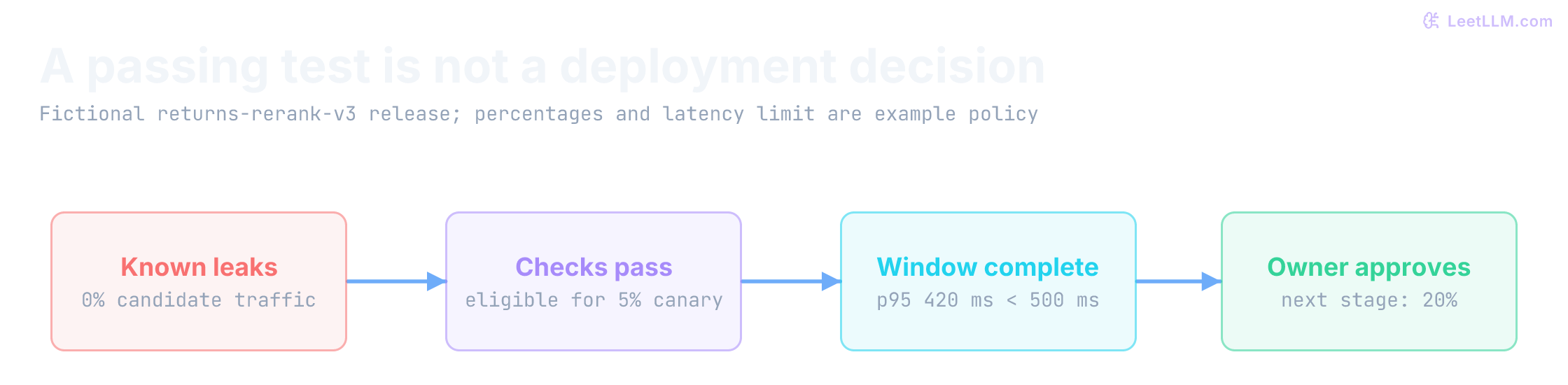
Here is a small executable version of the example policy. checks contains results for this candidate build, not an empty list interpreted as success. other_gates_pass summarizes the separately reviewed security, correctness, and operational checks. In a real system, evidence would also need authenticated provenance, build identity, freshness, and an authorized release owner.
The function recommends a next step; it doesn't deploy anything. Its hard-coded percentages are teaching choices. The assertions exercise missing evidence, a known failure, an incomplete observation window, the strict latency boundary, and a successful review.
import math

REQUIRED = {"acl-denied-snippet", "acl-denied-citation"}

def launch_action(checks, *, stage="offline", p95_ms=None,
                  window_complete=False, other_gates_pass=False):
    if stage not in {"offline", "canary"}:
        raise ValueError("unknown release stage")
    if not isinstance(checks, dict) or set(checks) != REQUIRED:
        return "hold: missing or unexpected authorization evidence", 0
    if any(value is not True for value in checks.values()):
        return "block: authorization check failed", 0
    if other_gates_pass is not True:
        return "hold: other release checks incomplete", 0
    if stage == "offline":
        return "eligible for approved canary", 5
    if (window_complete is not True or type(p95_ms) not in (int, float)
            or not math.isfinite(p95_ms) or p95_ms < 0):
        return "hold canary: latency evidence incomplete", 5
    if p95_ms >= 500:
        return "rollback candidate: latency limit breached", 0
    return "eligible for next-stage approval", 20

passed = {name: True for name in REQUIRED}
failed = {**passed, "acl-denied-snippet": False}
assert launch_action({})[1] == 0
assert launch_action(failed, other_gates_pass=True)[1] == 0
assert launch_action(passed)[1] == 0
assert launch_action(passed, other_gates_pass=True)[1] == 5
canary = dict(stage="canary", window_complete=True, other_gates_pass=True)
assert launch_action(passed, p95_ms=500, **canary)[1] == 0
assert launch_action(passed, p95_ms=float("nan"), **canary)[1] == 5
assert launch_action(passed, stage="canary", p95_ms=420,
                     other_gates_pass=True)[1] == 5
assert launch_action(passed, p95_ms=420, **canary)[1] == 20
assert launch_action(failed, p95_ms=420, **canary)[1] == 0
assert launch_action({}, p95_ms=420, **canary)[1] == 0
print("PASS missing evidence, failed checks, and other gates block exposure")
print("PASS canary window, nonfinite latency, strict 500 ms limit, next-stage review")
print("PASS failed or missing authorization withdraws a healthy-latency canary")PASS missing evidence, failed checks, and other gates block exposure
PASS canary window, nonfinite latency, strict 500 ms limit, next-stage review
PASS failed or missing authorization withdraws a healthy-latency canaryThe final two assertions keep latency at the apparently healthy 420 ms, but remove or fail authorization evidence. Predict the result before running them: operational health cannot override the access boundary. If a check becomes missing or fails during a canary, this policy recommends withdrawing the candidate. Existing traffic returns to the prior approved version. Real rollback still needs tested routing, cancellation, and data-handling behavior. It can stop further exposure but cannot retract restricted text already delivered; contain the access failure and investigate affected requests. The function tests release decisions, not the authorization implementation.
Say the answer, then defend its limits
A concise answer from the fictional facts might sound like this:
I was responsible for the release check, not the authorization service. Before a Friday reranker launch, I reproduced two cases that returned restricted content. Product wanted a 5 percent canary. I documented why those known failures violated the access boundary and asked the release owner to hold candidate traffic at zero. The service owner fixed authorization; I added the regression checks and verified the candidate build. After the other checks passed, the release owner approved a canary. Its p95 was 420 ms, below our 500 ms limit, and the team approved the next stage. I don't have evidence that the delay reduced incident rates. What changed in my later work was writing launch and rollback criteria before release review.
The answer separates personal work, another engineer's repair, and the release owner's authority. It also avoids equating two passing tests with proven security. A latency number still needs its measurement window and request population; if those facts aren't in your real notes, say you don't remember rather than inventing them.
Why does the packet need a reflection sentence?
Answer
It names the operating change that survived the launch. For returns-rerank-v3, that's writing rollback criteria before the next review, not just listing a past win.
Prepare for follow-up questions
Once the listener understands the launch, they can ask what you personally owned and why you chose that action. Google DeepMind's candidate guide recommends STAR (Situation, Task, Action, Result) and asks you to include data when you describe impact.[3] Keep that skeleton, then add the risk you were preventing and what you changed in how you operate.
| STAR beat | Inspectable overlay | returns-rerank-v3 |
|---|---|---|
| Situation | one sentence of context | Friday launch before returns volume |
| Task | your responsibility and constraint | own release checks; no restricted content in candidate responses |
| Action | your contribution, separate from the team | reproduce leaks, add release checks, recommend holding traffic |
| Result | evidence plus outcome | both cases pass, then p95 420 ms, then expand |
| Optional reflection | later change in practice | rollback criteria now exist before launch review |
Don't rehearse these as a second script. For each answer, point to one artifact, threshold, or observation. If you can't name one, the story may be polished beyond what you can defend.
| Follow-up | What to answer |
|---|---|
| "Were you too cautious?" | threshold that would have let you proceed earlier |
| "What did the other person believe?" | strongest version of their view |
| "What did you personally own?" | decision, artifact, migration, incident role, or metric |
| "What would you do differently?" | one specific process or design change |
| "What evidence changed your mind?" | test, incident, prototype, metric, user signal |
| "How did you handle disagreement afterward?" | relationship repair, shared doc, decision record |
| "What was the cost of your choice?" | latency, scope, migration risk, team time, opportunity cost |
| "How do you avoid over-indexing on safety?" | launch criterion, staged exposure, rollback, owner |
| "Where might you be wrong now?" | uncertainty and verification plan |
| "How does this transfer to AI systems?" | permissions, evals, observability, rollout, tools |
Don't defend every past choice. Show the gate, metric, or reversal signal you now write down before the next launch.
If a culture expects written decision records, rehearse this drill: before the meeting, write a one-page decision note with options considered, your recommendation, risks, and the reversal signal. In the room, explain the options and evidence rather than arguing from memory. Afterward, update the record with the decision and owner. A verbal win is hard to audit and easy to re-litigate.
One packet, many prompts
One evidence packet can answer several prompts when its mechanism is real. The interviewer can ask about speed, disagreement, or safety and still find the same decision trail from a different angle.
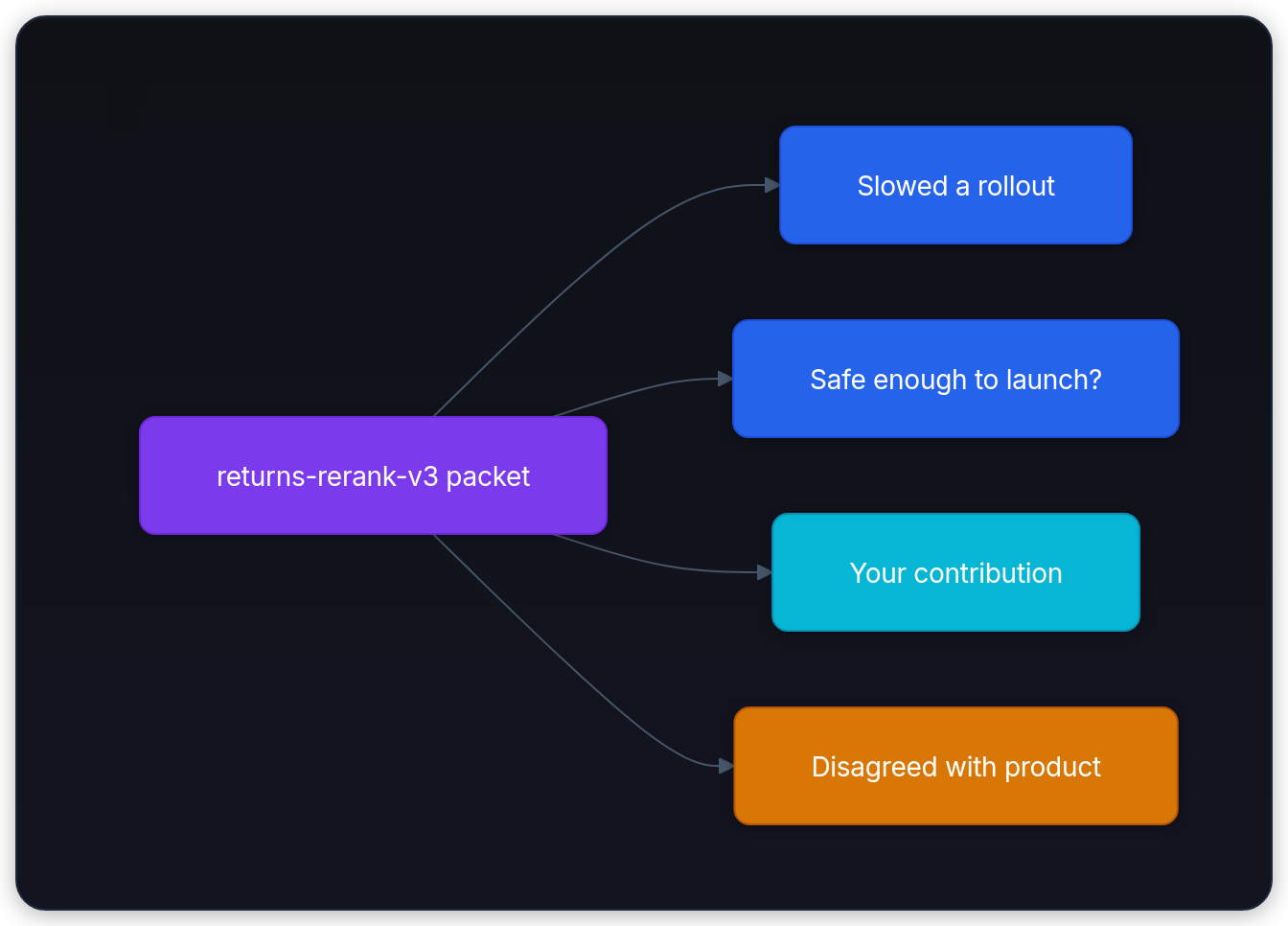
As a practice target, collect three to five examples with different decisions. The number isn't an employer requirement. Choose enough variety that you don't stretch this launch into an incident or a change-of-mind story it doesn't contain. Keep context, your role, the tradeoff, evidence, and the outcome separate. A number needs a baseline, denominator, or time window; a qualitative outcome can be useful when you explain what you observed.
| Story type | Use it for | Must include |
|---|---|---|
| Platform boundary | ownership, ambiguity, cross-team influence | API contract, adoption, migration risk |
| AI eval or investigation loop | AI-adjacent work, feedback systems | data quality, eval signal, failure analysis |
| Parser or migration | technical judgment, correctness | compatibility, rollout, regression suite |
| Incident command | reliability, leadership under pressure | customer impact, hypothesis, durable follow-up |
| Security or deployment hygiene | risk reduction | normal delivery path, not one-off cleanup |
What makes a behavioral story credible for a senior AI/backend role?
Answer
It has a mechanism and a consequence. "I improved reliability" is weak; "I added canary rollback, request traces, and a regression gate after a customer-impacting incident" is inspectable.
These are rehearsal prompts, not a prediction of any lab's question set. Don't memorize twelve openings; check that your packets can survive questions about motivation, risk, ownership, disagreement, speed, and learning:
- Why this kind of AI lab?
- Why now?
- What worries you about AI systems?
- What might a frontier lab get wrong?
- Tell me about a time you changed your mind.
- Tell me about a time you disagreed with product, research, or leadership.
- Tell me about a high-severity incident you led.
- Tell me about a time you slowed a rollout down.
- Tell me about a time you chose the simple solution.
- Tell me about a time you influenced without authority.
- What would your teammates say is hard about working with you?
- How do you decide when a system is safe enough to launch?
Read the lab, not a script
A public value page tells you what a lab chooses to explain, not a secret scoring rubric. Teams and roles still differ. Read those pages to form a hypothesis, then bring a true story and confirm team-specific expectations with your recruiter. Never bend a story until it matches a slogan.
The careers pages below were checked October 10, 2026. DeepMind's culture essay is a dated 2022 example; its current candidate guide supplies the interview advice.
| Lab | Published guidance | A preparation exercise, not a hiring rubric |
|---|---|---|
| Anthropic | "Hold light and shade," "do the simple thing that works," and a high-trust, low-ego style that communicates kindly and directly[2] | Weigh a decision's upside against its downside, prefer the smallest design that clears the bar, and disagree without ego. |
| OpenAI | "Act with humility," "update quickly," "find a way," and "creativity over control," plus collaboration, communication, and openness to feedback[5][1] | Show end-to-end ownership under ambiguity and a concrete example of updating when evidence changed. |
| Google DeepMind | A 2022 culture essay describes "pioneering responsibly": open discussion of responsibility, iterating as they learn, building social and technical safeguards[6], plus STAR, thinking out loud, and data-backed impact[3] | Surface ethical and safety risk early rather than after launch, say when you're unsure, and quantify what changed. |
The signals overlap more than they differ. Across these sources, evidence, humility, and judgment appear as actions: update a decision, surface a risk, invite challenge, or measure impact. Match that behavior to a true story, then verify the team's emphasis with the recruiter.
You delayed a release, but you have no evidence that the delay made later releases faster. How should you describe the tradeoff?
Answer
Name the failure, your decision, and the actual cost of waiting. Explain the release criterion and what happened afterward. Don't retrofit a speed improvement onto a decision whose justified outcome was avoiding known exposure.
Disagreement that produces evidence
Prompt: "Tell me about a time you disagreed with a strong engineer or researcher."
Prompt details:
- Use the answer to show direct communication, fair representation of the other view, and how the decision was made.
- Don't make the other person sound careless. Two competent people can value the same outcome and price risk differently.
- Show which evidence resolved the disagreement, or say what you would measure next if it stayed open.
Choose a story you can defend by asking yourself:
- Was the disagreement about architecture, product scope, or risk?
- Could I have changed my mind, and what result would have caused it?
For returns-rerank-v3, the disagreement is this: product believes two failing cases are an acceptable canary cost; you believe a known authorization leak isn't a canary candidate. Shared goal: ship before returns volume. Tradeoff: launch date versus leaking restricted snippets.
Follow the decision trail
Start with the shared goal: ship before returns volume. Then name the real tradeoff, launch date versus leaking restricted snippets, rather than turning the other person into a villain. Put both positions on the table: two failing leak cases on one side, "it's only 5 percent" on the other. Run the reproductions offline and require the complete release checks before user-visible traffic. Close with what changed: the canary waited, and later reviews reused the same reversal signal.
Say the fork out loud: "The disagreement wasn't whether reliability mattered. It was whether a 5 percent canary was an acceptable way to learn about a known authorization leak."
If asked about the relationship, stay with the shared goal and the test. Don't make the other person the obstacle. Name the artifact that kept the conversation from becoming a memory contest: "We wrote down the leak I was worried about, the launch date they needed, and the smallest gate that could produce evidence. Both leak cases had to pass before user-visible traffic. That result changed the rollout, and later reviews used written criteria. I would need timing data to claim they became faster."
When disagreement remains unresolved
Not every disagreement ends with your proposal winning or a decisive experiment. Explain the decision owner, the evidence available at the time, and what the team chose. If you disagreed and still supported a legitimate decision, describe that work. If a known security failure needed escalation, name the escalation path rather than claiming you had authority you didn't hold. An experiment is appropriate only when its exposure is acceptable; private-data leakage isn't a safe way to settle a debate.
Incidents, negative results, and dual-use
For an incident you actually worked on, establish impact and the order of decisions. Start with customer impact and your working hypothesis. Then name who owned rollback and diagnosis, what you changed, and how you checked the follow-up. State the observation period if you claim fewer recurrences. Drama, apology, or a later architecture diagram doesn't prove you coordinated anything.
Keep a second packet for the uncomfortable case: the aggregate eval looked green, but a slice or integrity check said the story was wrong. A good answer shows that you could stop promotion, preserve the negative result, and replace the misleading signal.
| Beat | Example content |
|---|---|
| Situation | Offline judge and aggregate score passed; launch window was this week |
| Disconfirming signal | Slice failure, bad judge correlation, or cherry-picked cohort that inflated the headline metric |
| Mechanism | Blocked promotion, preserved the negative result, fixed the eval or product path, reran the versioned suite, and checked an untouched holdout |
| Evidence | Which slice, judge disagreement, or holdout case changed the release decision |
| Outcome / reflection | Launch moved after the real gate passed; you now require slice and integrity checks before "green" means ship |
A slogan about caring about science is weak. Naming the disconfirming eval, the decision to block, and the cost of waiting makes the judgment inspectable.
Keep discovered failures as regressions, but don't claim general improvement from repeatedly tuning against that same exposed suite. Apply the held-out principle used to avoid test-data leakage: separate the development cases from held-out evidence.[7] Report which examples informed the repair, and preserve the failed slices alongside the new result.
When a prompt shifts from a past incident to capability upside and misuse risk, carry the same reasoning across. Name the benefit, the misuse path, the person or group exposed, and the control that would produce evidence before access expands. Separate a concrete mitigation you can evaluate from broader concerns that one engineering control won't settle.
| Length | Skeleton |
|---|---|
| 60s | Name the capability benefit, the concrete misuse path, and a preventive control and how you would check it. Logging observes actions; it doesn't itself block them. |
| 2m | Add who is harmed if the control fails, how you measure residual risk, and what evidence would justify expanding access. |
Example shape: "The tool speeds legitimate triage, but unrestricted export of private context is the misuse path. We scoped credentials, blocked bulk export, red-teamed exfil traces, and kept human review for high-risk actions. I'd expand access only when those gates stay green under adversarial cases."
Prompt: "What worries you about high-impact AI systems?"
Prompt details:
- Explain your concern and the evidence behind it without claiming to know an interviewer's preferred view.
- Distinguish risks you can reduce directly from uncertainty that needs broader research or governance.
- Connect the answer to systems you can build or improve.
Before answering, choose a risk you can bound and ask yourself:
- Is it product, infrastructure, or misuse risk?
- Does the mechanism come from a system you've worked on, or should you stay at the control level?
Move from risk to control
Name one risk you can actually bound: tool misuse, permission leakage, over-trusted demos, eval blind spots, irreversible writes, or long-running state. Explain where ordinary authorization and validation help, and what model or tool behavior they leave untested. Then map the risk to controls you could inspect, such as permission boundaries, eval gates, red-team cases, audit logs, staged rollout, rollback, and human review. End on the work: make the capability observable, bounded, testable, and reversible.
Don't stop at "AI could be unsafe." Name the path: "I worry about agent systems with broad tool authority and weak observability. The controls I would ship are scoped permissions, blocked irreversible writes, red-team traces, eval gates, support-visible decisions, and rollback paths."
If asked what you'd build, keep it concrete. If asked where you might be wrong, say what evidence would change your view. Example: "I'd worry less about broad tool use in a setting where permissions are narrow, actions are reversible, evals cover misuse, and every decision is traceable."
A weakness needs a consequence and a later change
The Friday launch doesn't establish a personal weakness. Choose another real example instead of inventing one to reuse it. A weakness answer can describe a work habit, its cost, and the practice you're still improving. It needn't reveal private health or family information.
Consider a separate fictional example: an engineer kept expanding a migration design before asking for feedback. The draft arrived three days late, and a teammate had to redo an integration. In the next migration, the engineer shared a one-page proposal early, agreed on a compatibility checklist, and scheduled a review before implementing the second stage. The teammate reviewed that proposal before coding began. There isn't yet enough follow-up to claim a lasting productivity improvement.
The useful answer is specific: "I delayed feedback by trying to finish the design alone. That caused rework. I now ask for review while the design is still cheap to change; in the next migration, the interface was reviewed before implementation. I still need to watch whether I slip back when deadlines are tight." It admits a cost without turning perfectionism into a disguised compliment.
A candidate says the new review habit eliminated missed deadlines, but has observed only one later project. How would you repair the claim?
Answer
Describe the one observed project and the practice that changed. Don't turn a single example into a claim that the problem is permanently solved. State that longer-term follow-up is still missing.
Mission without slogans
Mission-fit answers fail when they sound borrowed. Start with a problem you can name, attach a piece of work you can defend, and state the boundary you still have to learn. Build the answer from evidence:
| Layer | What to put in the packet |
|---|---|
| Problem you want to work on | reliability, data access, evals, agents, serving, safety, or developer tooling |
| Evidence | project, paper, product behavior, bug class, or system you inspected |
| Fit | why your strongest work maps to that problem |
| Humility | what you still need to learn |
| Question | what you want to understand about the team's bottleneck |
Example shape:
I'm most interested in making high-impact AI systems easier to bound, debug, and improve. My best evidence is
returns-rerank-v3, where the authorization boundary carried the main risk. I still need to learn more about how this team measures misuse in tool-using agents, so I'd want to understand where evals, permissions, or operational signal are currently thin.
Notice what the answer doesn't claim. It doesn't turn a reranker launch into frontier-model research, and it doesn't pretend to know the team's current bottleneck. It connects a real mechanism to a reason for moving, then leaves a precise question the team can answer.
Use AI within the stated policy
Use AI during preparation as a critic: find gaps, tighten wording, and rehearse follow-ups. During a live interview or take-home task, follow the format's exact policy.
Policies differ by employer and format. As checked October 10, 2026, OpenAI's interview guide says tool expectations vary by interview and should be explained in the preparation materials, with the recruiter as the fallback when they're unclear.[1] Google DeepMind's candidate PDF allows AI for preparation but, unless told otherwise, not during live interviews or interview tasks.[3] Anthropic's July 10, 2025 guidance remains the published policy: preparation and refinement are encouraged; live interviews and take-homes require explicit permission. For applications, it asks you to write the first draft yourself before using AI to refine it.[8]
Sanitize before sharing anything with a preparation tool. Don't paste private incident records, customer data, interview questions covered by confidentiality terms, or internal code into an unapproved service. Replace identifying details without changing the decision or inventing measurements. If the real evidence can't be discussed, choose a different example.
Good preparation use:
- Ask a model to challenge vague claims in your story bank.
- Generate skeptical follow-up questions, then answer with your real evidence.
- Practice compressing a two-minute answer into 60 seconds.
- Check whether acronyms, team names, or private details need neutral translation.
Bad interview-day behavior:
- Using an AI assistant during a live interview when the policy says not to.
- Presenting model-invented project details as personal experience.
- Reading a polished script that doesn't match your actual work.
- Hiding uncertainty instead of naming what you'd verify.
If asked how you used AI in preparation, answer plainly:
I used it for rehearsal and critique, not to invent experience. My final stories are based on projects I can defend with metrics, artifacts, and tradeoffs.
Rehearse until the evidence arrives early
Write each story before you practice it aloud:
Story name:
Question types it can answer:

Situation:
  One sentence. Who needed what?

Risk:
  What specific failure mode, tradeoff, or user impact mattered?

Mechanism:
  What did you change, test, gate, or decide?

Evidence:
  Which number, incident, adoption signal, or test result changed the decision?

Outcome:
  Who benefited? What shipped, improved, or stopped happening?

Reflection:
  What do you now do differently?

Follow-up:
  What evidence would have changed your mind?
Use three review passes, each answering a different question:
- Structure pass: fill every field. If you can't name the risk or evidence, choose a better story.
- Compression pass: tell the story in two minutes, then cut setup until the mechanism and evidence arrive early.
- Pressure pass: ask one skeptical follow-up. Examples: "Were you too cautious?", "What did the other person believe?", or "Which signal would change your mind?"
Choose examples relevant to the role. Launch judgment, disagreement, learning, and ownership under ambiguity are possible topics, not required experiences for every applicant. Pick one packet and record a two-minute answer. For this drill, aim to reach your responsibility and decision within about 45 seconds. This is a rehearsal aid, not a hiring cutoff; follow the actual prompt and requested length. Ask one skeptical follow-up, answer with a boundary or artifact rather than extra setup, then cut any claim you can't support with a metric, test, incident record, shipped change, or explicit ownership line.
Repair a claim before rehearsing it
Use these fictional notes: you reproduced the two leaks and wrote the release check; another engineer fixed authorization; the release owner approved the canary; p95 was 420 ms; the notes don't contain a baseline latency, sample count, or later incident rate.
Now critique this draft: "I fixed our security system and cut latency by 16 percent, so we never had this problem again."
Compare your repair
Three claims exceed the notes. You didn't own the authorization repair. A 500 ms limit isn't a before-change latency baseline, so 420 ms doesn't imply a 16 percent speedup. No recurrence claim is supported without follow-up observations.
A defensible revision is: "I reproduced two authorization failures and added the release check. The service owner repaired authorization. After review, the canary measured p95 at 420 ms against a 500 ms limit. I don't have a baseline or follow-up incident rate, so I can't claim a latency improvement or eliminated recurrence."
Ask your practice partner to identify your contribution, one result, and one unresolved fact without prompting. If they can't, revise the answer's order or remove jargon before making it shorter.
Try an AI rehearsal partner
Paste this public fictional packet into a preparation chat. Answer the first question before asking for a critique; the goal is to practice responding under interruption.
Act as a skeptical interviewer for a fictional reranker launch.
Ask one question at a time and wait for my answer.

Facts: I reproduced two authorization leaks and wrote the release check.
The service owner repaired authorization. The release owner approved
the canary. Its p95 was 420 ms against a 500 ms limit. The packet has
no baseline latency, traffic denominator, sample count, or recurrence data.

Start by asking why two failures don't establish that leaks were rare.
After my answer, identify any claim that exceeds this packet and ask
one follow-up about my contribution or the decision to hold traffic.
Use the packet as evidence. Leave missing facts unknown. Keep this
fictional practice separate from my actual experience.
If the model accepts "I reduced latency by 16 percent," correct it using the packet: 500 ms was a limit, not an earlier measurement. If it supplies a missing sample count, discard that number. Rehearsal feedback also needs checking. Repeat with your own discussable experience after removing private details, and compare each proposed revision with your real notes.
Diagnose weak stories
Listen for the symptom, then trace it to the missing evidence. This table turns a vague feeling that an answer is weak into a specific repair:
| Symptom | Why it weakens the answer | Fix |
|---|---|---|
| Memorized mission language | Sounds borrowed instead of earned. | Connect the value to one mechanism and one consequence. |
| Overclaiming core-model research ownership | Makes your contribution harder to trust. | Name your boundary precisely, then explain the part you owned in detail. |
| Incident heroics | Hides whether the system improved afterward. | Name hypothesis, owner, action, customer impact, and durable follow-up. |
| Negative lab critique | Shows concern without constructive judgment. | Pair each risk with a bounded, testable mechanism. |
| Outcome with no support | Leaves the listener unsure what changed. | Add an honest measurement or a specific observation; state missing data and avoid invented precision. |
| "Move fast" with no guardrail | Ignores how production failures compound. | Name rollback, eval gate, or staged exposure. |
| "Be safe" with no launch criterion | Reduces safety to intent. | Name permission boundaries, red-team cases, support traces, or human review. |