Personalize this lesson
Adapt explanations and teaching visuals to your background and preferred voice.
An early checkpoint produces fragments such as And the I the. After another 240 updates, the same prompt produces contractions and phrases such as I'll do, alongside obvious grammatical errors and repetition. Which changes indicate learning, and which checks would uncover a target-shift bug or future-token leakage?
In this lab, tokenization, vocabulary compaction, next-token targets, causal attention, optimization, and generation form one inspectable pipeline. They must agree on token meanings and permitted information flow.[1] Several choices here, including compaction, Pre-LN, AdamW, and top-k sampling, are design choices rather than requirements of every autoregressive model. A descending loss alone doesn't verify the pipeline.
Karpathy's nanoGPT offers a historical reference with a character-level Shakespeare demo. Its README marked it deprecated in November 2025 and points to nanochat for the newer end-to-end project.[2] Here we retain a small teaching model and use GPT-2's published byte-level byte pair encoding (BPE).[3] That matches GPT-2's tokenizer, not every current decoder's vocabulary.
Download the bundled Princeton course corpus: Download shakespeare.txt. This file is 4,538,523 bytes, larger than nanoGPT's roughly 1 MB Tiny Shakespeare example.[4] The lab tokenizes the entire bundled file and trains on random windows from its first 90%. Its 321 updates consume 184,896 target positions, about 16.4% of the training stream's length, with possible overlaps. We don't claim to visit every passage. Small width, context, and update count keep the CPU exercise bounded.
You'll need PyTorch tensor mechanics and the Transformer foundations in the prerequisites. We implement batching, causal masking, decoder blocks, the training loop, checkpoint handling, and generation. PyTorch supplies autograd, layers, cross-entropy, and AdamW; tiktoken supplies the already-trained GPT-2 tokenizer. We initialize model parameters from scratch and load no pretrained language-model weights.
Before training, verify the next-token target and visibility boundary separately. At positions before the final input, omitting the causal mask allows attention to read the exact successor being scored. That can lower loss through leakage, even when the labels are correctly shifted.
The causal LM contract
Every autoregressive language model obeys one core rule: at position , the network observes prefix tokens and outputs a probability distribution over the vocabulary for token . Because PyTorch executes arbitrary code without verifying theoretical validity, keep the five contractual steps visible across every metric:
- Convert raw text into discrete BPE token IDs
- Restrict position to attend only to historical keys
- Compute cross-entropy loss against target token
- Optimize parameters on sampled windows, which can overlap
- Validate quality through held-out loss curves and controlled generation
When one component drifts, error messages won't always sound an alarm. Tokenizer, batching, attention masks, and sampling logic have to agree on vocabulary bounds and causal boundaries. We establish those agreements directly before spending training updates.
Five moving parts
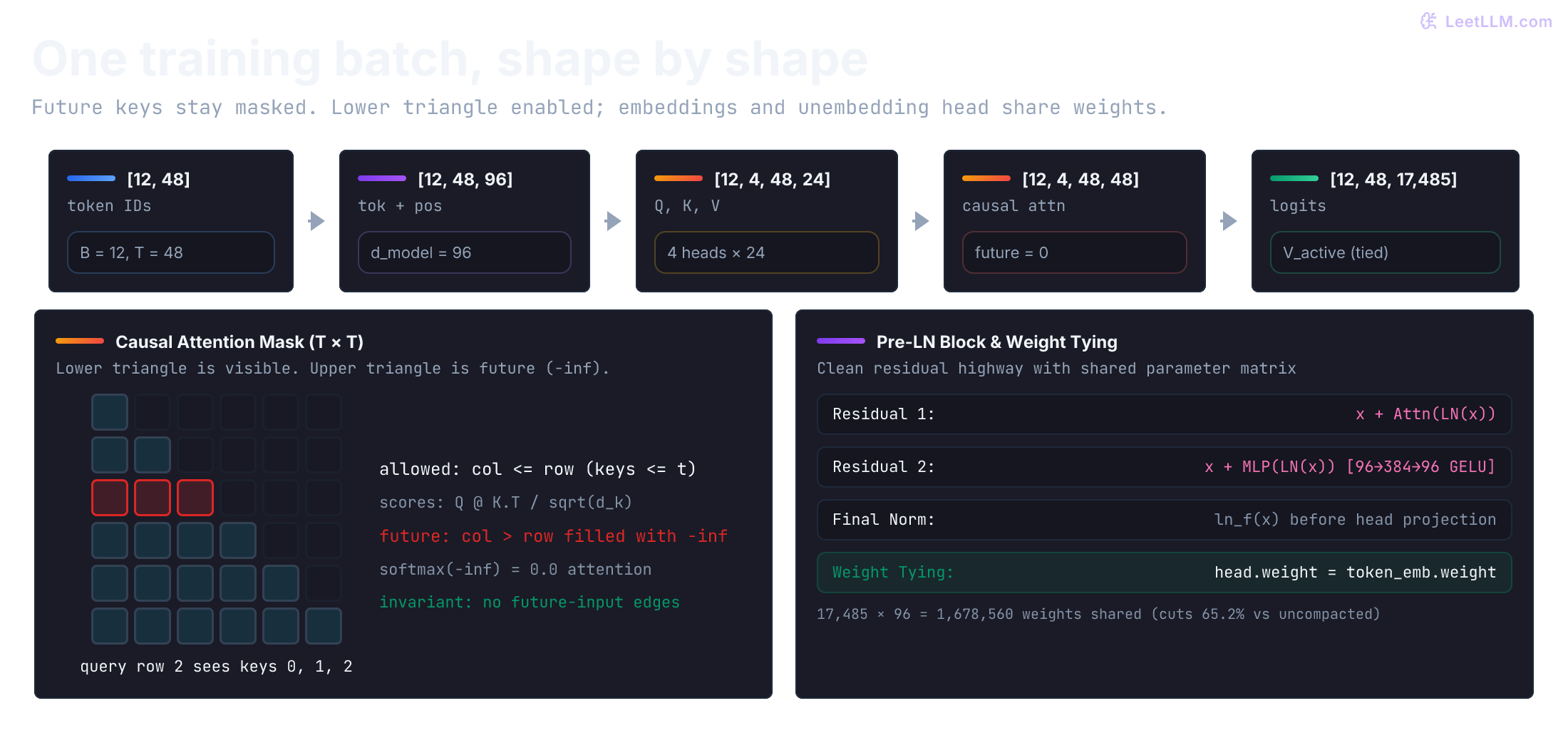
Our training run uses batch size 12, context length , hidden dimension , 4 attention heads, and 2 decoder layers. These values serve as an operational ledger: a batch enters as integer IDs of shape [12, 48] and leaves as next-token logit vectors across all 48 sequence positions.
| Component | Responsibility | Primary failure mode |
|---|---|---|
| Corpus | Supplies the empirical language distribution | Confusing the available inventory with passages actually sampled |
| Tokenizer | Converts Unicode text into GPT-2 subword IDs | Forgetting that token IDs depend entirely on the tokenizer vocabulary |
| Active-vocab remap | Compresses sparse GPT-2 IDs into a dense local range | Confusing a smaller output support with a loss-preserving relabeling |
| Block packer | Slices the token stream into context windows and targets | Off-by-one label alignment, or interleaving held-out chunks into synthetic boundaries |
| Decoder loop | Computes masked self-attention, loss, and checkpoints | Omitting the causal mask, or evaluating loss without sampling generated text |
Audit the vocabulary footprint first. GPT-2 has 50,257 token IDs, and this bundled file activates 17,485. Remapping them to 0..17484 preserves the active pieces while removing 65.2% of the tied vocabulary matrix's rows. In this architecture, absent-piece rows would account for about 62.3% of the full-vocabulary model's parameters, not over 70%. The complete GPT-2 byte vocabulary covers UTF-8 text; our restricted subset loses that general coverage.[3]
This remap acts as an efficiency technique for a fixed corpus rather than a new tokenizer. Our architecture mirrors GPT-2's weight-tying design: the model shares weights between the input token embedding and the final unembedding projection layer.[5] Projecting the final hidden state back to vocabulary logits uses the transpose of the token embedding table:
We build the map across the full file before splitting, so validation pieces remain representable. This uses unlabeled held-out token identities to choose the output support: validation doesn't participate in gradient updates, but it isn't completely unseen by preprocessing. There are 335 IDs found only in the validation portion. For an independent evaluation, choose a tokenizer and support without inspecting held-out data, or declare an explicit unknown-piece policy. In this lab, prompts with any missing piece raise an error, and sampled local IDs must be reverse-mapped before decoding.
Remapping also modifies the softmax denominator. Absent vocabulary tokens no longer compete for probability mass. In a full table, a row can receive an output-side gradient even when its piece is neither an input nor a target. Loss values between compact and full-vocabulary runs aren't directly interchangeable.
Check the output-side gradient on a three-piece fixture. Row 2 is neither the input nor the target, yet it receives a gradient through the tied output matrix:
import torch
import torch.nn.functional as F

weights = torch.tensor([[1., 0.], [0., 1.], [1., 1.]], dtype=torch.float64, requires_grad=True)
hidden = weights[0:1]
logits = hidden @ weights.T
loss = F.cross_entropy(logits, torch.tensor([1]))
loss.backward()
assert weights.grad[2].abs().sum() > 0
print("input ID=0, target ID=1")
print("row 2 receives gradient:", bool(weights.grad[2].abs().sum() > 0))
print("row 2 gradient:", [round(float(value), 6) for value in weights.grad[2]])input ID=0, target ID=1
row 2 receives gradient: True
row 2 gradient: [0.422319, 0.0]import math
gpt2_vocab = 50_257
active_vocab = 17_485
d_model = 96
# GPT-2 reuses token-embedding weights for output logits, so one
# vocabulary-sized matrix determines this part of parameter cost.
full_weights = gpt2_vocab * d_model
compact_weights = active_vocab * d_model
reduction = 1 - compact_weights / full_weights
chance_ce = math.log(active_vocab)
print(f"full vocab tied weights: {full_weights:,}")
print(f"compact tied weights: {compact_weights:,}")
print(f"vocabulary-weight reduction: {reduction:.1%}")
print(f"uniform next-token CE: {chance_ce:.3f}")full vocab tied weights: 4,824,672
compact tied weights: 1,678,560
vocabulary-weight reduction: 65.2%
uniform next-token CE: 9.769A uniform random guess across 17,485 active IDs yields an expected cross-entropy loss of:
The first logged batch has loss 9.775, close to this uniform reference. Random initialization needn't produce exactly uniform logits. A much lower loss is a reason to inspect targets, masks, initialization, and the data distribution, not proof of leakage: a biased predictor can score well on a skewed distribution without seeing future inputs. Use as the appropriate uniform reference, rather than .
Could a predictor with no input access beat that reference? In this authored four-piece dataset, every target has ID 0. A constant predictor assigning it probability 0.9 scores well without reading any tokens:
import math

targets = [0] * 20
probabilities = [0.9, 1 / 30, 1 / 30, 1 / 30]
constant_loss = -sum(math.log(probabilities[target]) for target in targets) / len(targets)
print(f"uniform reference: {math.log(4):.3f}")
print(f"constant predictor: {constant_loss:.3f}")
print("predictor reads inputs: False")uniform reference: 1.386
constant predictor: 0.105
predictor reads inputs: FalseAudit the causal target before training
A silent bug that ruins autoregressive models is training tokens to predict themselves () instead of predicting their successor (). Before writing any network modules, verify the label shift on a concrete token sequence. The sample below shows the running prompt we'll test during checkpoint generation:
block = ["Good", " sir", ",", "\n", "Spe", "ak", " plain", "."]
x = block[:-1]
y = block[1:]

for current, target in zip(x, y):
    print(f"{current!r:>8} -> {target!r}")

assert y[0] == " sir" and y[-1] == "."'Good' -> ' sir'
' sir' -> ','
',' -> '\n'
'\n' -> 'Spe'
'Spe' -> 'ak'
'ak' -> ' plain'
' plain' -> '.'The shifted target specifies the supervision label, while the causal mask governs what information reaches that prediction. In each forward pass, the model emits logits: raw unnormalized scores for all 17,485 vocabulary tokens at each of the 48 positions. The causal language-modeling objective computes the mean negative log-likelihood of the ground-truth successor token:[3]
Here represents the logit vector emitted at position , and is the target token ID. In PyTorch, flattening logits of shape [12, 48, 17485] into [576, 17485] and targets [12, 48] into [576] enables F.cross_entropy to score every position in parallel using numerically stable log-sum-exp arithmetic.
Inside self-attention, future keys receive an additive bias of . Their softmax weights are zero when each row has valid finite scores and at least one allowed key. Together with per-position normalization and MLPs, this blocks dependence on future input positions. It doesn't make the target statistically independent of the prefix: learning that dependency is the objective.
Predict the visibility pattern for row 2 in a 4-token sequence. It should observe keys 0, 1, and 2, while key 3 remains strictly invisible:
n = 4
mask = [[col <= row for col in range(n)] for row in range(n)]

for row in mask:
    print(" ".join("1" if visible else "0" for visible in row))

assert mask[2] == [True, True, True, False]
print("position 2 can read positions:", [index for index, visible in enumerate(mask[2]) if visible])1 0 0 0
1 1 0 0
1 1 1 0
1 1 1 1
position 2 can read positions: [0, 1, 2]The visibility rule is unchanged with BPE pieces. GPT-2 encodes Good sir,\nSpeak into six IDs. Verify the complete sequence rather than silently dropping the final ak:
x: [10248, 15967, 11, 198, 5248]
y: [15967,    11, 198, 5248, 461]
Token 10248 is Good, 15967 is sir, 11 is ,, and 198 is a newline. Notice that Speak spans two distinct subwords: 5248 for Spe, followed by 461 for ak. Autoregressive targets don't require clean word boundaries; the network learns subword morphology and sentence syntax through the exact same transition loss.
import tiktoken

encoder = tiktoken.get_encoding("gpt2")
text = "Good sir,\nSpeak"
ids = encoder.encode(text)
print("IDs:", ids)
print("pieces:", [encoder.decode([token]) for token in ids])
print("round trip:", encoder.decode(ids) == text)
assert ids == [10248, 15967, 11, 198, 5248, 461]IDs: [10248, 15967, 11, 198, 5248, 461]
pieces: ['Good', ' sir', ',', '\n', 'Spe', 'ak']
round trip: TrueEach target is the next token, but attention can still read every position in the block. Has the model learned a valid causal objective?
Answer
No. Shifted labels define the next-token target, while the causal mask prevents each position from reading future inputs. Both invariants are required; without the mask, training leaks the answer into the hidden state.
Split the stream without inventing boundaries
We treat the file as one continuous stream and split by its existing order: first 90% training, final 10% validation. This preserves neighboring tokens within each portion. It doesn't establish chronological authorship order or remove duplicated phrases across portions. No training window crosses the split, and the transition across the split itself isn't scored.
Splicing distant chunks creates new transitions. Whether those are acceptable depends on the intended objective. Ordinary causal pre-training can concatenate documents with separators; independent-document objectives need both attention isolation and boundary-target handling. Resetting positions alone doesn't isolate attention. Here we preserve within-portion order and draw random slices of length :
tokens = list(range(20))
chunks = [tokens[start:start + 4] for start in range(0, len(tokens), 4)]

interleaved_train = chunks[0] + chunks[2]
fake_transition = (interleaved_train[3], interleaved_train[4])

split_at = int(0.8 * len(tokens))
contiguous_train = tokens[:split_at]
contiguous_validation = tokens[split_at:]

print("interleaved concatenation transition:", fake_transition)
print("was adjacent in source:", fake_transition[1] == fake_transition[0] + 1)
print("contiguous split sizes:", len(contiguous_train), len(contiguous_validation))interleaved concatenation transition: (3, 8)
was adjacent in source: False
contiguous split sizes: 16 4With our data pipeline established, trace the tensor transformations across one forward pass. Input IDs of shape [12, 48] expand into embedding vectors [12, 48, 96], split into four attention heads of shape [12, 4, 48, 24], form attention score matrices [12, 4, 48, 48], pass through the GELU feed-forward layer, and project into [12, 48, 17485] output logits. If your final tensor dimension doesn't match , that's a shape mismatch bug, not an optimization quirk.
Train, sample, then keep going
Execute the six main lab blocks in order, from build_gpt_from_scratch.py through probe-causality-and-boundaries.py, in one Python session. Alternatively, combine them into build_gpt_from_scratch.py. The earlier small demonstrations and final SDPA comparison are independent. Put the downloaded corpus at assets/shakespeare.txt relative to your working directory. Run the pinned environment with:
uv run --python 3.12 --with torch==2.13.0 --with tiktoken==0.14.0 build_gpt_from_scratch.pyOn a cache miss, tiktoken downloads GPT-2's vocabulary and merge files. The model runs on CPU in float32. Package pins, one CPU thread, and separate random generators make comparisons controlled within this environment; they don't promise matching logs or text on another machine or release.[6] A CUDA-capable wheel can print a +cu130 version suffix while all model tensors remain on CPU.
Our training script follows a four-step progression:
- Train an initial phase (81 updates, with a constant learning rate)
- Sample text from the early checkpoint
- Continue training the exact same model and optimizer state to 321 updates
- Sample again and compare improvements and remaining failures
Examine the architectural components in the implementation:
- Pre-LN block: Layer normalization precedes each attention or MLP branch. The residual addition provides an identity derivative path, alongside the branch's derivative. Ba et al. introduced LayerNorm, not this Transformer arrangement.[7] Xiong et al. analyzed large output-side initialization gradients in Post-LN and better-behaved gradients in Pre-LN, including experiments without learning-rate warmup. That isn't a universal stability guarantee.[8]
- Causal Self-Attention: Projects input vectors into query, key, and value matrices via a single fused linear layer. It splits the 96 hidden units into 4 heads of dimension 24 (), computes scaled dot products , applies the lower-triangular causal mask with , normalizes via softmax, and recombines output values through a projection layer.
- GELU MLP: Expands and applies , where is the standard Gaussian CDF.[9] Smooth gating is a mechanism, not a guarantee of faster convergence. PyTorch's default exact GELU also differs from the tanh approximation in GPT-2's original source.[5]
- Tied output head:
self.head.weight = self.token_emb.weightmakes the two modules share one parameter. This saves 1,678,560 parameters relative to a separate bias-free compact output matrix. Both input lookup and output scoring contribute to its gradient; sharing isn't a guarantee of semantic quality.[5]
This GPT-style teaching model has no dropout. It doesn't apply the depth-scaled residual initialization described in the GPT-2 paper and uses a 48-token context. Those choices matter if you try to reproduce GPT-2 rather than study the training loop.[3]
At this model size, one float32 logit tensor requires of memory per batch before allocating gradients or backward activation caches.
from pathlib import Path
import copy
import hashlib
import math
import torch
import torch.nn as nn
import torch.nn.functional as F
import tiktoken

# Control this CPU run without promising cross-platform bitwise equality.
torch.set_num_threads(1)
torch.manual_seed(7)
print(f"torch={torch.__version__} tiktoken={tiktoken.__version__} device=cpu")

# Load raw text exactly as learner will download it.
all_text = Path("assets/shakespeare.txt").read_text(encoding="utf-8")
corpus = all_text
corpus_sha256 = hashlib.sha256(corpus.encode("utf-8")).hexdigest()

# Use GPT-2 BPE so tokenization matches GPT-2's published input representation.
encoding_name = "gpt2"
encoder = tiktoken.get_encoding(encoding_name)
corpus_token_ids = encoder.encode(corpus)

# GPT-2 token ids are sparse across a 50k vocabulary. This run only needs
# tokens that actually appear inside bundled Shakespeare corpus, so remap them to 0..N-1.
# That keeps tied embedding/output weights much smaller without changing
# which subword pieces the tokenizer produced.
active_token_ids = sorted(set(corpus_token_ids))
token_to_local = {token_id: idx for idx, token_id in enumerate(active_token_ids)}
local_to_token = {idx: token_id for token_id, idx in token_to_local.items()}
ids = [token_to_local[token_id] for token_id in corpus_token_ids]

# Each training example needs block_size input tokens plus 1 next-token label.
block_size = 48

# Split once along original stream. Concatenating interleaved held-out chunks
# would create fake transitions where non-adjacent Shakespeare passages meet.
split_index = int(0.9 * len(ids))
train_ids = torch.tensor(ids[:split_index], dtype=torch.long)
val_ids = torch.tensor(ids[split_index:], dtype=torch.long)
batch_size = 12

# Keep training, validation, and text-sampling randomness independent. Logging
# one sample should never change which training windows the model sees next.
train_generator = torch.Generator().manual_seed(101)
val_generator = torch.Generator().manual_seed(202)

print(
    f"tokens={len(ids)} active_vocab={len(active_token_ids)} "
    f"train={len(train_ids)} val={len(val_ids)}"
)

def sample_batch(
    source: torch.Tensor,
    *,
    generator: torch.Generator,
) -> tuple[torch.Tensor, torch.Tensor]:
    if source.ndim != 1 or len(source) <= block_size:
        raise ValueError("source must be a 1-D stream with at least block_size + 1 tokens")
    # Pick random starting positions from long token stream.
    starts = torch.randint(
        0,
        len(source) - block_size,
        (batch_size,),
        generator=generator,
    )

    # x is current context window.
    x = torch.stack([source[s:s + block_size] for s in starts])

    # y is the same window shifted one token to the right: each x[t] predicts y[t].
    y = torch.stack([source[s + 1:s + block_size + 1] for s in starts])
    return x, y

class CausalSelfAttention(nn.Module):
    def __init__(self, d_model: int = 96, n_heads: int = 4):
        super().__init__()
        if n_heads <= 0 or d_model <= 0 or d_model % n_heads:
            raise ValueError("d_model must be positive and divisible by n_heads")
        self.n_heads = n_heads
        self.head_dim = d_model // n_heads

        # One linear layer projects each position into query, key, and value vectors.
        self.qkv = nn.Linear(d_model, 3 * d_model)
        self.proj = nn.Linear(d_model, d_model)

        # Lower-triangular mask blocks attention to future positions.
        self.register_buffer(
            "mask",
            torch.tril(torch.ones(block_size, block_size, dtype=torch.bool)),
        )

    def forward(self, x: torch.Tensor) -> torch.Tensor:
        batch_size, seqlen, width = x.shape
        q, k, v = self.qkv(x).chunk(3, dim=-1)

        def split_heads(tensor: torch.Tensor) -> torch.Tensor:
            # Turn [batch, time, width] into [batch, heads, time, head_dim].
            return tensor.view(batch_size, seqlen, self.n_heads, self.head_dim).transpose(1, 2)

        q = split_heads(q)
        k = split_heads(k)
        v = split_heads(v)

        # Attention score = query-key similarity, scaled to keep softmax stable.
        attn = (q @ k.transpose(-2, -1)) / math.sqrt(self.head_dim)

        # Any position above diagonal is future token, so hide it from model.
        attn = attn.masked_fill(~self.mask[:seqlen, :seqlen], float("-inf"))
        attn = attn.softmax(dim=-1)

        # Weighted sum of value vectors produces contextualized representation.
        out = attn @ v
        out = out.transpose(1, 2).contiguous().view(batch_size, seqlen, width)
        return self.proj(out)

class Block(nn.Module):
    def __init__(self, d_model: int = 96, n_heads: int = 4):
        super().__init__()

        # Pre-LN transformer block: normalize, attend, add residual, then MLP.
        self.ln1 = nn.LayerNorm(d_model)
        self.attn = CausalSelfAttention(d_model, n_heads)
        self.ln2 = nn.LayerNorm(d_model)
        self.ff = nn.Sequential(
            nn.Linear(d_model, 4 * d_model),
            nn.GELU(),
            nn.Linear(4 * d_model, d_model),
        )

    def forward(self, x: torch.Tensor) -> torch.Tensor:
        x = x + self.attn(self.ln1(x))
        x = x + self.ff(self.ln2(x))
        return x

class TinyGPT(nn.Module):
    def __init__(self, vocab_size: int, d_model: int = 96, n_heads: int = 4, n_layers: int = 2):
        super().__init__()

        # Token embeddings say "which subword is this?".
        self.token_emb = nn.Embedding(vocab_size, d_model)

        # Position embeddings say "where is this token inside current window?".
        self.pos_emb = nn.Embedding(block_size, d_model)
        self.blocks = nn.ModuleList([Block(d_model, n_heads) for _ in range(n_layers)])
        self.ln_f = nn.LayerNorm(d_model)

        # GPT-2 reuses token embedding weights for its output logits.
        self.head = nn.Linear(d_model, vocab_size, bias=False)
        self.apply(self._init_weights)
        self.head.weight = self.token_emb.weight

    @staticmethod
    def _init_weights(module: nn.Module) -> None:
        # GPT-style small initialization is important once output weights are tied.
        if isinstance(module, (nn.Linear, nn.Embedding)):
            nn.init.normal_(module.weight, mean=0.0, std=0.02)
        if isinstance(module, nn.Linear) and module.bias is not None:
            nn.init.zeros_(module.bias)

    def forward(self, x: torch.Tensor) -> torch.Tensor:
        _, seqlen = x.shape
        if not 1 <= seqlen <= block_size:
            raise ValueError("context length must be between 1 and block_size")
        positions = torch.arange(seqlen, device=x.device)

        # GPT adds token meaning and position meaning before any attention happens.
        h = self.token_emb(x) + self.pos_emb(positions)[None, :, :]
        for block in self.blocks:
            h = block(h)
        h = self.ln_f(h)
        return self.head(h)

# Build model and optimizer.
model_config = {"d_model": 96, "n_heads": 4, "n_layers": 2}
model = TinyGPT(vocab_size=len(active_token_ids), **model_config)
optimizer = torch.optim.AdamW(model.parameters(), lr=2e-3)

def evaluate(source: torch.Tensor) -> tuple[float, float]:
    # Average across a few validation batches so accuracy is less noisy.
    was_training = model.training
    model.eval()
    losses = []
    accuracies = []
    with torch.no_grad():
        for _ in range(8):
            x, y = sample_batch(source, generator=val_generator)
            logits = model(x)
            losses.append(F.cross_entropy(logits.reshape(-1, logits.size(-1)), y.reshape(-1)).item())
            accuracies.append((logits.argmax(dim=-1) == y).float().mean().item())
    model.train(was_training)
    return sum(losses) / len(losses), sum(accuracies) / len(accuracies)

def sample_completion(prompt: str, steps: int = 80) -> str:
    if not prompt or type(steps) is not int or steps < 0:
        raise ValueError("provide a nonempty prompt and a nonnegative integer step count")
    # Use a local generator so fixed-prompt monitoring cannot perturb training.
    sampling_generator = torch.Generator().manual_seed(17)

    prompt_token_ids = encoder.encode(prompt)
    missing_ids = sorted(set(prompt_token_ids) - set(active_token_ids))
    if missing_ids:
        raise ValueError(f"Prompt uses token ids outside compact corpus vocabulary: {missing_ids}")
    prompt_local_ids = [token_to_local[token_id] for token_id in prompt_token_ids]
    context = torch.tensor([prompt_local_ids], dtype=torch.long)

    was_training = model.training
    model.eval()
    with torch.no_grad():
        for _ in range(steps):
            # If sample gets longer than block size, GPT only sees most recent window.
            x = context[:, -block_size:]
            logits = model(x)

            # Only final position matters for next-token sampling.
            next_logits = logits[:, -1, :]

            # Restrict to top candidates so toy model doesn't wander too wildly.
            top_values, top_indices = torch.topk(next_logits, k=min(8, next_logits.size(-1)), dim=-1)
            probs = torch.softmax(top_values / 0.9, dim=-1)
            sampled_index = torch.multinomial(
                probs,
                num_samples=1,
                generator=sampling_generator,
            )
            next_local_id = top_indices.gather(-1, sampled_index)

            # Append sampled token and continue autoregressive loop.
            context = torch.cat([context, next_local_id], dim=1)

    # Convert local ids back to original GPT-2 token ids, then decode to text.
    sample = encoder.decode([local_to_token[int(idx)] for idx in context[0]])
    model.train(was_training)
    return sample

for updates in range(1, 82):
    # 1. Draw random training batch.
    x, y = sample_batch(train_ids, generator=train_generator)

    # 2. Predict next-token logits for every position.
    logits = model(x)

    # 3. Compare logits against shifted targets.
    loss = F.cross_entropy(logits.reshape(-1, logits.size(-1)), y.reshape(-1))

    # 4. Backpropagate and update weights.
    optimizer.zero_grad()
    loss.backward()
    optimizer.step()

    # Print occasional train/val snapshots so learner can watch first useful learning happen.
    if updates in (1, 41, 81):
        val_loss, val_acc = evaluate(val_ids)
        print(
            f"updates={updates:03d} train_before_update={loss.item():.3f} "
            f"val={val_loss:.3f} val_acc={val_acc:.3f}"
        )

# Save first-checkpoint metrics so later cell can compare improvement directly.
early_val_loss = val_loss
early_val_acc = val_acc

# Save enough state to keep sampling compatible with trained weights.
checkpoint = copy.deepcopy({
    "encoding_name": encoding_name,
    "active_token_ids": active_token_ids,
    "model_config": model_config,
    "block_size": block_size,
    "split_index": split_index,
    "corpus_sha256": corpus_sha256,
    "completed_updates": updates,
    "torch_version": str(torch.__version__),
    "tiktoken_version": tiktoken.__version__,
    "model_state_dict": model.state_dict(),
    "optimizer_state_dict": optimizer.state_dict(),
    "train_generator_state": train_generator.get_state(),
    "val_generator_state": val_generator.get_state(),
})torch=2.13.0+cu130 tiktoken=0.14.0 device=cpu
tokens=1255253 active_vocab=17485 train=1129727 val=125526
updates=001 train_before_update=9.775 val=9.535 val_acc=0.108
updates=041 train_before_update=6.428 val=6.416 val_acc=0.151
updates=081 train_before_update=5.911 val=6.050 val_acc=0.171train_before_update scores the sampled training batch before its update; validation uses the updated weights. Eight sampled validation batches contain 4,608 evaluated positions, potentially overlapping rather than 4,608 distinct tokens. The displayed update-81 log has loss 6.050 and accuracy 0.171, about 17.1%. The first logged validation accuracy is already 10.8% after one update; we didn't log a pre-update validation accuracy.
Now sample from this checkpoint using Good sir,\nSpeak plain.\n. The exact prompt isn't in the file. That avoids directly copying the prompt, but proves nothing about whether its completion is memorized. An unseen prompt can retrieve a familiar passage.
# Prompt is intentionally not copied from training corpus verbatim.
prompt = "Good sir,\nSpeak plain.\n"

# This first sample should still look rough and undertrained.
sample = sample_completion(prompt)
print(f"prompt_seen_verbatim={prompt in corpus}")
print("sample:")
print("\n".join(line.rstrip() for line in sample.splitlines()))
Initial sample
prompt_seen_verbatim=False
sample:
Good sir,
Speak plain.

And the I the

And it .

 and the my the I it ,

 and it and
The I and be I my the it the the my I ,

And

 and my

I
 and

 and

 II
This sample contains many newlines and common words, with broken syntax. One sample describes behavior under these decoding settings; it doesn't establish exactly which internal representations the model has learned.
Continue the same model and optimizer for another 240 steps, reaching 321. AdamW retains first and second gradient moments and its step count. Recreating it would reset those states; it wouldn't automatically reset this lab's constant lr=2e-3.
# Continue from exact same checkpoint instead of restarting from scratch.
for updates in range(checkpoint["completed_updates"] + 1, 322):
    x, y = sample_batch(train_ids, generator=train_generator)
    logits = model(x)
    loss = F.cross_entropy(logits.reshape(-1, logits.size(-1)), y.reshape(-1))
    optimizer.zero_grad()
    loss.backward()
    optimizer.step()

    if updates in (161, 241, 321):
        late_val_loss, late_val_acc = evaluate(val_ids)
        print(
            f"updates={updates:03d} train_before_update={loss.item():.3f} "
            f"val={late_val_loss:.3f} val_acc={late_val_acc:.3f}"
        )

print(f"val_loss_improved_by={early_val_loss - late_val_loss:.3f}")
print(f"val_acc_improved_by={late_val_acc - early_val_acc:.3f}")

checkpoint = copy.deepcopy({
    "encoding_name": encoding_name,
    "active_token_ids": active_token_ids,
    "model_config": model_config,
    "block_size": block_size,
    "split_index": split_index,
    "corpus_sha256": corpus_sha256,
    "completed_updates": updates,
    "torch_version": str(torch.__version__),
    "tiktoken_version": tiktoken.__version__,
    "model_state_dict": model.state_dict(),
    "optimizer_state_dict": optimizer.state_dict(),
    "train_generator_state": train_generator.get_state(),
    "val_generator_state": val_generator.get_state(),
})updates=161 train_before_update=5.775 val=5.747 val_acc=0.170
updates=241 train_before_update=5.751 val=5.721 val_acc=0.175
updates=321 train_before_update=5.635 val=5.550 val_acc=0.183
val_loss_improved_by=0.500
val_acc_improved_by=0.013The displayed Python 3.12 CPU run shows a further 0.500-nat validation-loss reduction, from 6.050 to 5.550, and a 0.013 accuracy increase. The rounded accuracies are about 17.1% and 18.3%. These are sampled estimates from one run, not a promised learning curve.
Now sample text using the identical prompt and random seed:
# Same prompt, same sampling settings. Only model weights changed.
sample = sample_completion(prompt)
print(f"prompt_seen_verbatim={prompt in corpus}")
print("sample:")
print("\n".join(line.rstrip() for line in sample.splitlines()))
Longer-training sample
prompt_seen_verbatim=False
sample:
Good sir,
Speak plain.
For I I will have my am not .
I'll do to I is my good ,

I is the king :
I is you , but you I ,
The lord ?

To you , but ,
I am it you I'll not , you do I have be not to you have you I , and I am not not you have not not the good ,
The later sample contains I'll do and The lord, but also I is the king and I am it you I'll not. Which phrases are plausible, and where does the grammar break? Treat both observations as evidence about this continuation, not proof of coherent dialogue or absence of memorization.
How to read the two checkpoints
Always evaluate checkpoints using both quantitative loss metrics and qualitative text generation. Held-out validation cross-entropy evaluates average log-likelihood across thousands of positions, while generation exposes degeneracies, mode collapse, or repetitive cycles that a scalar loss averages away.
Between our two logged checkpoints:
- Sampled validation cross-entropy dropped from
6.050to5.550nats/token - Rounded validation next-token accuracy rose from 17.1% to 18.3%
- The fixed-prompt continuation gained some short phrases while retaining repetition and grammatical errors
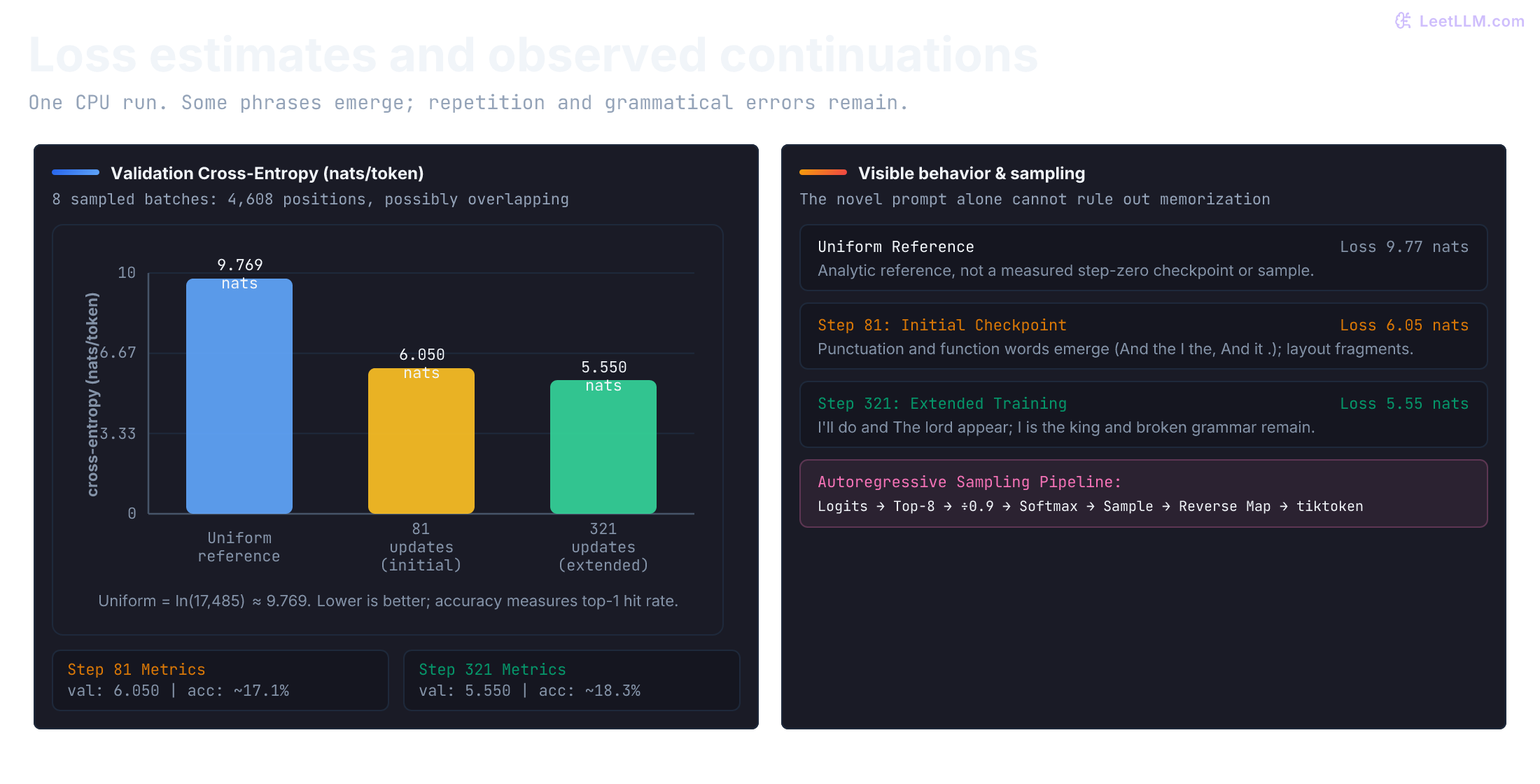
In sample_completion, inspect three decoding decisions:
- Top- selection:
torch.topkretains exactly eight indices here. Tail removal changes the model's distribution and may also remove useful candidates; it doesn't guarantee valid continuations.[10] - Temperature: The selected logits are divided by . Positive scaling leaves their ranking unchanged and sharpens probabilities relative to temperature 1. As , a unique maximum dominates; tied maxima retain equal limiting probability. Implement temperature-zero greedy decoding with an explicit argmax branch, not division by zero.
- Categorical draw:
torch.multinomialsamples one retained candidate. This can vary tokens, but repetition remains possible. The function resets its local generator to seed 17 for each call; identical prompts and weights repeat the trace in this environment.
Validation loss improves, but fixed-prompt samples become repetitive and collapse onto copied training phrases. Which evidence controls the decision?
Answer
Hold the checkpoint. Lower held-out loss is useful, but generation checks reveal a behavior regression the scalar average can hide. Compare fixed prompts, memorization or overlap checks, and held-out task metrics before selecting the run.
What a resume file has to remember
Restoring model weights alone isn't an exact training continuation. AdamW's moments and step count affect the next update, so a fresh optimizer can change the trajectory.[11] The size and usefulness of that change depend on the run; an immediate optimization shock isn't guaranteed.
A complete resume file must serialize:
- Model weights (
model.state_dict()) - Optimizer moments (
optimizer.state_dict()) - Active vocabulary mapping tables (
token_to_local,local_to_token) - Current generator states for
train_generatorandval_generator(their initial seeds alone don't retain progress) - Model and training configuration, completed updates, tokenizer identity/version, and split policy
- Source corpus hash to detect data drift across restarts
We use copy.deepcopy when saving in-memory checkpoints. In PyTorch, model.state_dict() contains references to tensor memory; subsequent in-place parameter mutations will overwrite the saved dictionary unless deep-copied.[12]
This CPU model has no dropout or stochastic forward layers; batching uses the two stored generators. A model with dropout, CUDA draws, a scheduler, or mixed-precision scaling would require those additional states too. The next block tests update 322 in the same process and environment. It reuses the current corpus and checks that its fingerprint and split match; it isn't a standalone inference loader.
We save the checkpoint, load it with weights_only=True, and compare the next batch, loss, and weights:
checkpoint_path = Path("tiny_gpt_checkpoint.pt")
torch.save(checkpoint, checkpoint_path)
restored = torch.load(checkpoint_path, weights_only=True)

assert restored["corpus_sha256"] == hashlib.sha256(corpus.encode("utf-8")).hexdigest()
assert restored["encoding_name"] == encoding_name
assert restored["block_size"] == block_size
assert restored["split_index"] == split_index
assert restored["completed_updates"] == 321
resumed_model = TinyGPT(vocab_size=len(restored["active_token_ids"]), **restored["model_config"])
resumed_model.load_state_dict(restored["model_state_dict"])
resumed_optimizer = torch.optim.AdamW(resumed_model.parameters(), lr=2e-3)
resumed_optimizer.load_state_dict(restored["optimizer_state_dict"])

resumed_train_generator = torch.Generator()
resumed_train_generator.set_state(restored["train_generator_state"])
resumed_val_generator = torch.Generator()
resumed_val_generator.set_state(restored["val_generator_state"])

resumed_token_to_local = {
    token_id: idx for idx, token_id in enumerate(restored["active_token_ids"])
}
assert resumed_token_to_local == token_to_local
assert torch.equal(resumed_val_generator.get_state(), restored["val_generator_state"])

probe_generator = torch.Generator().manual_seed(303)
probe_x, _ = sample_batch(val_ids, generator=probe_generator)
model.eval()
resumed_model.eval()
with torch.no_grad():
    original_logits = model(probe_x)
    resumed_logits = resumed_model(probe_x)
assert torch.equal(original_logits, resumed_logits)

# Advance the actual uninterrupted sampler as well as the resumed sampler.
expected_x, expected_y = sample_batch(train_ids, generator=train_generator)
resumed_x, resumed_y = sample_batch(train_ids, generator=resumed_train_generator)
assert torch.equal(expected_x, resumed_x) and torch.equal(expected_y, resumed_y)
assert torch.equal(train_generator.get_state(), resumed_train_generator.get_state())

# Both paths take update 322 from the same frozen weights, moments, and batch.
def one_update(network, opt, x, y):
    network.train()
    logits = network(x)
    loss = F.cross_entropy(logits.reshape(-1, logits.size(-1)), y.reshape(-1))
    opt.zero_grad()
    loss.backward()
    opt.step()
    return loss.detach()

original_loss = one_update(model, optimizer, expected_x, expected_y)
resumed_loss = one_update(resumed_model, resumed_optimizer, resumed_x, resumed_y)
assert torch.equal(original_loss, resumed_loss)
same_updated_weights = all(
    torch.equal(original, resumed)
    for original, resumed in zip(model.parameters(), resumed_model.parameters())
)
assert same_updated_weights

print(f"saved checkpoint={checkpoint_path}")
print(f"restored encoding={restored['encoding_name']} active_vocab={len(restored['active_token_ids'])}")
print("same logits after round trip:", torch.equal(original_logits, resumed_logits))
print(
    "same next training batch after round trip:",
    torch.equal(expected_x, resumed_x) and torch.equal(expected_y, resumed_y),
)
print("same weights after the next optimizer update:", same_updated_weights)saved checkpoint=tiny_gpt_checkpoint.pt
restored encoding=gpt2 active_vocab=17485
same logits after round trip: True
same next training batch after round trip: True
same weights after the next optimizer update: TrueThe assertions compare logits, batches, losses, and updated weights bit for bit within this controlled CPU run. They don't promise bitwise continuation across devices or releases.[6]
Now probe the causal attention boundary directly in the trained model. Modify input tokens at positions 3 through 7 while keeping positions 0 through 2 untouched. In a causally masked architecture, logits at positions 0, 1, and 2 must remain perfectly identical. Next, temporarily disable the causal mask by setting all mask entries to True; logits at early positions will immediately change as future tokens leak backward:
model.eval()
prefix = train_ids[:8].unsqueeze(0)
changed = prefix.clone()
changed[:, 3:] = (changed[:, 3:] + 1) % len(active_token_ids)
with torch.no_grad():
    before = model(prefix)[:, :3]
    after = model(changed)[:, :3]
assert torch.equal(before, after)

saved_masks = [block.attn.mask.clone() for block in model.blocks]
try:
    for block in model.blocks:
        block.attn.mask.fill_(True)
    with torch.no_grad():
        leaked = not torch.equal(model(prefix)[:, :3], model(changed)[:, :3])
    assert leaked
finally:
    for block, saved in zip(model.blocks, saved_masks):
        block.attn.mask.copy_(saved)

# Exactly 49 tokens permit one length-48 window and its shifted labels.
edge = torch.arange(block_size + 1)
edge_x, edge_y = sample_batch(edge, generator=torch.Generator().manual_seed(1))
assert torch.equal(edge_y[:, :-1], edge_x[:, 1:])
assert (edge_y[:, -1] == block_size).all()
for invalid in (edge[:-1], edge[:0]):
    try:
        sample_batch(invalid, generator=torch.Generator())
    except ValueError:
        pass
    else:
        raise AssertionError("short stream was accepted")
print("causal prefix unchanged; unmasked leakage detected; window boundaries pass")causal prefix unchanged; unmasked leakage detected; window boundaries passA restored model produces identical logits, but its next training batch differs from the uninterrupted run. Is the checkpoint round trip complete?
Answer
No. Matching logits verifies model state only. Exact continuation also needs optimizer and scheduler state, data or sampler position, and relevant RNG state so the next update consumes the same batch and randomness.
What this lab kept from GPT-2
Our architecture preserves the foundational choices of OpenAI's GPT-2: learned absolute positional embeddings, Pre-LN sub-block normalization, multi-head self-attention with causal masking, a GELU feed-forward network, and tied input/output embeddings.[3][5]
Llama 2 is a historical 2023 comparison that retains the causal next-token objective while changing several components. Its released 7B and 13B models use MHA; 70B uses GQA.[13] These alternatives aren't a universal successor stack for every current model:
| GPT-style lab component | Alternative used in Llama 2 | Mechanism and tradeoff |
|---|---|---|
Learned pos_emb table | Rotary Position Embeddings (RoPE) | Rotates query/key pairs so their dot products depend on relative positions. Removing the lookup-table bound doesn't guarantee quality beyond trained lengths.[14][13] |
nn.LayerNorm | Root Mean Square Normalization (RMSNorm) | Divides by root mean square without centering. Mean square is a second moment, not variance about the mean; runtime savings depend on the implementation.[15][13] |
| GELU MLP ( width) | SwiGLU feed-forward | Multiplies a linear branch by a SiLU/Swish gate, then applies an output projection. Shazeer's controlled experiments improved perplexity; architecture alone doesn't guarantee sample efficiency.[16][13] |
| Multi-Head Attention (MHA) | Grouped-Query Attention (GQA) | Shares KV heads across query groups. With unchanged sequence length, head width, and dtype, ideal KV storage scales with KV-head count; serving speedups need measurement.[17][13] |
Manual attention materializes [batch, heads, seqlen, seqlen] scores. PyTorch's scaled_dot_product_attention is an API with multiple backends. On supported CUDA inputs it can select fused kernels; CPU execution doesn't demonstrate FlashAttention. FlashAttention avoids storing the full score matrix in high-bandwidth memory while still performing quadratic full-attention arithmetic.[18][19]
import math
import torch
import torch.nn.functional as F

torch.manual_seed(3)
q = torch.randn(1, 2, 4, 8)
k = torch.randn(1, 2, 4, 8)
v = torch.randn(1, 2, 4, 8)

scores = (q @ k.transpose(-2, -1)) / math.sqrt(q.size(-1))
mask = torch.tril(torch.ones(4, 4, dtype=torch.bool))
manual = scores.masked_fill(~mask, float("-inf")).softmax(dim=-1) @ v
fused_api = F.scaled_dot_product_attention(q, k, v, is_causal=True, dropout_p=0.0)
assert torch.allclose(manual, fused_api, atol=1e-6)

print("output shape:", tuple(fused_api.shape))
print("numerically close:", torch.allclose(manual, fused_api, atol=1e-6))output shape: (1, 2, 4, 8)
numerically close: TrueThe CPU example verifies numerical closeness of two attention formulations, not which CUDA kernel ran, bitwise identity, lower memory, or faster training. Fused implementations can change floating-point accumulation order. Check backend eligibility and profile your workload; keep masking, label, and gradient checks when refactoring.[19]
Diagnostics and debugging failure modes
These symptoms suggest investigations. They don't uniquely identify a cause:
- Symptom: Training loss drops toward 0.00 in a few steps, but generations are pure gibberish. Possible cause: Self-copy targets or future-input leakage. Check: Verify the label shift separately, then run the causal perturbation probe. Prefix invariance alone can't detect unshifted labels. A strictly inverted mask can instead create an all-masked row and NaNs.
- Symptom: Generation crashes with index errors or produces completely scrambled text after checkpoint resume. Possible cause: Vocabulary mapping mismatch, missing prompt pieces, or a context/configuration mismatch. Check: Decode via the saved inverse map, validate prompt coverage, and match the model configuration. Decoding a local ID directly as a GPT-2 ID can produce plausible wrong text without raising an index error.
- Symptom: Sampling gets trapped in infinite repetitive loops (
the man to the man to the man). Possible cause: Model distribution, repetitive data, context loss, or decoding settings. Check: Compare prompts and several decoding settings. Top-eight sampling at 0.9 is this lab's setting, not a cure; truncation and lower temperature can themselves reduce entropy. - Symptom: Training loss spikes abruptly to NaN. Possible cause: Nonfinite activations or gradients, excessive update size, or an all-masked attention row. An untied head isn't inherently unstable. Check: Locate the first nonfinite tensor and inspect mask rows and scaling. Gradient clipping can limit a finite norm; it doesn't repair an already-NaN forward pass.
- Symptom: Optimizer resume produces different losses on the next step. Possible cause: Weights, batch/RNG state, configuration, or optimizer state differs. Check: Compare the pre-update weights and exact batch first. In this deterministic model, optimizer moments change the post-update result; they don't change the same batch's loss before an update.
AdamW decouples decay from the adaptive gradient update.[11] That is separate from deciding which parameter groups receive decay. Our simple call applies PyTorch's default decay to every supplied parameter, including biases and LayerNorm scales. nanoGPT groups tensors by dimensionality, decaying matrices and excluding vectors; that's a recipe to evaluate, not a universal rule or proof that normalization decay has no benefit.[2]
Our PyTorch implementation mutates network weights, optimizer states, and random number generators in place. In the next chapter, we look at functional programming in JAX, where model parameters and random states become explicit inputs and return values.