Personalize this lesson
Adapt explanations and teaching visuals to your background and preferred voice.
In a 32-layer decoder, each token carries its own hidden vector through the stack. The collection of those states is the residual stream. Take one token's state: [3.0, 1.0, -1.0, 5.0]. Attention reads other visible tokens and writes an update; a feed-forward network writes another. Repeated additions can change the stream's scale. We want to control what each branch reads without accidentally blocking useful gradients.
LayerNorm subtracts the token's mean and divides by the square root of its variance plus a small epsilon, then applies a learned scale and shift. Which vector should it normalize: the residual sum after the addition, or the branch input before the addition? Trace those two choices and you get different activations and gradient paths.
Positional techniques like RoPE and ALiBi tell the model where tokens sit relative to one another. Normalization addresses a different question: what scale does each operation read? We'll calculate LayerNorm by hand, contrast it with BatchNorm and RMSNorm, then test what residual placement can and cannot tell us about training stability.
One residual stream, many writes
A plain residual sublayer follows this blueprint, before choosing normalization or residual scaling:
The input takes a direct skip path, while the Sublayer computes an attention or feed-forward update. If each sublayer produces perturbations with roughly independent variance , the variance of the unnormalized sum climbs steadily with layer depth :
This is a model of uncorrelated writes, not a law of trained transformers. In general, . Correlated, cancelling, or rescaled updates can behave differently. Even linear variance growth means standard deviation grows like , not like .
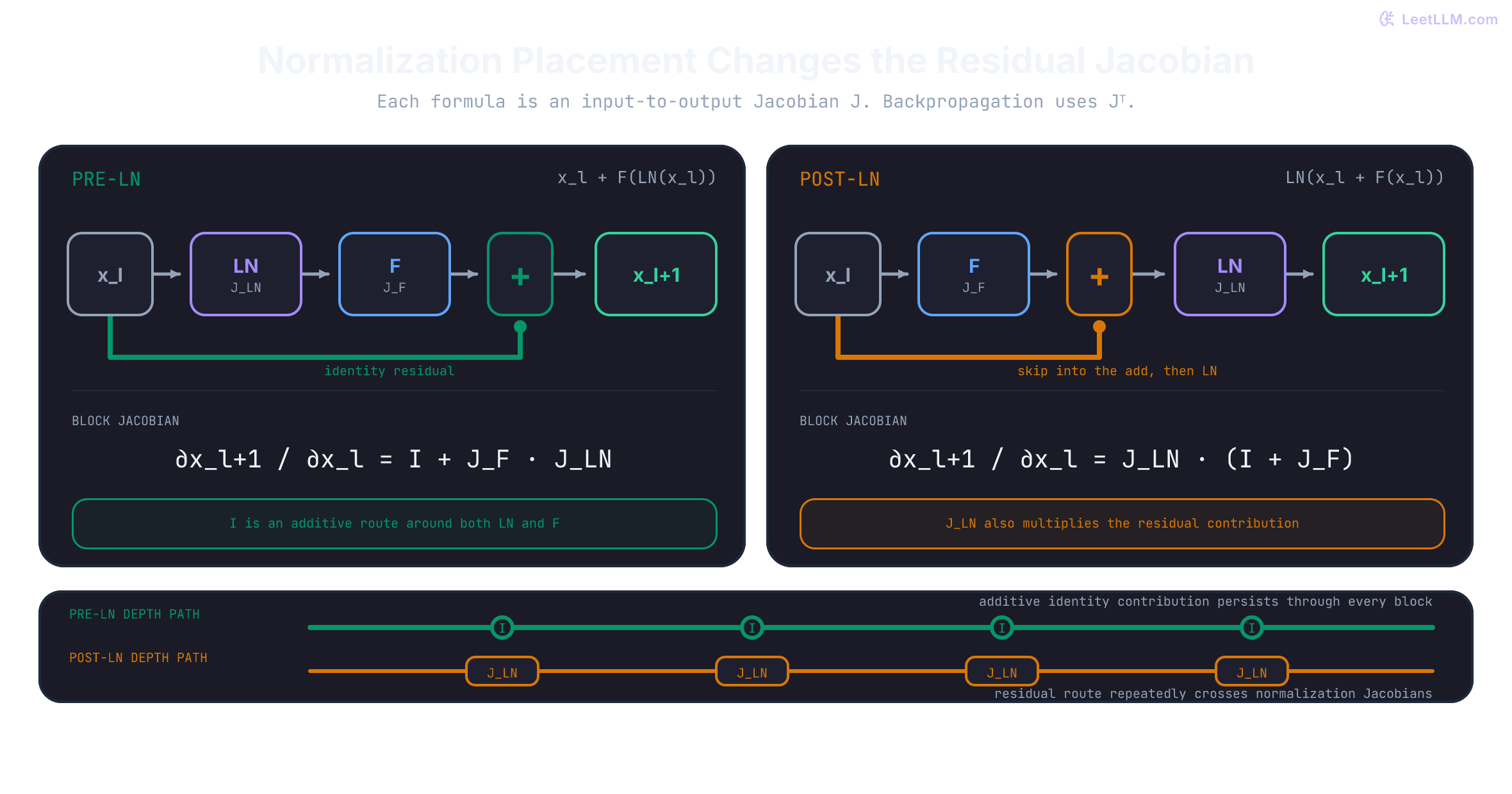
In Post-LN, normalization wraps the sum after the write. In Pre-LN, normalization sits on the input to the sublayer branch, leaving the skip path untouched. During backpropagation, Pre-LN's block Jacobian therefore has an additive identity term; Post-LN's includes a normalization Jacobian outside the sum. Later we'll construct a branch that cancels the identity contribution in one direction.[1]
We'll start with the bare arithmetic of a single token vector.
LayerNorm by hand
Take our running token vector as the hidden state of one token:
x = [3.0, 1.0, -1.0, 5.0]First, calculate its mean over the 4 features:
Subtracting this mean centers the features around zero, giving [1.0, -1.0, -3.0, 3.0]. Centering shifts the coordinate origin without altering pairwise distances between features.
Next, calculate the population variance across the centered values:
LayerNorm uses the biased population variance (dividing by ) rather than the sample variance ().
For this hand calculation, ignore epsilon. Take the square root: . Dividing each centered feature by produces:
Before any learned affine transform, its mean is 0 and its variance is 1 in this epsilon-free calculation. With positive epsilon the variance is slightly smaller here; a constant input has zero normalized variance.
Finally, learned scale () and shift () vectors can reshape the standardized features. When initialized to and , the values pass through unchanged. During training, the optimizer tunes and so the layer can restore whatever dynamic range the downstream computation needs.
Because these operations run strictly across the feature coordinates of one token, other tokens in the sequence or batch don't influence this token's statistics.
If you feed 16 token hidden states through LayerNorm, which numbers determine the mean and variance for one token?
Answer
For per-token LayerNorm over the hidden dimension, only that token's feature values determine its statistics. The normalization formula is the same during training and evaluation; the surrounding model can still differ because of dropout, masks, or different token contexts.
Here's the calculation packaged as a standalone Python function with strict input validation:
from math import isclose, isfinite, sqrt

def layer_norm(values, gamma=None, beta=None, eps=1e-5):
    if not values or not isfinite(eps) or eps <= 0:
        raise ValueError("Use a nonempty vector and positive finite epsilon")
    if gamma is None:
        gamma = [1.0] * len(values)
    if beta is None:
        beta = [0.0] * len(values)
    if len(gamma) != len(values) or len(beta) != len(values):
        raise ValueError("gamma and beta must match the feature count")
    if not all(isfinite(v) for v in [*values, *gamma, *beta]):
        raise ValueError("All values must be finite")
    mean = sum(values) / len(values)
    variance = sum((value - mean) ** 2 for value in values) / len(values)
    scale = sqrt(variance + eps)
    return [
        gamma_i * ((value - mean) / scale) + beta_i
        for value, gamma_i, beta_i in zip(values, gamma, beta)
    ]

normalized = layer_norm([3.0, 1.0, -1.0, 5.0])
rounded = [round(value, 2) for value in normalized]
assert rounded == [0.45, -0.45, -1.34, 1.34]
assert isclose(sum(normalized), 0.0, abs_tol=1e-12)
assert layer_norm([3.0, 1.0], gamma=[0.0, 0.0]) == [0.0, 0.0]
assert layer_norm([7.0, 7.0], beta=[2.0, -1.0]) == [2.0, -1.0]
The general formula
For any token state , LayerNorm computes:[2]
where:
- : feature mean of this token
- : feature variance of this token
- : learnable per-channel scale and bias parameters
- : small positive constant (typically or ) guarding against division by zero
Before the affine transform, variance equals . It is near 1 when , exactly when , and zero for a flat vector. Learned per-channel and can change both output mean and variance. Epsilon keeps the denominator nonzero, but the gain near a flat input can still approach .
In mixed precision, distinguish the input dtype from the dtype used for reductions and epsilon addition. FP16's smallest positive subnormal is about ; 1e-12 rounds to zero if represented directly in FP16. BF16 has a wider exponent range. Accumulating statistics in FP32 avoids that particular epsilon underflow, but cannot recover differences already lost when inputs were rounded. Match the checkpoint's epsilon and check the actual kernel; changing it changes the function.
Why BatchNorm is awkward in causal sequence models
BatchNorm usually reduces each channel across the batch and spatial or temporal positions. That creates different constraints from per-token LayerNorm:[3]
- Padding and causality: Padding can contaminate statistics unless explicitly excluded.
BatchNorm1don(batch, channels, time)reduces across batch and time, so a training-time token can depend on future tokens through those statistics. A causal attention mask does not repair that separate dependency. - Cross-sample coupling: With batch statistics, changing the other examples changes a token's normalization. Whether that helps or hurts depends on the task and sampling.
- Train/eval statistics: With PyTorch's default running-statistics policy, evaluation uses stored estimates and can handle batch size one. If
track_running_stats=False, evaluation also uses current batch statistics. One value per channel is insufficient for PyTorch's training-style BatchNorm; batch size one with several temporal positions is a different case.
Per-token LayerNorm avoids batch/sequence reduction. It does not erase padding's effects elsewhere in the model; attention masks and loss masks still matter.
| Property | BatchNorm | LayerNorm |
|---|---|---|
| Reduction axis | Mini-batch and spatial positions | Feature coordinates within one token |
| Batch size dependency | Current statistics depend on all reduced samples; stored-statistics eval is different | Statistics independent of peer tokens |
| Inference statistics | Stored estimates by default; current batch statistics if configured | Computed from each token |
| Variable sequence lengths | Padding/time reduction requires care | Hidden-dimension statistics do not mix tokens |
| Autoregressive decoding | Mismatched train vs eval statistics | Identical computation in both modes |
| Modern LLM adoption | Rare | Foundation of transformer normalization |
Why is BatchNorm awkward for autoregressive decoding while LayerNorm is natural?
Answer
BatchNorm's reduction and running-statistics policy need to fit causal training and single-token evaluation. Stored-statistics evaluation can handle batch size one; it is the different statistics source and possible time reduction that need care. Per-token LayerNorm uses just the current token's features in either mode.
Here's an executable demonstration comparing how LayerNorm and BatchNorm react when neighboring batch elements change:
from math import sqrt

def layer_norm(values, eps=1e-5):
    mean = sum(values) / len(values)
    variance = sum((value - mean) ** 2 for value in values) / len(values)
    return [(value - mean) / sqrt(variance + eps) for value in values]

def batch_norm_one_feature(values, eps=1e-5):
    mean = sum(values) / len(values)
    variance = sum((value - mean) ** 2 for value in values) / len(values)
    return [(value - mean) / sqrt(variance + eps) for value in values]

token = [1.0, 3.0, 5.0, 7.0]
ln_before = [layer_norm(row) for row in [token, [2.0, 4.0, 6.0, 8.0]]][0]
ln_after = [layer_norm(row) for row in [token, [100.0, 100.0, 100.0, 100.0]]][0]
batch_a = batch_norm_one_feature([token[0], 2.0, 3.0])
batch_b = batch_norm_one_feature([token[0], 2.0, 100.0])

print("LayerNorm token:", [round(value, 3) for value in ln_before])
print("Batch feature with peers=2,3:", round(batch_a[0], 3))
print("Batch feature with peers=2,100:", round(batch_b[0], 3))
assert ln_before == ln_after
assert round(batch_a[0], 3) != round(batch_b[0], 3)LayerNorm token: [-1.342, -0.447, 0.447, 1.342]
Batch feature with peers=2,3: -1.225
Batch feature with peers=2,100: -0.718The LayerNorm output for token is identical regardless of whether its neighbor has values near 2 or 100. The batch-normalized feature shifts from -1.225 to -0.718 purely because its batch neighbors shifted.
PyTorch implementation
For (batch, seq_len, d_model), nn.LayerNorm(d_model) reduces over hidden features. More generally, normalized_shape selects all matching trailing dimensions: nn.LayerNorm((seq_len, d_model)) also mixes time. That can leak future-token information in a causal decoder.[4]
Try changing just the last token. Which normalization keeps the first token unchanged?
import torch

x = torch.tensor([[[1., 2., 4.], [2., 5., 8.]]], dtype=torch.float64)
changed = x.clone()
changed[:, 1] += 100
per_token = torch.nn.LayerNorm(3, elementwise_affine=False).double()
over_time = torch.nn.LayerNorm((2, 3), elementwise_affine=False).double()
same_token = torch.allclose(per_token(x)[:, 0], per_token(changed)[:, 0])
same_time = torch.allclose(over_time(x)[:, 0], over_time(changed)[:, 0])
assert same_token and not same_time
print("First token unchanged with hidden-only reduction:", same_token)
print("First token unchanged with time-and-hidden reduction:", same_time)First token unchanged with hidden-only reduction: True
First token unchanged with time-and-hidden reduction: FalseHere is a single-hidden-dimension implementation. It upcasts half-precision statistics, keeps the output dtype, and broadcasts the affine parameters. It is an educational module, not a fused-kernel performance replacement:
from math import isfinite
import torch
import torch.nn as nn

class LayerNorm(nn.Module):
    """Layer Normalization from scratch."""
    def __init__(self, d_model: int, eps: float = 1e-5):
        super().__init__()
        if (not isinstance(d_model, int) or isinstance(d_model, bool)
                or d_model < 1 or not isfinite(eps) or eps <= 0):
            raise ValueError("Use a positive feature count and finite positive epsilon")
        self.gamma = nn.Parameter(torch.ones(d_model))
        self.beta = nn.Parameter(torch.zeros(d_model))
        self.eps = eps

    def forward(self, x: torch.Tensor) -> torch.Tensor:
        # x shape: (batch, seq_len, d_model)
        if not x.is_floating_point() or x.shape[-1:] != self.gamma.shape:
            raise ValueError("Use a floating tensor whose final dimension matches d_model")
        work = x.float() if x.dtype in (torch.float16, torch.bfloat16) else x
        mean = work.mean(dim=-1, keepdim=True)
        var = work.var(dim=-1, keepdim=True, unbiased=False)
        x_norm = (work - mean) / torch.sqrt(var + self.eps)
        return (self.gamma * x_norm + self.beta).to(x.dtype)

# Quick check with the hand-worked example
x = torch.tensor([[[3.0, 1.0, -1.0, 5.0]]])  # shape (1, 1, 4)
ln = LayerNorm(d_model=4)
# Fix gamma=1, beta=0 to match the hand calculation
nn.init.constant_(ln.gamma, 1.0)
nn.init.constant_(ln.beta, 0.0)
out = ln(x)
print(out.round(decimals=2).detach())
expected = torch.tensor([[[0.45, -0.45, -1.34, 1.34]]])
assert torch.allclose(out.round(decimals=2), expected)tensor([[[ 0.4500, -0.4500, -1.3400, 1.3400]]])The gradients of scale and shift
Understanding LayerNorm during the backward pass requires looking at how gradients flow back through the reduction operations. Let , where and .
Let represent upstream gradients. Because and are shared across all tokens in the batch and sequence, their gradients sum over both axes:
For the input gradient of one token, define . Differentiating through the mean and variance reductions yields:
Every mean in this expression runs across the feature coordinates of that token. The three terms have intuitive roles:
- : direct scaled gradient signal
- : enforces that the gradient of the centered vector has mean zero
- : adjusts the component along the centered input. With positive epsilon this is not a complete orthogonal projection; changing the input scale still changes the normalized output slightly.
Here's an exact numerical test validating all three analytical gradients against PyTorch autograd:
import torch

torch.manual_seed(7)
x = torch.randn(2, 3, 4, dtype=torch.float64, requires_grad=True)
norm = torch.nn.LayerNorm(4, eps=1e-5).double()
with torch.no_grad():
    norm.weight.copy_(torch.tensor([0.5, 1.0, -2.0, 3.0]))
    norm.bias.copy_(torch.tensor([1.0, -1.0, 0.2, 0.0]))
g = torch.randn_like(x)
s = (x.var(-1, keepdim=True, unbiased=False) + norm.eps).sqrt()
xhat = (x - x.mean(-1, keepdim=True)) / s
manual = norm.weight * xhat + norm.bias
torch.testing.assert_close(norm(x), manual)
dx, dgamma, dbeta = torch.autograd.grad(norm(x), (x, norm.weight, norm.bias), g)
u = g * norm.weight
expected_dx = (u - u.mean(-1, keepdim=True)
               - xhat * (u * xhat).mean(-1, keepdim=True)) / s
torch.testing.assert_close(dx, expected_dx)
torch.testing.assert_close(dgamma, (g * xhat).sum((0, 1)))
torch.testing.assert_close(dbeta, g.sum((0, 1)))
print("Forward, input gradient, scale gradient, shift gradient: match")Forward, input gradient, scale gradient, shift gradient: match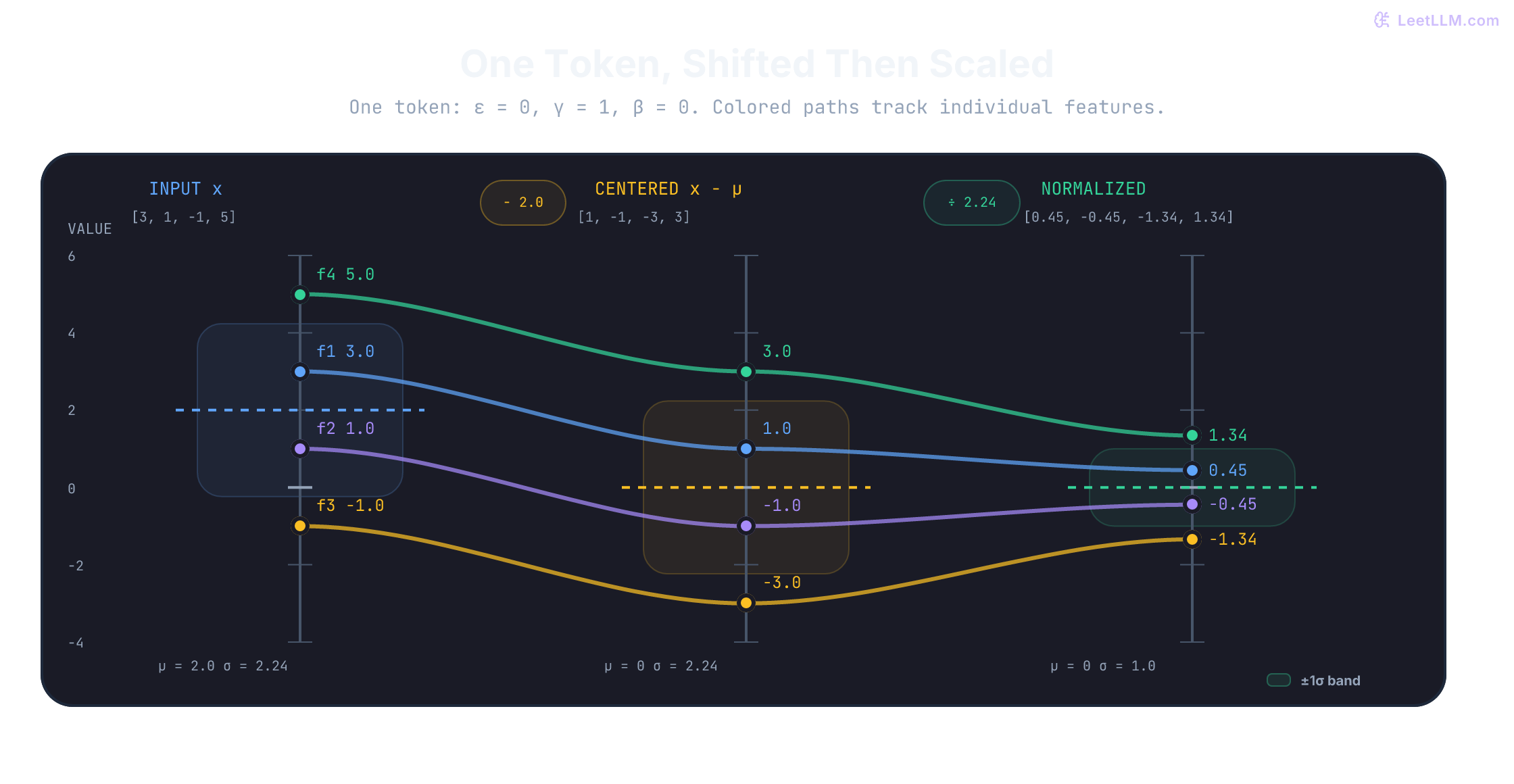
Where you put LayerNorm matters
Knowing how LayerNorm operates on a single vector sets up the bigger architectural choice: where does it go in a residual block?
One block, two placements
A transformer layer contains two residual sublayers: multi-head self-attention and a feed-forward network. Each sublayer takes an input and computes an update . The question is whether normalization wraps the sum or only the branch input:
- Post-LN: Normalizes after adding the residual update.
- Pre-LN: Normalizes before feeding the vector into the sublayer.
Post-LN: the original transformer
Vaswani et al. (2017) and early models like BERT placed LayerNorm on the output of the addition:[5][6]
Compute the sublayer output, add it to the incoming skip connection, then normalize the sum. Normalization sits directly on the residual highway. Gradients backpropagating down the residual path must pass through a LayerNorm Jacobian at every single block.
Pre-LN: an identity contribution around the branch
GPT-2 reversed this order, normalizing the input before the sublayer:[7]
Normalize , send the normalized vector into the sublayer, then add the sublayer's output to the raw, unnormalized . The skip connection from to stays completely unobstructed.
GPT-2-style Pre-LN includes a final normalization before prediction. Its block input norms do not normalize the accumulated block output:[7][1]
In one equation, what is the architectural difference between Post-LN and Pre-LN?
Answer
Post-LN is . Pre-LN is . The critical difference is whether normalization sits on the residual highway after the addition, or only on the sublayer branch before the addition.
A two-layer walkthrough
Step through both layouts with a concrete numerical example. Let , and run two steps starting from with and .
With this example's fixed affine parameters, Post-LN outputs have zero mean and standard deviation close to one. Pre-LN accumulates these particular updates. A different could cancel or redirect them; neither layout forces a trained stream to follow this toy trajectory.
from math import sqrt

def layer_norm(values, eps=1e-5):
    mean = sum(values) / len(values)
    variance = sum((value - mean) ** 2 for value in values) / len(values)
    scale = sqrt(variance + eps)
    return [(value - mean) / scale for value in values]

def sublayer(values):
    # Deterministic stand-in for attention or an FFN update.
    return [0.2 * value + 0.1 for value in values]

def pre_ln_step(values):
    return [value + update for value, update in zip(values, sublayer(layer_norm(values)))]

def post_ln_step(values):
    raw = [value + update for value, update in zip(values, sublayer(values))]
    return layer_norm(raw)

start = [1.0, 2.0, 4.0, 8.0]
pre_after_two = pre_ln_step(pre_ln_step(start))
post_after_two = post_ln_step(post_ln_step(start))

assert sum(abs(value) for value in pre_after_two) > sum(abs(value) for value in start)
assert abs(sum(post_after_two) / len(post_after_two)) < 1e-12
assert abs(sum(pre_after_two) / len(pre_after_two) - 3.95) < 1e-12
print("Pre-LN after two steps:", [round(v, 3) for v in pre_after_two])
print("Post-LN after two steps:", [round(v, 3) for v in post_after_two])Pre-LN after two steps: [0.79, 1.939, 4.237, 8.834]
Post-LN after two steps: [-1.026, -0.653, 0.093, 1.585]Why Pre-LN can train more stably
The forward pass shows what gets normalized. The real breakthrough of Pre-LN lies in optimization dynamics: how gradients propagate from the loss down to layer 0.
The Post-LN gradient problem
Differentiating one Post-LN block with respect to its input yields:
where is evaluated at the sum .
Let . The order matters because these matrices need not commute:
For one token, the exact normalization Jacobian is
It removes the common-offset direction and rescales other directions according to , , and input geometry. A long product can attenuate or amplify a gradient; the placement equation alone does not give a universal depth law.
Xiong et al.'s formal last-FFN result uses a simplified initialization: single-head attention, zero Q/K projections (uniform attention), Gaussian remaining weights/inputs, and concentration assumptions. For width and depth , their high-probability upper bounds on are[1]
These concern the final FFN's second weight matrix, not every layer's weights or every trained checkpoint. The paper's broader analysis and experiments find large Post-LN gradients near the output and show that warmup helps its tested recipes. That is useful evidence for inspecting early update sizes, not a requirement that every Post-LN model use a fixed number of warmup steps.
The Pre-LN gradient advantage
Now differentiate a Pre-LN block:
Unrolling this across depth from layer to layer gives an additive decomposition:
The additive provides a path around the branch. But can have a very large norm, or can cancel the identity on a direction . The final norm and prediction head also participate in the loss gradient. Pre-LN does not guarantee nonvanishing gradients, bounded branch outputs, or safety at any learning rate.
Xiong et al. successfully removed warmup in their tested Pre-LN translation and BERT recipes.[1] Later Peri-LN experiments report Pre-LN gradient spikes and changing activation growth during training, and use warmup themselves.[8] Treat schedule, initialization, precision, and placement as one training recipe.
Here's an autograd check verifying the exact block Jacobians and their vector-Jacobian products:
import torch
from torch.autograd.functional import jacobian

torch.manual_seed(11)
x = torch.tensor([3.0, 1.0, -1.0, 5.0], dtype=torch.float64, requires_grad=True)
W = torch.randn(4, 4, dtype=x.dtype) * 0.2
identity = torch.eye(4, dtype=x.dtype)
def ln(v):
    return torch.nn.functional.layer_norm(v, (4,), eps=1e-5)
def pre(v):
    return v + W @ ln(v)
def post(v):
    return ln(v + W @ v)

J_pre = jacobian(pre, x)
J_post = jacobian(post, x)
torch.testing.assert_close(J_pre, identity + W @ jacobian(ln, x))
torch.testing.assert_close(J_post, jacobian(ln, x + W @ x) @ (identity + W))
g = torch.tensor([1.0, -2.0, 0.5, 3.0], dtype=x.dtype)
for block, J in [(pre, J_pre), (post, J_post)]:
    actual = torch.autograd.grad(block(x), x, grad_outputs=g)[0]
    torch.testing.assert_close(actual, J.T @ g)
print("Both block Jacobians and transposed gradient products: match")

# A fixed branch can cancel the identity on a particular direction.
point = torch.tensor([1., -1., 2., -2.], dtype=x.dtype)
direction = torch.tensor([2., -2., -1., 1.], dtype=x.dtype)
fixed_scale = (point.var(unbiased=False) + 1e-5).sqrt()
J_cancel = jacobian(lambda v: v - fixed_scale * ln(v), point)
cancelled = torch.allclose(J_cancel @ direction, torch.zeros_like(direction), atol=1e-12)
assert cancelled
print("Pre-LN identity term can cancel in one direction:", cancelled)Both block Jacobians and transposed gradient products: match
Pre-LN identity term can cancel in one direction: TrueA reported Pre-LN risk: representation collapse
Pre-LN can ease optimization while the residual stream dominates newer writes. This is a behavior to investigate, not a guaranteed outcome.
Because the residual stream bypasses normalization at each addition:
Suppose writes have bounded, comparable variance and are roughly uncorrelated with the accumulated stream. For fixed width, this motivates:
Meanwhile, the update added at layer remains . The relative contribution of each new layer shrinks as depth increases:
A normalized input does not itself bound 's output: learned weights can grow. Correlated writes can also invalidate the linear-variance argument. ResiDual studies increasingly similar normalized hidden states and diminishing later-block contributions in its analysis and translation experiments.[9] A small raw norm ratio alone does not prove that a layer is useless; measure normalized-state changes, direction, and the task effect of ablating it.
| Property | Post-LN | Pre-LN |
|---|---|---|
| Skip gradient path | Passes through chained matrices | Direct identity highway () |
| Initialization evidence | Large output-near gradients in Xiong's analyzed setup | Smaller last-FFN bound in that setup |
| Warmup | Helps tested recipes; tune and measure | Removable in some recipes; still used in others |
| Deep layer contribution | Depends on training and branch behavior | Relative writes can dilute under stated assumptions |
| Final norm | Last block already applies an output norm | Part of GPT-2-style recipe; preserve checkpoint design |
| Primary adopters | Original Transformer, BERT | GPT-2, Llama, Mistral, Qwen |
What is the representation-collapse risk reported for Pre-LN?
Answer
If writes have comparable bounded variance and little correlation, stream scale can grow while relative write size shrinks. ResiDual reports increasingly similar normalized hidden states. Those assumptions need checking in trained models; normalized branch inputs alone do not bound branch outputs, and small norm ratios need task-level ablations before declaring a layer redundant.
Residual magnitude growth across depth
This simulation deliberately adds the same aligned write eight times. Its Pre-LN norm grows linearly, so it illustrates write dilution, not the preceding uncorrelated-write estimate. The DeepNorm-shaped column uses only residual scaling; it does not implement the full initialization or training recipe. The displayed write share is , distinct from :
from math import sqrt

def l2(values: list[float]) -> float:
    return sqrt(sum(v * v for v in values))

def layer_norm(values: list[float], eps: float = 1e-5) -> list[float]:
    mean = sum(values) / len(values)
    var = sum((v - mean) ** 2 for v in values) / len(values)
    scale = sqrt(var + eps)
    return [(v - mean) / scale for v in values]

depth = 8
update = [1.0, 0.0, 0.0, 0.0]
alpha = (2 * depth) ** 0.25  # encoder-only residual scale from DeepNet
x_pre = [1.0, 0.0, 0.0, 0.0]
x_post = [1.0, 0.0, 0.0, 0.0]
x_deep = [1.0, 0.0, 0.0, 0.0]

print(f"alpha={alpha:.3f}")
print("layer | Pre ||x|| | Pre write share | Post ||x|| | Deep ||αx|| | Deep ||x||")
for layer in range(1, depth + 1):
    pre_share = l2(update) / (l2(x_pre) + l2(update))
    x_pre = [a + b for a, b in zip(x_pre, update)]
    x_post = layer_norm([a + b for a, b in zip(x_post, update)])
    scaled = [alpha * a for a in x_deep]
    x_deep = layer_norm([a + b for a, b in zip(scaled, update)])
    print(
        f"{layer:5d} | {l2(x_pre):8.3f} | {pre_share:15.3f} | "
        f"{l2(x_post):10.3f} | {l2(scaled):9.3f} | {l2(x_deep):9.3f}"
    )

assert l2(x_pre) > l2(x_post)
assert abs(l2(x_post) - l2(x_deep)) < 1e-5
assert alpha == 2.0alpha=2.000
layer | Pre ||x|| | Pre write share | Post ||x|| | Deep ||αx|| | Deep ||x||
1 | 2.000 | 0.500 | 2.000 | 2.000 | 2.000
2 | 3.000 | 0.333 | 2.000 | 4.000 | 2.000
3 | 4.000 | 0.250 | 2.000 | 4.000 | 2.000
4 | 5.000 | 0.200 | 2.000 | 4.000 | 2.000
5 | 6.000 | 0.167 | 2.000 | 4.000 | 2.000
6 | 7.000 | 0.143 | 2.000 | 4.000 | 2.000
7 | 8.000 | 0.125 | 2.000 | 4.000 | 2.000
8 | 9.000 | 0.111 | 2.000 | 4.000 | 2.000In this aligned-write example, Pre-LN norm grows from 2.0 to 9.0 and write share drops from 0.50 to 0.11. With unit affine parameters and tiny epsilon, the normalized columns stay near . Learned affine weights would change that scale.
DeepNorm: scaled residual and matched init
Wang et al. (2022) introduced DeepNorm in DeepNet as a way to stabilize very deep Post-LN-shaped stacks.[10]
DeepNorm preserves the Post-LN layout but modifies the residual sum with a depth-dependent scaling factor and a matched initialization gain :
The original recipe applies Xavier gain to FFN weights and attention's value/output projections, while Q/K projections use gain 1. Multiplying a weight by multiplies its initialization variance by . This is not an extra multiplication on every forward pass.
For an encoder-only stack with layers and two residual sublayers per layer:
A decoder-only stack uses the same formula with its layer count. An encoder-decoder is different because the decoder also has cross-attention:
| Stack | Residual scale | Initialization gain |
|---|---|---|
| Encoder-only, layers | ||
| Decoder-only, layers | ||
| Encoder in encoder-decoder | ||
| Decoder in encoder-decoder |
The analyzed model update is a change in the same model's output after a parameter update, . It is not the difference between the final and initial hidden states. Under its assumptions, DeepNet targets an output change on the order of the SGD step size, independent of increasing depth. The paper reports scaling to 1,000 layers; its documented translation recipes include warmup (for example, 4,000 updates on WMT-17), so that result does not establish a warmup-free recipe.[10]
What two mechanisms does DeepNorm add on top of a Post-LN-shaped block?
Answer
A depth-dependent residual scale on the skip path in , and a matched down-scaling factor applied to sublayer weight initialization.
RMSNorm: scale-only normalization
Where normalization sits is one choice. What formula sits inside that box is another.
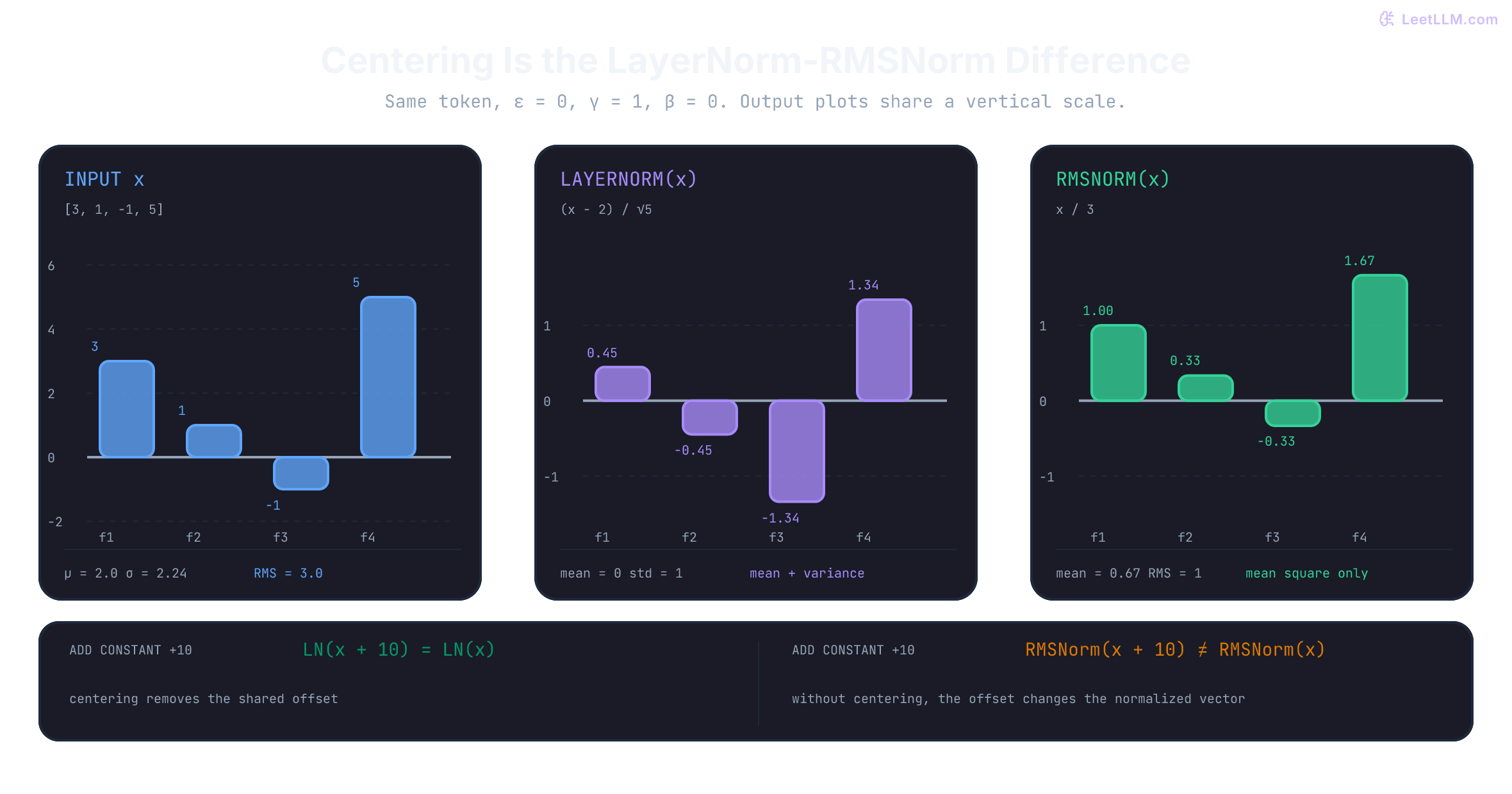
Zhang and Sennrich (2019) tested whether mean-centering was necessary in their networks.[11] RMSNorm drops it and uses the uncentered root mean square, usually with a learned gain and no learned shift. Their comparable-quality results are empirical evidence for the tested tasks, not proof that centering never matters:
Less arithmetic does not specify a GPU speedup
Llama, Qwen 2.5, and Gemma 2 provide examples of RMSNorm adoption; their placement recipes differ.[12][13] The formula needs a mean-square statistic, without a mean subtraction or canonical bias. That saves work, but statistics are not the same as HBM passes or kernel launches.
LayerNorm can combine mean and variance estimation using Welford's algorithm, and fuse statistics, affine transformation, and output into a kernel. Triton's official tutorial demonstrates fused LayerNorm. It does not follow that RMSNorm always halves memory traffic, registers, barriers, or runtime.[14][15]
The original RMSNorm paper reports 7%–64% running-time reductions across its different tested models and frameworks, not a fixed modern GPU kernel result.[11] Actual speed depends on width, row count, dtype, fusion, hardware, and backward work. Measure both the operator and the full step. If normalization takes 2% of a step, halving its time saves only 1% of that step.
| Step | LayerNorm | RMSNorm |
|---|---|---|
| Mean calculation | Yes () | No |
| Mean subtraction | Yes () | No |
| Required statistics | Mean and centered variance; computation can be fused | Uncentered mean square |
| Scale statistic | Standard deviation | Root mean square |
| Learned scale | Usual default; affine can be disabled | Usual default; affine can be disabled |
| Learned shift | Usual default; bias can be disabled | Omitted in the common formulation |
| Runtime cost | Depends on the implementation and workload | Less formula work; benchmark actual kernels |
What does RMSNorm remove from LayerNorm, and what does it keep?
Answer
The common formulation removes mean-centering and the learned shift. It divides by an epsilon-adjusted uncentered RMS and retains a learned gain. That controls a magnitude statistic, not a zero-mean guarantee.
Here's an implementation of RMSNorm:
from math import isfinite, sqrt

def rms_norm(values, weight=None, eps=1e-6):
    if not values or not isfinite(eps) or eps <= 0:
        raise ValueError("Use a nonempty vector and positive finite epsilon")
    if weight is None:
        weight = [1.0] * len(values)
    if len(weight) != len(values) or not all(isfinite(v) for v in [*values, *weight]):
        raise ValueError("Use one finite weight per finite feature")
    rms = sqrt(sum(value * value for value in values) / len(values) + eps)
    return [value * scale / rms for value, scale in zip(values, weight)]

values = [3.0, 1.0, -1.0, 5.0]
normalized = rms_norm(values)

assert round(sqrt(sum(value * value for value in normalized) / len(normalized)), 6) == 1.0
assert round(sum(normalized) / len(normalized), 6) != 0.0
assert rms_norm([3.0, 1.0], weight=[0.0, 0.0]) == [0.0, 0.0]
assert rms_norm([0.0, 0.0]) == [0.0, 0.0]
And the equivalent PyTorch module:[16]
from math import isfinite
import torch
import torch.nn as nn

class RMSNorm(nn.Module):
    """Root Mean Square Layer Normalization."""
    def __init__(self, d_model: int, eps: float = 1e-6):
        super().__init__()
        if (not isinstance(d_model, int) or isinstance(d_model, bool)
                or d_model < 1 or not isfinite(eps) or eps <= 0):
            raise ValueError("Use a positive feature count and finite positive epsilon")
        self.weight = nn.Parameter(torch.ones(d_model))
        self.eps = eps

    def forward(self, x: torch.Tensor) -> torch.Tensor:
        # x shape: (batch, seq_len, d_model)
        if not x.is_floating_point() or x.shape[-1:] != self.weight.shape:
            raise ValueError("Use a floating tensor whose final dimension matches d_model")
        work = x.float() if x.dtype in (torch.float16, torch.bfloat16) else x
        rms = torch.sqrt(work.pow(2).mean(dim=-1, keepdim=True) + self.eps)
        return (self.weight * (work / rms)).to(x.dtype)

# Quick sanity check
x = torch.tensor([[[3.0, 1.0, -1.0, 5.0]]])
rms = RMSNorm(d_model=4)
out = rms(x)
print(out.round(decimals=4).detach())
feature_rms = torch.sqrt(out.pow(2).mean(dim=-1))
assert torch.allclose(feature_rms, torch.ones_like(feature_rms), atol=1e-5)
assert not torch.allclose(out.mean(dim=-1), torch.zeros_like(out.mean(dim=-1)))tensor([[[ 1.0000, 0.3333, -0.3333, 1.6667]]])To compare with PyTorch, specify nn.RMSNorm(4, eps=1e-6). This module's explicit epsilon differs from PyTorch 2.14's eps=None policy, which uses the computation type's machine epsilon (FP32 for half/BF16/FP32 inputs, FP64 for FP64 inputs).[16] Positive epsilon makes rescaling invariance approximate, particularly for tiny inputs. A zero vector remains zero; a constant nonzero vector generally remains nonzero. Both normalize before the learned gain, which can change the final RMS.
The cast before squaring matters. FP16 can represent 300, but its square, 90,000, exceeds FP16's largest finite value. torch.finfo(torch.float16).max reports that limit.[17] Predict what the two RMS calculations will return, then compare them:
import torch
import torch.nn.functional as F

large = torch.tensor([300., -300.], dtype=torch.float16)
half_rms = (large.square().mean() + 1e-6).sqrt()
wide_rms = (large.float().square().mean() + 1e-6).sqrt()
assert torch.isinf(half_rms) and wide_rms.item() == 300.
print("RMS, FP16 accumulation:", half_rms.item())
print("RMS, FP32 accumulation:", wide_rms.item())

# A separate failure occurs before the normalization kernel runs.
original = torch.tensor([10000., 10001., 9999., 10002.])
rounded = original.half().float()
before = F.layer_norm(original, (4,), eps=1e-5)
after = F.layer_norm(rounded, (4,), eps=1e-5)
assert torch.equal(rounded, torch.full_like(rounded, 10000.))
assert torch.equal(after, torch.zeros_like(after))
assert before.abs().max() > 1.
print("FP16 input, cast back to FP32:", rounded.tolist())
print("LayerNorm of original:", [round(v, 4) for v in before.tolist()])
print("LayerNorm after input rounding:", after.tolist())RMS, FP16 accumulation: inf
RMS, FP32 accumulation: 300.0
FP16 input, cast back to FP32: [10000.0, 10000.0, 10000.0, 10000.0]
LayerNorm of original: [-0.4472, 0.4472, -1.3416, 1.3416]
LayerNorm after input rounding: [0.0, 0.0, 0.0, 0.0]Casting the squared tensor afterward leaves the infinity intact. Casting before the product repairs this accumulation failure. In the second case, FP16 rounds all four values to 10,000 before LayerNorm sees them. FP32 accumulation cannot recover those lost differences. When checking a low-precision kernel against a reference, feed both the same rounded input; compare with the original FP32 input separately to measure input-rounding error.
Reported normalization layouts
Different architectures combine normalization operators and placements in distinct configurations:
| Layout | Representative model | Structural mechanism |
|---|---|---|
| Post-LN | Original Transformer, BERT | Normalizes after the residual addition |
| Pre-LN | GPT-2 | Normalizes sublayer inputs; preserves identity gradient path |
| Pre-RMSNorm | Llama 3, Mistral, Qwen 2.5 | Pre-LN placement with RMSNorm; retain the model's recipe[12] |
| Dual input-output norm | Gemma 2 | RMSNorm on both input and output of each sublayer, before the add[13] |
| Peri-LN | Kim et al. (2025) study | Input/output branch norms plus embedding/final norms in its full recipe[8] |
| DeepNorm | DeepNet (Wang et al. 2022) | Post-LN layout with depth-dependent skip scaling and init scaling [10] |
| QK-Norm | ViT-22B, Gemma 3, Qwen3 | Normalizes Q/K inside attention; can accompany residual norms[18][19][20] |
These rows name different design dimensions, not mutually exclusive architectures. Qwen3 combines Pre-RMSNorm with per-head Q/K RMSNorm before RoPE. Gemma 3 keeps its input/output residual-branch norms and replaces Gemma 2's attention soft-capping with QK-Norm. These concrete designs were checked October 10, 2026; the Qwen3 code reference is pinned to Transformers 5.17.0.[20][19]
A naming trap: Qwen3's post_attention_layernorm is applied after the attention residual addition but before the MLP, followed by another residual addition. It is the MLP's input norm in a Pre-LN layout. Read the operations around the add instead of classifying placement from a variable name.[20]
QK-Norm controls one source of attention scale
Residual normalization regulates activations between layers. But inside the attention head, another instability can trigger loss divergence: attention logit growth.
In standard attention, raw attention logits equal:
Growing Q/K norms can enlarge score differences, making attention nearly one-hot. Absolute magnitude alone is insufficient: softmax([1000, 1000]) is [0.5, 0.5], and adding one constant to every score changes nothing. ViT-22B and Rybakov et al. report specific instability experiments; Rybakov also examines growth in other linear outputs and combines QK normalization with soft-capping.[18][21]
For an increasingly one-hot distribution, the score-to-probability Jacobian entries approach zero:
This can weaken that route, not freeze every attention parameter. The value path still participates, and losses composed directly with softmax can have different gradient behavior (for example, cross-entropy has a logit gradient ).
One QK-Norm family applies LayerNorm or RMSNorm before the dot product:[21]
The original QKNorm paper instead uses per-head unit-L2 vectors and a learned scalar multiplying cosine similarity. That is different from unit-RMS vectors with the usual scaling. Normalization axis, affine gain, temperature, and RoPE order are checkpoint choices.[22][20]
Cauchy-Schwarz always gives:
Without affine parameters, unit-RMS vectors have norm , giving under standard scaling. Learned gains enlarge this bound; biases and extra temperatures also matter. Even that unit-gain bound permits highly peaked attention. Normalization reduces dependence on raw Q/K magnitude, without guaranteeing entropy or stable optimization.
import torch

d = 256
q = torch.cat((torch.ones(d // 2), -torch.ones(d // 2))).double()
keys = torch.stack((q, -q))
# Both vectors already have zero mean, RMS 1, and L2 norm sqrt(d).
scores = keys @ q / d**0.5
probabilities = scores.softmax(0)
large_equal = torch.tensor([1000., 1000.]).softmax(0)
gain = 10
gained_scores = (gain * keys) @ (gain * q) / d**0.5
assert scores.tolist() == [16., -16.]
assert probabilities[1] < 2e-14
assert torch.equal(large_equal, torch.tensor([0.5, 0.5]))
assert gained_scores.tolist() == [1600., -1600.]
print("Uniform large logits:", large_equal.tolist())
print("Normalized logits:", scores.tolist())
print(f"Opposite-key probability: {probabilities[1].item():.2e}")
print("Gain 10 on both Q and K:", gained_scores.tolist())Uniform large logits: [0.5, 0.5]
Normalized logits: [16.0, -16.0]
Opposite-key probability: 1.27e-14
Gain 10 on both Q and K: [1600.0, -1600.0]from math import isclose, sqrt
def rms_rescale(values):
rms = sqrt(sum(value * value for value in values) / len(values))
if rms == 0:
raise ValueError("This epsilon-free illustration requires a nonzero vector")
return [value / rms for value in values]
def attention_logit(query, key):
return sum(q * k for q, k in zip(query, key)) / sqrt(len(query))
query = [6.0, -3.0, 2.0, 1.0]
key = [4.0, -2.0, 1.0, 3.0]
large_query = [20.0 * value for value in query]
raw = attention_logit(query, key)
raw_large = attention_logit(large_query, key)
controlled = attention_logit(rms_rescale(query), rms_rescale(key))
controlled_large = attention_logit(rms_rescale(large_query), rms_rescale(key))
print("raw logits:", round(raw, 3), round(raw_large, 3))
print("RMS-rescaled logits:", round(controlled, 3), round(controlled_large, 3))
assert raw_large == 20.0 * raw
assert isclose(controlled, controlled_large, rel_tol=1e-12)raw logits: 17.5 350.0
RMS-rescaled logits: 1.807 1.807Peri-LN and sandwich normalization
Sandwich-style layouts surround the sublayer with normalizers on both sides:
Here sits inside the branch before the residual addition. It regulates each write while retaining an additive identity term. The stream can still grow through repeated writes, and learned gains affect its scale. Gemma 2 uses branch input/output RMSNorm; Kim et al.'s full Peri-LN recipe also normalizes embeddings and the final output. “Post-norm” on a branch is not the plain Post-LN equation that normalizes the entire sum.[8][13]
In Kim et al.'s experiments, 400M, 1.5B, and 3.2B models trained on 30B tokens show fewer gradient spikes and better measured losses with Peri-LN. The paper uses RMSNorm for its main runs and 10% warmup. Its observation of changing Pre-LN variance growth during training also cautions against treating an initialization estimate as a universal trained-model law.[8]
Debug normalization failures
When a transformer diverges during training, systematic logging isolates the failure mode:
| Symptom | Probable cause | Diagnostic check and fix |
|---|---|---|
| Nonfinite loss in early steps | Invalid inputs/masks, precision overflow, or excessive updates | Locate the first nonfinite tensor and log layerwise gradients and optimizer updates. Test a smaller early rate/warmup only after identifying the affected route. |
| Nearly one-hot attention | Large score gaps, Q/K gains, temperature, or actual data | Log visible score gaps, attention entropy, and gains. Check stable softmax and compare the checkpoint's QK/soft-cap recipe; no universal score-50 trigger exists. |
| Changed scale at a ported Pre-LN head | Missing final norm or other checkpoint mismatch | Compare final norm, epsilon, affine weights, head scaling, and reference activations. Restore the checkpoint's design. |
| Small early-block gradients | Jacobian geometry, loss/head behavior, optimizer, or precision | Measure activations, gradients, and updates across depth. Compare matched recipes; adding an identity term alone proves no gradient bound. |
| Half-precision normalization differs | Reduction dtype, epsilon, input rounding, or kernel behavior | Compare FP32 calculations on the same rounded inputs. Match epsilon and inspect accumulation/output dtypes instead of imposing a universal epsilon floor. |
| Late Pre-LN states look redundant | Stream-dominated writes under the measured training conditions | Compare raw write ratios and normalized-state changes, then ablate blocks on task metrics before changing architecture. |
Practice: compare residual MLP blocks
Test the difference in gradient propagation directly by building a configurable residual block that toggles between Pre-LN and Post-LN:
import torch
import torch.nn as nn

class ToggleBlock(nn.Module):
    """Residual MLP block with style='pre' or style='post'."""
    def __init__(self, d_model: int, style: str = "pre"):
        super().__init__()
        if style not in ("pre", "post"):
            raise ValueError("style must be 'pre' or 'post'")
        if not isinstance(d_model, int) or isinstance(d_model, bool) or d_model < 1:
            raise ValueError("d_model must be a positive integer")
        self.style = style
        self.norm = nn.LayerNorm(d_model)
        # Simplified sublayer: single linear + ReLU
        self.sublayer = nn.Sequential(
            nn.Linear(d_model, d_model * 4),
            nn.ReLU(),
            nn.Linear(d_model * 4, d_model),
        )

    def forward(self, x: torch.Tensor) -> torch.Tensor:
        if self.style == "pre":
            # x_l + Sublayer(LayerNorm(x_l))
            return x + self.sublayer(self.norm(x))
        else:
            # LayerNorm(x_l + Sublayer(x_l))
            return self.norm(x + self.sublayer(x))

class TinyStack(nn.Module):
    def __init__(self, d_model: int = 64, depth: int = 6, style: str = "pre"):
        super().__init__()
        if not isinstance(depth, int) or isinstance(depth, bool) or depth < 1:
            raise ValueError("depth must be a positive integer")
        self.blocks = nn.ModuleList([ToggleBlock(d_model, style) for _ in range(depth)])
        self.final_norm = nn.LayerNorm(d_model) if style == "pre" else nn.Identity()
        self.head = nn.Linear(d_model, 16)

    def forward(self, x: torch.Tensor) -> torch.Tensor:
        for block in self.blocks:
            x = block(x)
        return self.head(self.final_norm(x))

def inspect_grad(style: str, d_model: int = 64, depth: int = 6, seed: int = 0):
    torch.manual_seed(seed)
    model = TinyStack(d_model=d_model, depth=depth, style=style)
    x = torch.randn(2, 8, d_model)
    target = torch.randn(2, 8, 16)
    out = model(x)
    loss = nn.functional.mse_loss(out, target)
    loss.backward()
    grad_norms = [block.sublayer[0].weight.grad.norm().item() for block in model.blocks]
    rounded_norms = [round(value, 4) for value in grad_norms]
    print(f"{style:4} | loss={loss.item():.4f} | block grad norms={rounded_norms}")
    return grad_norms

pre_grad_norms = inspect_grad("pre")
post_grad_norms = inspect_grad("post")

assert len(pre_grad_norms) == len(post_grad_norms) == 6
assert all(value > 0 for value in pre_grad_norms + post_grad_norms)pre | loss=1.3247 | block grad norms=[0.2664, 0.2565, 0.2494, 0.2392, 0.2472, 0.2415]
post | loss=1.3183 | block grad norms=[0.2663, 0.2614, 0.2619, 0.2555, 0.2684, 0.2698]Both layouts have healthy nonzero gradients in this small MLP example. It contains no attention or training loop, and is not a reproduction of the papers' transformers. The seed gives matching linear weights, inputs, targets, and heads here; the final Pre-LN norm initializes to unit scale/zero bias without drawing random values. For a training comparison, preserve those controls and compare schedules and output norms explicitly.
Mini exercise
- Try depths 6, 24, and 48 across several seeds. Record first/last-block gradient ratios. Does a claimed placement effect survive seed changes, or do both layouts remain similar?
- Replace the final Pre-LN norm with
nn.Identity()while preserving the other weights. Measure head input RMS and logits. This is an architectural ablation, not a safe checkpoint-porting change. - Compare
nn.LayerNorm(d_model, eps=1e-5)withnn.RMSNorm(d_model, eps=1e-5). Match epsilon and learned gains; then ask whether any difference comes from centering, placement, or the training recipe. CPU gradient norms do not measure GPU kernel speed.
Mastery check
- Calculate LayerNorm by hand: token mean, population variance, epsilon adjustment, and learned scale/shift.
- Trace the exact reduction axes. Explain BatchNorm's batch/time coupling and eval policy, and show why a hidden-only norm avoids future-token mixing.
- Formulate the block Jacobians for Pre-LN () and Post-LN ().
- Scope Xiong's last-FFN initialization bound and explain why measured gradients/updates motivate a warmup experiment without establishing a universal schedule.
- State the assumptions behind relative-write dilution, distinguish aligned from uncorrelated writes, and use task ablations to investigate redundancy.
- Implement RMSNorm with explicit epsilon and gain. Separate formula simplification from measured operator or full-step performance.
- Preserve DeepNorm's placement and selective initialization gain. Distinguish decoder-only from encoder-decoder scales, and demonstrate why normalized Q/K can still produce peaked attention.
Practice checkpoints
Your 48-layer decoder diverges during the first few hundred steps, but the same optimizer settings work on a 12-layer version. What should you inspect first?
Answer
Find the first nonfinite activation or gradient, then compare layerwise gradients and optimizer updates. Inspect masks, data, precision, initialization, normalization placement, and head configuration. If excessive early updates are observed, test a smaller early learning rate or warmup. For the ported Pre-LN model, also verify its final norm. A depth correlation is a clue, not a diagnosis.
An RMSNorm implementation is faster in a microbenchmark. What must you check before claiming a training speedup?
Answer
Match shape, dtype, epsilon, affine settings, hardware, synchronization, and forward/backward work. Check fusion and measure full steps too. RMSNorm removes centering and usually a bias, but LayerNorm can fuse its work; two statistics do not imply two HBM passes. A small operator fraction limits the full-step improvement.
Why can't QK-Norm replace residual normalization?
Answer
QK-Norm operates inside attention. It does not normalize FFN writes, the value/output branch, or the accumulated stream. Normalized Q/K can still produce large score gaps because of width, alignment, gains, or temperature. A checkpoint's residual norms and Q/K norms control different routes; replacing one with the other changes its recipe.