Personalize this lesson
Adapt explanations and teaching visuals to your background and preferred voice.
The previous chapter scored stored embedding vectors with cosine and dot product. A retriever compares one query vector to many keys.
A transformer layer turns that same routing idea inward: each token supplies a query and a key, while a mask decides which positions it may read.
Take the line "The cache stopped growing because it was full." You know "it" is the cache. Attention can bring information from that earlier position into the representation of "it", so later layers can use it.
Before naming any matrices, predict the operation: each token should choose source positions, turn those scores into weights, and mix the chosen content. Scaled dot-product attention learns that routing with matrix multiplication.
![Two-token causal attention flow: query cache reads only its own value producing [2.00, 1.00], while query grew mixes 42.1 percent cache and 57.9 percent grew values to produce [1.42, 1.58].](/cdn/content-image/fundamentals/scaled-dot-product-attention/illustrations/_generated/attention_flow_dark.png?v=a689d064731f)
The mask answers a separate question from relevance: which positions are legal to read? A causal mask blocks future-key logits with , giving those keys zero weight. Compute the unmasked two-token slice by hand first, then put the mask back.
Every active query still needs at least one allowed key. An entirely blocked row has no softmax probability distribution. The textbook max-subtraction formula produces NaN there; some kernels explicitly return zeros instead. Don't rely on a backend's invalid-row behavior to define your masking semantics.
Three views of one token
Self-attention computes a dynamic, weighted mix of token representations. Each query gets its weights from learned relevance scores against the keys.[1]
Raw dot products use the same features to ask for context and to offer it. Learned projections let the model change that compatibility function and choose separately which content to transfer. The projections transform the available token states; they don't create information about an unseen token.
One distinction matters: is symmetric, but its row-softmax weights needn't be. Each row has its own denominator, and a causal mask can block one direction. Symmetric scores alone don't force "it" and "cache" to attend equally to each other.
The model uses three learned linear transformations with different jobs:
| Vector | Question it answers | Role in attention |
|---|---|---|
| Query (Q) | What context does this position need? | Interrogation vector searching for relevant context |
| Key (K) | When should another position read me? | Advertisement vector broadcasting token identity and role |
| Value (V) | What information do I contribute if selected? | Content payload mixed into the receiver's representation |
Each token hidden state is projected three ways. maps into the interrogation subspace, maps into the advertisement subspace, and maps into the payload subspace:
Here and . is the residual stream width; and are the query/key and value widths.[1] The learned score is . It can be asymmetric, but doesn't guarantee unequal scores for every pair. For example, and still give symmetric raw scores.
Try to predict which statement survives this counterexample: symmetric raw scores, symmetric weights, or both?
import math

X = [[1.0, 0.0], [1.0, 1.0]]
scores = [[sum(a * b for a, b in zip(x, y)) for y in X] for x in X]

def softmax(row):
    exps = [math.exp(x - max(row)) for x in row]
    return [x / sum(exps) for x in exps]

weights = [softmax(row) for row in scores]
# W_Q = I and W_K = 2I are unequal, yet the raw score matrix stays symmetric.
unequal_projection_scores = [[2 * s for s in row] for row in scores]
print("raw scores symmetric:", scores[0][1] == scores[1][0])
print("opposite weights:", round(weights[0][1], 6), round(weights[1][0], 6))
print("unequal projections, symmetric scores:",
unequal_projection_scores[0][1] == unequal_projection_scores[1][0])raw scores symmetric: True
opposite weights: 0.5 0.268941
unequal projections, symmetric scores: TrueFor the running example, token cache uses these toy vectors after projection:
| Role | Vector |
|---|---|
| Query | |
| Key | |
| Value |
Predict the split before reading the diagram: Q and K meet to produce a routing score, while V travels past that score to remain content. The self-score for cache uses and , not .
![Token cache state x projects through W_Q, W_K, and W_V into query [1.0, 0.5], key [0.8, 0.2], and value [2.0, 1.0]. Query and key meet to compute routing score 0.90, while value bypasses routing to serve as content payload.](/cdn/content-image/fundamentals/scaled-dot-product-attention/illustrations/_generated/qkv_projections_dark.png?v=24b98ee30dc5)
Q and K determine where to look. Their dot products produce routing scores, and softmax converts those scores into weights.
V determines what information to extract. Separating routing (Q, K) from content (V) lets attention route information flexibly across representation subspaces.
In one sentence, which tensors choose where attention goes, and which tensor carries content?
Answer
Q and K choose where attention goes. Their dot products produce routing scores that softmax converts into weights. V carries the content that gets mixed by those weights.
The core formula
Read the formula as a lookup followed by a weighted read. Compatibility of queries with keys becomes weights; those weights mix values.[1] Softmax turns each query row into non-negative weights that sum to 1:
When some key positions aren't allowed, add a mask matrix after scaling. An allowed location has ; a blocked logit gets :
These formulas assume attention-weight dropout is disabled. Before dropout, each valid row is a distribution and its context lies in the convex hull of the visible value vectors. Training-time dropout can change the row sum and that convex-hull property. The later output projection and residual addition also needn't preserve either property.
Step by step
| Step | Operation | What it means |
|---|---|---|
| Compute scores | Build one score for each of the query-key pairs. | |
| Scale | Counter width-dependent score growth under the assumptions derived below. | |
| Mask | Add for allowed keys and for blocked keys. | |
| Normalize | Turn each active query row into weights that sum to 1. | |
| Aggregate | Blend value vectors according to the attention weights. |
The order is the contract: scores choose locations, softmax makes each choice a distribution, and only then do those weights touch V. Predict the shapes before following the picture: two queries compared with two keys make a routing matrix, while the value width survives into the output.
The shape flow uses batch size , number of heads , query count , key count , and value width . Query and key widths must match (); value width needn't. Queries and keys build one routing matrix; values join only after softmax:
![Diagram showing Q [B, h, Nq, d_k], QKᵀ / √d_k + mask [B, h, Nq, Nk], Kᵀ [B, h, d_k, Nk], and softmax over keys [B, h, Nq, Nk].](/cdn/content-image/fundamentals/scaled-dot-product-attention/diagrams/_generated/content_diagram_0_dark.png?v=3bf3c5762591)
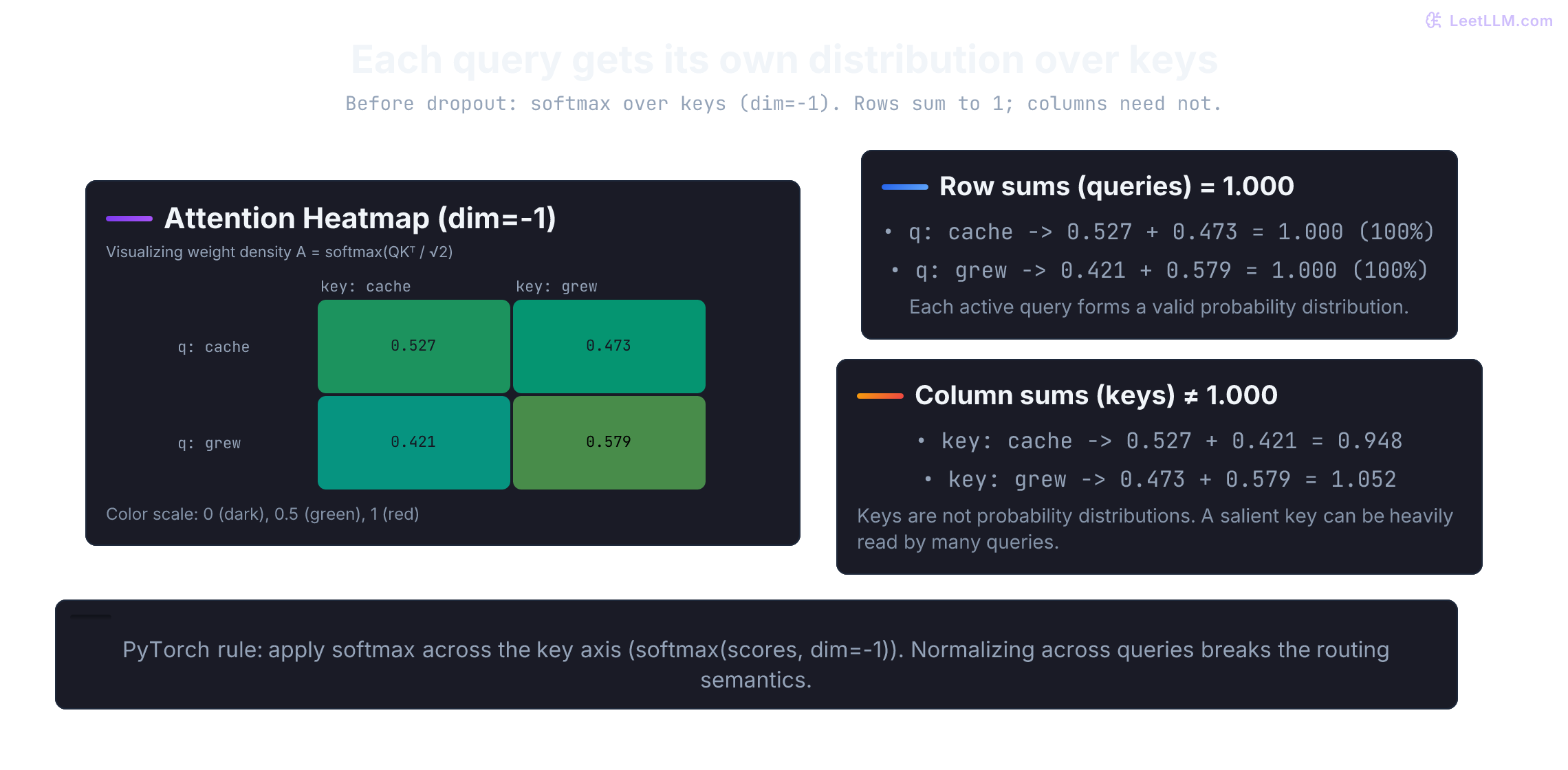
![Two-token unmasked attention trace: raw scores [0.90, 0.75; 0.60, 1.05] are scaled by square root of 2 into logits [0.636, 0.530; 0.424, 0.742], normalized by row softmax to weights [0.527, 0.473; 0.421, 0.579], and multiplied by values to produce context [1.421, 1.579] for grew.](/cdn/content-image/fundamentals/scaled-dot-product-attention/illustrations/_generated/attention_trace_dark.png?v=9ded21e02d1a)
A trace with real numbers
Walk through cache and grew without a mask first. Each uses 2-dimensional toy projections:
| Token | Query vector | Key vector | Value vector |
|---|---|---|---|
| cache | [1.0, 0.5] | [0.8, 0.2] | [2.0, 1.0] |
| grew | [0.5, 1.0] | [0.3, 0.9] | [1.0, 2.0] |
Step 1: raw scores
Compute the dot product of every query with every key:
Step 2: scale
With , divide by :
Step 3: softmax
Normalize each row so it sums to 1:
Step 4: weighted values
Multiply the weights by the value vectors:
- Context for "cache"
- Context for "grew"
Each head produces a blend of values, not a replacement for the entire token state. A transformer block projects the heads' outputs and combines them with the residual stream. Here cache pulls slightly more from its own value (0.53) than from grew (0.47); grew mixes both nearly evenly. All displayed decimals are rounded after computation.
In this toy trace, skipping the scaling step barely changes softmax. Why does the same omission hurt when grows to 64 or 512?
Answer
At , raw scores stay small. Under the initialization assumptions used below, increasing increases the dot-product spread like . That makes saturated, low-gradient softmax rows more likely unless scores are scaled.
The same arithmetic is easy to verify without a tensor library:
import math

Q = [[1.0, 0.5], [0.5, 1.0]]
K = [[0.8, 0.2], [0.3, 0.9]]
V = [[2.0, 1.0], [1.0, 2.0]]

def softmax(row: list[float]) -> list[float]:
    if not row or any(math.isnan(x) or x == math.inf for x in row):
        raise ValueError("softmax needs finite logits or masked -inf entries")
    shift = max(row)
    if shift == -math.inf:
        raise ValueError("each query needs at least one finite logit")
    exps = [math.exp(x - shift) for x in row]
    total = sum(exps)
    return [x / total for x in exps]

scores = [[sum(q_i * k_i for q_i, k_i in zip(q, k)) for k in K] for q in Q]
scaled = [[score / math.sqrt(2) for score in row] for row in scores]
weights = [softmax(row) for row in scaled]
outputs = [
    [sum(weight * value[col] for weight, value in zip(row, V)) for col in range(2)]
    for row in weights
]

print([[round(x, 2) for x in row] for row in weights])
print([[round(x, 2) for x in row] for row in outputs])
print([round(sum(row), 3) for row in weights])[[0.53, 0.47], [0.42, 0.58]]
[[1.53, 1.47], [1.42, 1.58]]
[1.0, 1.0]Add the causal mask
The mask changes who may be read, not how the allowed weights are computed. This function reuses Q, K, V, and softmax from the previous cell. With a lower-triangular mask, cache can only read itself, while grew can read both tokens, matching the opening figure.
causal = [[True, False], [True, True]]

def scaled_dot_product_attention(
    Q: list[list[float]],
    K: list[list[float]],
    V: list[list[float]],
    mask: list[list[bool]] | None = None,
) -> tuple[list[list[float]], list[list[float]]]:
    def shape(matrix: list[list[float]]) -> tuple[int, int]:
        if not matrix or not matrix[0]:
            raise ValueError("matrices must be nonempty")
        width = len(matrix[0])
        if any(len(row) != width for row in matrix):
            raise ValueError("matrices must be rectangular")
        if any(not math.isfinite(x) for row in matrix for x in row):
            raise ValueError("Q, K, and V must be finite")
        return len(matrix), width

    n_q, d_k = shape(Q)
    n_k, key_width = shape(K)
    n_v, d_v = shape(V)
    if d_k != key_width or n_k != n_v:
        raise ValueError("Q/K widths and K/V row counts must match")
    if mask is not None:
        if len(mask) != n_q or any(len(row) != n_k for row in mask):
            raise ValueError("mask must have shape (Nq, Nk)")
        if any(type(x) is not bool for row in mask for x in row):
            raise ValueError("this teaching mask must contain booleans")
        if not all(any(row) for row in mask):
            raise ValueError("each query row must have at least one visible key")
    scores = [
        [sum(q_i * k_i for q_i, k_i in zip(q, k, strict=True)) / math.sqrt(d_k) for k in K]
        for q in Q
    ]
    if any(not math.isfinite(x) for row in scores for x in row):
        raise ValueError("score arithmetic overflowed; finite inputs aren't sufficient")
    if mask is not None:
        scores = [
            [logit if visible else float("-inf") for logit, visible in zip(row, visible_row)]
            for row, visible_row in zip(scores, mask)
        ]
    weights = [softmax(row) for row in scores]
    outputs = [
        [sum(weight * value[col] for weight, value in zip(row, V)) for col in range(d_v)]
        for row in weights
    ]
    if any(not math.isfinite(x) for row in outputs for x in row):
        raise ValueError("value aggregation overflowed")
    return outputs, weights

output, weights = scaled_dot_product_attention(Q, K, V, causal)
pretty_weights = [[round(value, 3) for value in row] for row in weights]
print("causal weights:", pretty_weights)
print("cache future weight:", pretty_weights[0][1])
print("output rows:", len(output), "width:", len(output[0]))causal weights: [[1.0, 0.0], [0.421, 0.579]]
cache future weight: 0.0
output rows: 2 width: 2Two masking details matter in real code. First, softmax must run along the key axis so each query row sums to 1; normalizing along the query axis silently changes the operation.
Second, a row with no permitted key has no valid attention distribution. Our teaching function rejects it before softmax, and deliberately requires an exact mask shape rather than supporting broadcasting. It also rejects non-finite intermediate arithmetic: finite Q and K can still overflow when multiplied. Max-shifting helps with exponentiation; it can't repair an already corrupted score.
Replacing every logit in a fully blocked row with the same finite negative value hides the bug: softmax assigns weight to blocked keys because they all tie. Adding a finite negative mask instead can preserve differences between blocked scores, but a fully blocked row still gets total weight 1. In a valid row, very negative finite logits may underflow to zero; that numerical accident isn't a masking contract. Ensure each active query has an allowed key, or explicitly suppress outputs for padded query rows.
Predict the failure before running this case: with a finite fill value, a fully blocked row gives every blocked key the same score, so softmax invents a uniform distribution. The suppression step must handle that row explicitly.
This short failure case makes the second rule concrete:
import math

scores = [[0.8, 0.1], [0.4, -0.2]]
visible = [[True, False], [False, False]]

def softmax(row: list[float]) -> list[float]:
    shift = max(row)
    exps = [math.exp(x - shift) for x in row]
    total = sum(exps)
    return [x / total for x in exps]

filled = [
    [logit if allowed else -1e4 for logit, allowed in zip(row, mask_row)]
    for row, mask_row in zip(scores, visible)
]
finite_fill_weights = [softmax(row) for row in filled]
served_weights = [
    row if any(mask_row) else [0.0] * len(row)
    for row, mask_row in zip(finite_fill_weights, visible)
]

print("finite fill, invalid row:", [round(x, 4) for x in finite_fill_weights[1]])
print("after padded-query suppression:", served_weights[1])
print("valid row ignores blocked key:", [round(x, 4) for x in served_weights[0]])finite fill, invalid row: [0.5, 0.5]
after padded-query suppression: [0.0, 0.0]
valid row ignores blocked key: [1.0, 0.0]In PyTorch, F.scaled_dot_product_attention is an entry point for the same math, with backend dispatch that can select a fused implementation.
A fused kernel isn't guaranteed for every device, shape, and dtype. Two API traps matter: True in a boolean attn_mask means the position participates, unlike nn.MultiheadAttention's boolean key_padding_mask; and dropout_p is applied whenever it's greater than zero, so pass 0.0 at eval.[2]
Common shape mistakes
When attention breaks, start with two questions: do the dimensions produce one score per query-key pair, and did the score scale stay stable? The two mistakes below produce distinct symptoms.
Forgetting to transpose K
With shape and shape , you need . In PyTorch that's Q @ K.transpose(-2, -1), not Q @ K. Usually the wrong version crashes. If by coincidence, it can run and compute the wrong operation. Test unequal dimensions too.
Forgetting to scale
If you skip attn_scores / math.sqrt(d_k), the code won't crash. Under the independent unit-variance setup below, a raw dot product has standard deviation 8 rather than 1. That larger spread can saturate softmax and reduce routing gradients.
Inspect score statistics and attention entropy when debugging, then restore the scale factor unless you're intentionally testing a different attention formulation.
Why scale by ? The variance proof
The two-token trace hides a silent failure mode because its head dimension is only two numbers wide. Each attention score adds one feature product per dimension into a single scalar logit.
Under the initialization model below, increasing head width widens the spread of raw dot products. Larger differences between logits can make softmax concentrate nearly all weight on one key, reducing its derivatives. Dividing by counteracts that width-dependent spread.[1]
The derivation models all components of both vectors as mutually independent, with mean 0 and variance 1. Shared token states and learned projections can violate these assumptions, so this is a motivation for the scale, not a theorem about every learned attention row.[1]
Deriving the raw dot-product variance
Assume satisfy that mutual-independence model, with , , , and . The dot product sums their elementwise products:
For each dimension , independence gives an expected product of zero:
The variance of each individual product term is:
Because all terms are mutually independent across dimensions, the variance of their sum equals the sum of their variances:
The standard deviation of the raw dot product is therefore . As head dimension grows, raw scores disperse much more widely across zero:
| 16 | 4.0 | 1.0 |
| 64 | 8.0 | 1.0 |
| 128 | 11.3 | 1.0 |
| 512 | 22.6 | 1.0 |
| 4096 | 64.0 | 1.0 |
The softmax gradient saturation trap
What can wider scores do to routing gradients? For the unscaled case, softmax converts logits into probability weights:
The gaps matter, not the absolute logit values. If the largest logit exceeds another by 10, their unnormalized weights differ by . Whether the winning probability approaches one also depends on the number and scores of the other keys. A standard deviation alone doesn't determine the largest gap in a particular row.
Look at the Jacobian, the matrix of softmax derivatives with respect to its input logits. Here is 1 when and 0 otherwise:
When softmax saturates:
- For the winning key (): .
- For any nonwinning row (): the factor approaches zero, so approaches zero for every .
As a row approaches a one-hot distribution, its softmax Jacobian approaches zero. During backpropagation, gradients into query and key projections pass through this Jacobian:
With bounded upstream gradients and bounded query/key norms, that concentration can make this row's routing gradients small. It doesn't permanently freeze the model: other rows and training steps can still update shared projections. The value path has a different derivative, derived below.
Would adding 1,000 to every logit cause the same problem as making one logit 20 larger than its neighbors?
import math

def softmax(logits):
    exps = [math.exp(x - max(logits)) for x in logits]
    return [x / sum(exps) for x in exps]

uniform = softmax([0.0, 0.0, 0.0])
shifted = softmax([1000.0, 1000.0, 1000.0])
gapped = softmax([20.0, 0.0, 0.0])
print("common offset leaves weights unchanged:", uniform == shifted)
print("uniform self-derivative:", round(uniform[0] * (1 - uniform[0]), 6))
print("gapped self-derivative:", f"{gapped[0] * (1 - gapped[0]):.2e}")common offset leaves weights unchanged: True
uniform self-derivative: 0.222222
gapped self-derivative: 4.12e-09Restoring unit variance
Dividing the dot product by scales the logit variance by :
Under those assumptions, the scaled population standard deviation is 1 regardless of head width. This controls one source of score growth. It doesn't guarantee a nonzero gradient: a row with just one allowed key has constant weight 1, and identical values can make routing irrelevant even when weights aren't saturated.
Independence is doing real work. Let every coordinate be an independent random sign. If and are independent draws, the variance proof applies. If , the coordinates of each vector still have mean 0 and variance 1, but is constant. Enumerate the complete four-coordinate distribution to see the difference:
import itertools
import math
import statistics

width = 4
vectors = list(itertools.product((-1.0, 1.0), repeat=width))
independent = [sum(a * b for a, b in zip(q, k)) for q in vectors for k in vectors]
correlated = [sum(a * a for a in q) for q in vectors]  # k = q
print("independent raw variance:", statistics.pvariance(independent))
print("independent scaled variance:", statistics.pvariance([x / math.sqrt(width) for x in independent]))
print("k=q mean and variance:", statistics.mean(correlated), statistics.pvariance(correlated))independent raw variance: 4.0
independent scaled variance: 1.0
k=q mean and variance: 4.0 0.0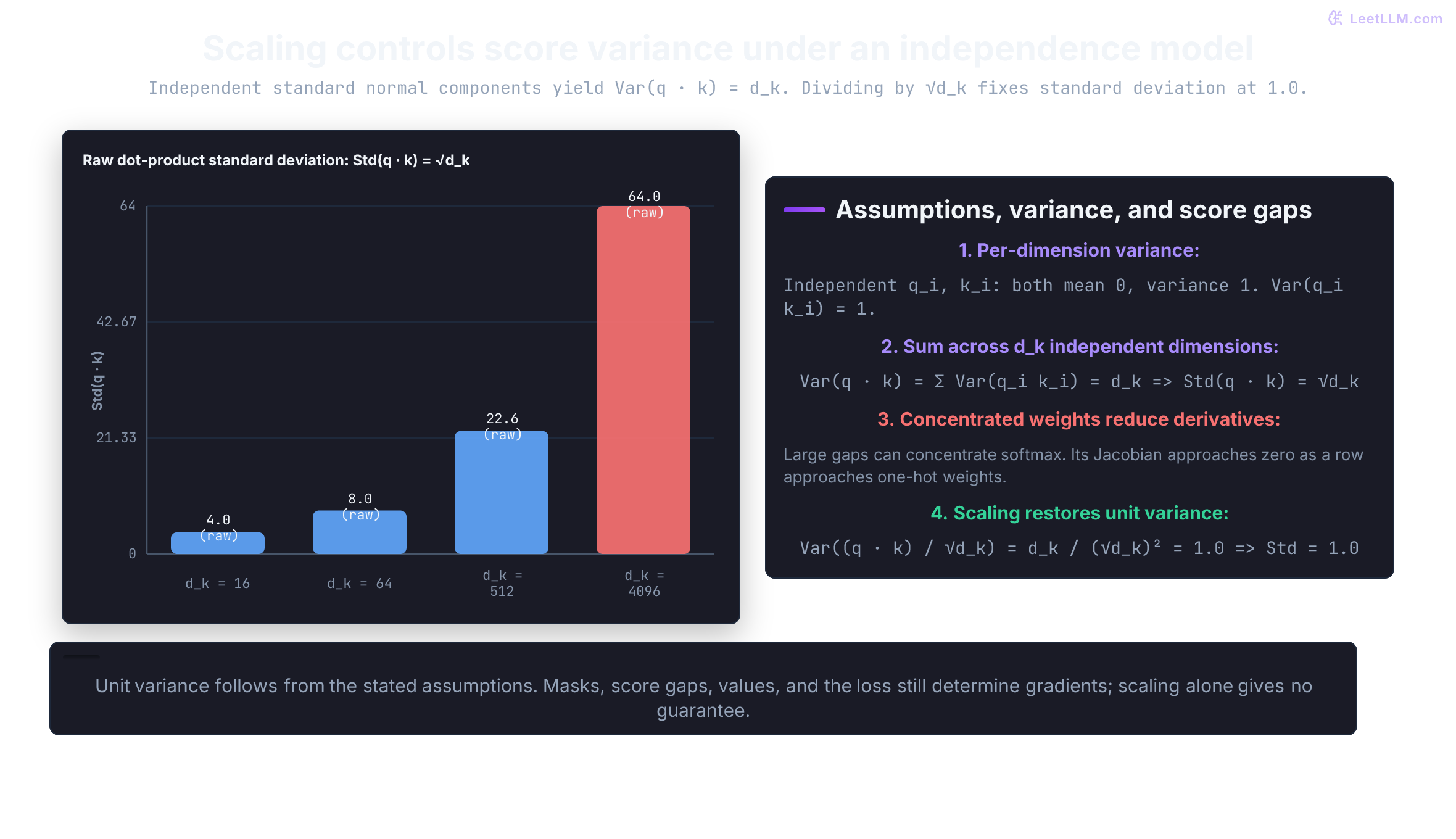
Verify the prediction in code. This experiment samples 5,000 independent unit-variance vector pairs across three head widths to confirm that raw standard deviation tracks while scaled standard deviation stays centered near 1.0:
import math
import random
import statistics

rng = random.Random(7)

def dot_products(width: int, samples: int = 5000) -> list[float]:
    return [
        sum(rng.gauss(0, 1) * rng.gauss(0, 1) for _ in range(width))
        for _ in range(samples)
    ]

for width in (16, 64, 512):
    raw = dot_products(width)
    raw_std = statistics.pstdev(raw)
    scaled_std = statistics.pstdev([x / math.sqrt(width) for x in raw])
print(f"d_k={width:3d}: raw std={raw_std:5.2f}, scaled std={scaled_std:4.2f}")d_k= 16: raw std= 4.07, scaled std=1.02
d_k= 64: raw std= 8.09, scaled std=1.01
d_k=512: raw std=22.39, scaled std=0.99The finite-sample values differ from the population prediction. In this independent Gaussian experiment, raw spread tracks and scaled spread stays near one; this isn't a measurement of a trained model's logits.
Why divide by instead of by ?
Answer
The raw dot product has variance , so its standard deviation is . Softmax sees the scale of logits through their standard deviation, so dividing by brings the variance back to 1. Dividing by would over-shrink the logits as dimensions grow.
Three types of attention
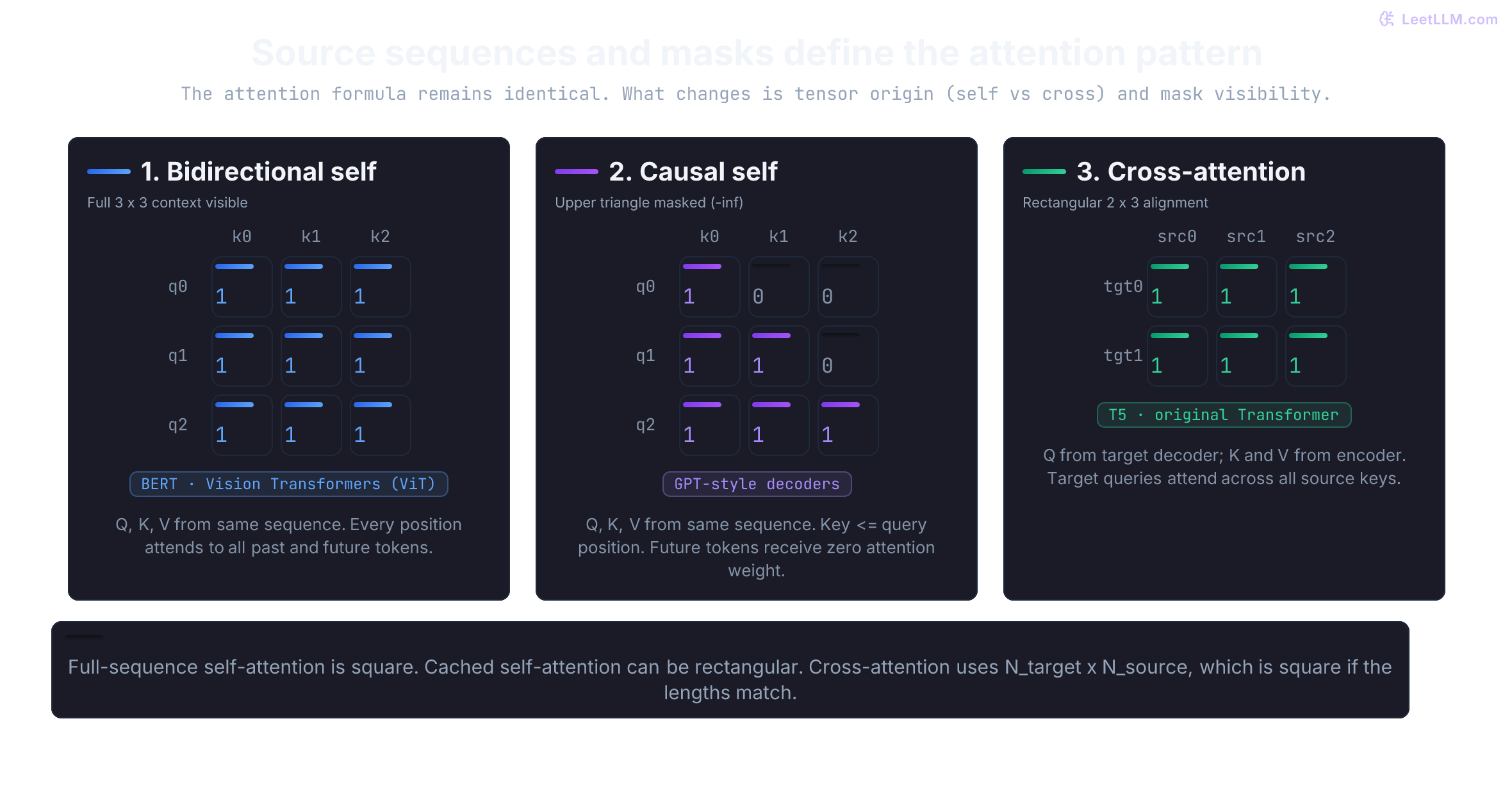
The formula doesn't decide who may read whom. The mask and the sources of , , and do.
Bidirectional attention lets every visible position read every other visible position. Causal attention allows only the current and earlier positions. Its training queries can be computed in parallel; generation adds tokens sequentially. Cross-attention lets a target sequence read from a separate source sequence, such as a decoder reading encoder states.
1. Bidirectional self-attention (encoder)
Every non-padding token may attend to every other non-padding token; there's no future-token mask. Encoder architectures such as BERT, and the Vision Transformer you'll meet next, use this pattern when the full input is already available:
"The cache grew quickly"
 Token "grew" attends to: [The, cache, grew, quickly]  (full context)
2. Causal self-attention (decoder)
Each token can only attend to itself and previous tokens. Future positions are masked with . Decoder architectures such as GPT-style and other autoregressive language models use this pattern for generation tasks where the model must predict the next token without seeing the future.
When processing a sequence step-by-step, the model progressively builds context but remains strictly blind to upcoming words:
"The cache grew quickly"
 Token "grew" attends to: [The, cache, grew]  (only past + self)
 Token "quickly" attends to: [The, cache, grew, quickly]  (full history)
The causal mask is a lower-triangular matrix that lets each position look only at itself and the positions before it. This minimal Python version takes the sequence length as input and outputs a boolean matrix where True indicates an allowed connection and False indicates a masked one.
def create_causal_mask(seq_len: int) -> list[list[bool]]:
    if type(seq_len) is not int or seq_len <= 0:
        raise ValueError("sequence length must be a positive integer")
    return [[key_pos <= query_pos for key_pos in range(seq_len)] for query_pos in range(seq_len)]

mask = create_causal_mask(4)
for row in mask:
    print(row)
print(mask[0] == [True, False, False, False])
print(mask[1] == [True, True, False, False])
print(mask[3] == [True, True, True, True])[True, False, False, False]
[True, True, False, False]
[True, True, True, False]
[True, True, True, True]
True
True
TrueWhy must token 0 be unable to attend to token 1 in causal self-attention?
Answer
During next-token training, token 0 is only allowed to use itself and earlier context. If it can attend to token 1, the model can leak the future answer during training. Loss can look good, but generation fails because that future token isn't available at inference time.
Cached queries need absolute positions
Before switching sequences, there's one subtle causal case: cached decoding. A new query at absolute position 4 may read keys at positions 0 through 4. Its local row index is 0, but that doesn't make it the first token of the sequence. A naive 1 x 5 lower triangle would incorrectly allow only key 0.
Use absolute positions when building a mask for a cache or a chunk of new tokens. This example also covers a two-token chunk starting at position 3:
def causal_positions(query_positions, key_positions):
    queries, keys = list(query_positions), list(key_positions)
    if any(type(p) is not int or p < 0 for p in queries + keys):
        raise ValueError("absolute positions must be nonnegative integers")
    return [[k <= q for k in keys] for q in queries]

single = causal_positions([4], range(5))
chunk = causal_positions([3, 4], range(5))
wrong_local_triangle = [[k <= 0 for k in range(5)]]
assert single == [[True] * 5]
assert chunk[0] == [True, True, True, True, False]
assert chunk[1] == single[0]
assert causal_positions([3, 4], iter(range(5))) == chunk
print("new query at position 4:", single[0])
print("chunk query at position 3:", chunk[0])
print("wrong local triangle:", wrong_local_triangle[0])new query at position 4: [True, True, True, True, True]
chunk query at position 3: [True, True, True, True, False]
wrong local triangle: [True, False, False, False, False]PyTorch documents is_causal=True as upper-left aligned for non-square attention. For an offset cache, supply the appropriate explicit mask with is_causal=False, or use a supported causal-bias representation with the required alignment. A single new query with only past/current, non-padding keys needs no additional causal restriction.[2]
Now combine two constraints: a query at absolute position 2 can read all three cached positions, but position 1 is padding. The correct allowed mask is [True, False, True]. Predict the context when the two visible keys have equal scores. Then compare SDPA with the inverse padding-mask convention in nn.MultiheadAttention.[3]
import math
import torch
import torch.nn.functional as F
from torch.nn.attention import SDPBackend, sdpa_kernel

# (batch, heads, queries/keys, width), already projected.
q = torch.tensor([[[[1.0, 0.0]]]], dtype=torch.float64)
k = torch.tensor([[[[1.0, 0.0], [0.0, 1.0], [1.0, 1.0]]]], dtype=torch.float64)
v = torch.tensor([[[[1.0, 0.0], [0.0, 1.0], [2.0, 2.0]]]], dtype=torch.float64)
allowed = torch.tensor([[True, False, True]])

# Pin the CPU math backend for this correctness check, not a GPU benchmark.
with sdpa_kernel(backends=[SDPBackend.MATH]):
    cached = F.scaled_dot_product_attention(q, k, v, attn_mask=allowed, dropout_p=0.0)
    upper_left = F.scaled_dot_product_attention(q, k, v, is_causal=True, dropout_p=0.0)

logits = (q @ k.transpose(-2, -1)) / math.sqrt(2)
reference = torch.softmax(logits.masked_fill(~allowed, -torch.inf), dim=-1) @ v
assert torch.allclose(cached, reference, atol=1e-12, rtol=1e-12)

# Identity projections make MHA's projected Q/K/V equal to the tensors above.
mha = torch.nn.MultiheadAttention(2, 1, dropout=0.0, bias=False,
                                batch_first=True, dtype=torch.float64).eval()
with torch.no_grad():
    identity = torch.eye(2, dtype=torch.float64)
    mha.in_proj_weight.copy_(torch.cat([identity] * 3))
    mha.out_proj.weight.copy_(identity)
    mha_output, _ = mha(q[0], k[0], v[0], key_padding_mask=~allowed, need_weights=False)

agrees = torch.allclose(mha_output, cached[0], atol=1e-12, rtol=1e-12)
assert agrees
print("explicit cached mask:", cached.flatten().tolist())
print("upper-left causal mask:", upper_left.flatten().tolist())
print("SDPA/MHA inverse masks agree:", agrees)explicit cached mask: [1.5, 1.0]
upper-left causal mask: [1.0, 0.0]
SDPA/MHA inverse masks agree: TrueThe upper-left mask reads only key 0 here. It doesn't encode the query's offset or the padding constraint. SDPA's boolean attn_mask uses True for allowed entries; MHA's boolean key_padding_mask and attn_mask use True for blocked entries. Don't pass both an explicit SDPA mask and is_causal=True; construct the combined allowed mask instead.[2][3]
Padding keys and padding queries are different
A key padding mask prevents every query from reading a padded source. It doesn't remove a padded query from the output. With left padding, a causal query at the first padded position may have no allowed key at all.
For a batch, combine visibility as causal AND key_valid AND query_valid. The key-valid tensor needs shape (B, 1, 1, Nk) to broadcast across heads and queries. The query-valid tensor needs (B, 1, Nq, 1). Passing a raw (B, Nk) mask can align the batch dimension with the query axis by accident.
Handle padded rows before an undefined softmax enters the computation. In this reference implementation, padded query rows temporarily receive zero logits, then their weights are explicitly replaced with zeros. Active rows still require a visible key. This avoids computing softmax([-inf, ...]) and hoping that multiplying its NaN output by zero will remove it.
For this padding test, change both real queries to [1, 0] and the real keys to [1, 0] and [1, 1]. Their scores now tie, isolating mask behavior from compatibility. Keep the original value vectors.
Predict the three output rows for the left-padded sequence [PAD, cache, grew]. The padded query should output zero, cache should read itself, and grew should mix the two real values equally:
import math
import torch
import torch.nn.functional as F
from torch.nn.attention import SDPBackend, sdpa_kernel

q = torch.tensor([[[[1., 0.], [1., 0.], [1., 0.]]]],
                 dtype=torch.float64, requires_grad=True)
k = torch.tensor([[[[9., 9.], [1., 0.], [1., 1.]]]],
                 dtype=torch.float64, requires_grad=True)
v = torch.tensor([[[[999., 999.], [2., 1.], [1., 2.]]]],
                 dtype=torch.float64, requires_grad=True)
valid = torch.tensor([[False, True, True]])  # (B, N)
positions = torch.arange(3)
causal = positions[None, :] <= positions[:, None]  # (Nq, Nk)
active = valid[:, None, :, None]  # (B, 1, Nq, 1)
allowed = causal[None, None] & valid[:, None, None, :] & active
assert ((~active) | allowed.any(dim=-1, keepdim=True)).all()
assert all(torch.isfinite(t).all() for t in (q, k, v))

logits = (q @ k.transpose(-2, -1)) / math.sqrt(q.shape[-1])
masked = logits.masked_fill(~allowed, -torch.inf)
safe_logits = torch.where(active, masked, torch.zeros_like(masked))
weights = torch.softmax(safe_logits, dim=-1).masked_fill(~active, 0.)
context = weights @ v

# Compare only active queries, whose rows define valid distributions.
with sdpa_kernel(backends=[SDPBackend.MATH]):
    library = F.scaled_dot_product_attention(
        q[:, :, 1:], k, v, attn_mask=allowed[:, :, 1:], dropout_p=0.)
torch.testing.assert_close(context[:, :, 1:], library)
context[..., 0].sum().backward()
assert all(torch.isfinite(t.grad).all() for t in (q, k, v))
assert torch.equal(q.grad[:, :, 0], torch.zeros_like(q.grad[:, :, 0]))
assert torch.equal(k.grad[:, :, 0], torch.zeros_like(k.grad[:, :, 0]))
assert torch.equal(v.grad[:, :, 0], torch.zeros_like(v.grad[:, :, 0]))
print("weight row sums:", weights.sum(dim=-1).flatten().tolist())
print("context:", context.detach()[0, 0].tolist())
print("active rows match SDPA and padding gradients are zero")weight row sums: [0.0, 1.0, 1.0]
context: [[0.0, 0.0], [2.0, 1.0], [1.5, 1.5]]
active rows match SDPA and padding gradients are zeroThe padded row has sum zero because it is deliberately suppressed, not a probability distribution. Keep its loss excluded too. This reference materializes scores for clarity. Production implementations can skip padded queries instead. Keep all Q/K/V entries finite, including padding: masking scores doesn't repair NaN values, and 0 * NaN is NaN.
3. Cross-attention (encoder-decoder)
Queries come from one sequence, Keys and Values from another. The original Transformer uses this pattern in its decoder: encoder outputs provide keys and values, while current decoder states provide queries.[1]
The resulting weights choose which source positions contribute to each target representation:
Encoder output (source): "cache memory pressure"   provides K, V
Decoder state (target):  "decode slows ___"        provides Q

Q from decoder times K from encoder gives attention weights
Weights times V from encoder give decoder context
In an offline encoder-decoder model, cross-attention usually applies a source padding mask so decoder tokens don't attend to padded encoder positions. It generally doesn't need a causal source mask, because the encoder has already seen the whole source. Streaming systems can impose additional availability constraints.
Full-sequence self-attention produces a square query-by-key matrix. Cached self-attention and cross-attention can both be rectangular. Two target queries reading three source positions produce a 2 x 3 routing matrix.
import math

decoder_queries = [[1.0, 0.0], [0.0, 1.0]]
encoder_keys = [[1.0, 0.0], [0.2, 0.8], [0.0, 1.0]]
encoder_values = [[1.0, 0.0], [0.5, 0.5], [0.0, 1.0]]

def softmax(row: list[float]) -> list[float]:
    exps = [math.exp(x - max(row)) for x in row]
    return [value / sum(exps) for value in exps]

logits = [
    [sum(q_i * k_i for q_i, k_i in zip(q, k)) / math.sqrt(2) for k in encoder_keys]
    for q in decoder_queries
]
weights = [softmax(row) for row in logits]
context = [
    [sum(weight * value[d] for weight, value in zip(row, encoder_values)) for d in range(2)]
    for row in weights
]

print(f"routing shape: {len(weights)} x {len(weights[0])}")
print("row sums:", [round(sum(row), 3) for row in weights])
print("context:", [[round(x, 3) for x in row] for row in context])routing shape: 2 x 3
row sums: [1.0, 1.0]
context: [[0.623, 0.377], [0.393, 0.607]]| Attention Type | Q Source | K, V Source | Mask | Architecture |
|---|---|---|---|---|
| Bidirectional Self | Same sequence | Same sequence | Padding mask only (if needed) | BERT, Vision Transformer (ViT) |
| Causal Self | Same sequence | Same sequence | Lower-triangular, plus padding if needed | GPT, Llama |
| Cross | Target sequence | Source sequence | Source padding mask common | T5, original Transformer |
Multi-head attention
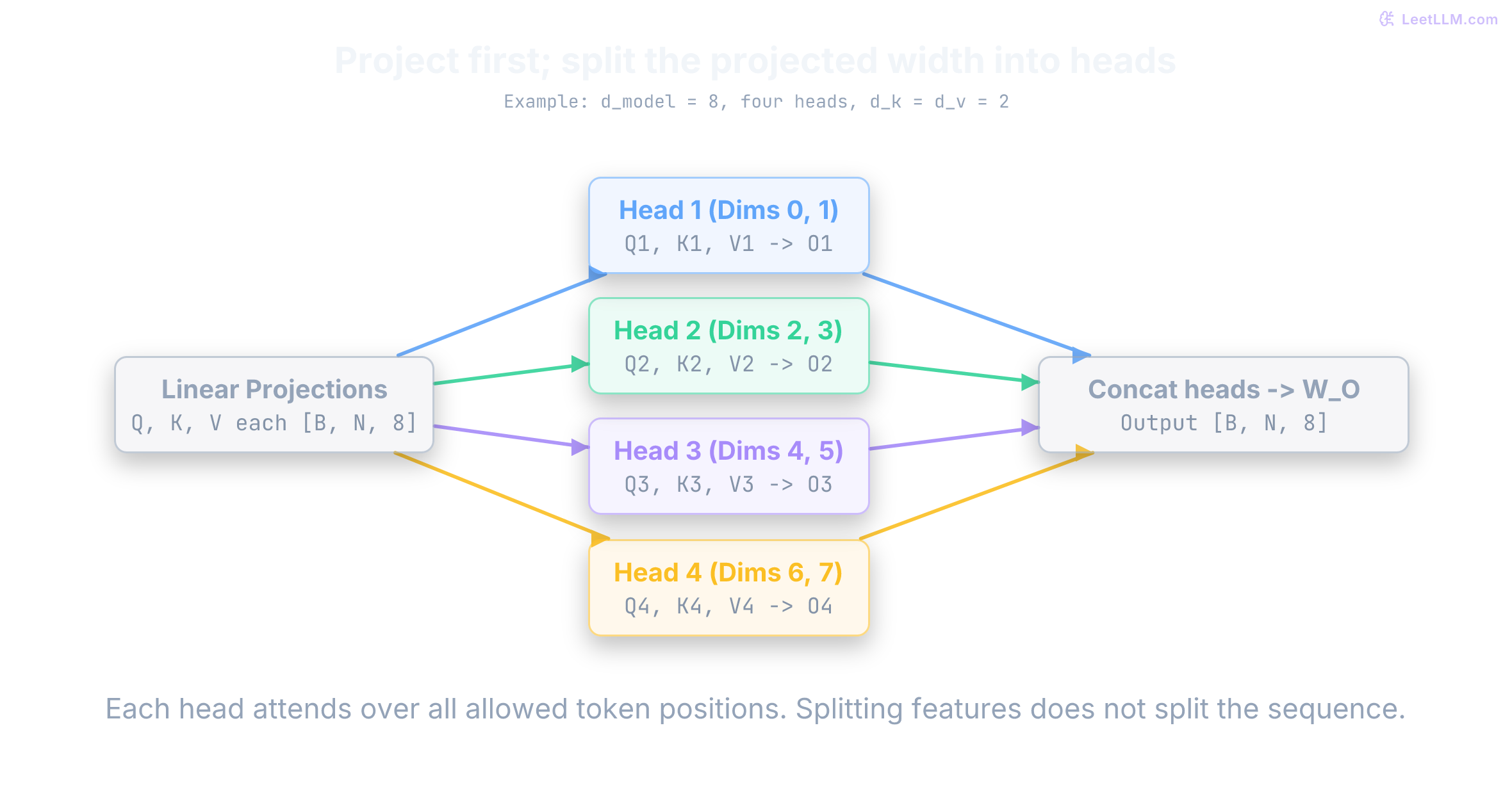
A single attention head constructs one distribution over keys for each query token. Multiple heads let the same token use several distributions at once. For example, one distribution might emphasize nearby positions while another emphasizes an earlier noun. These are possible learned patterns, rather than tasks assigned to particular head numbers.
Multi-Head Attention (MHA) uses separately parameterized sets of projections. A common choice is .[1] In self-attention, each head computes:
Here and . The heads are trained jointly and their outputs can correlate; separate projections don't imply statistically independent or orthogonal features. Studies have found positional and syntactic patterns in some translation heads, and copy-like induction circuits in other tested models.[4][5] A heatmap showing a pronoun attending to a noun is a clue to investigate, not proof that the head performs coreference resolution.
The head outputs concatenate to width . The output projection has shape ; it is square in the common case :
is a learned linear mixture into the residual stream. It isn't constrained to be a rotation, preserve distances, or keep head contributions separate.
What do attention heads learn?
These interpretability results are evidence about specific trained models, not a promise about every transformer. Voita et al. found positional and syntactic patterns among heads in neural machine translation encoders.[4]
Michel et al. found head redundancy in their tested WMT translation model and fine-tuned BERT.[6] Olsson et al. presented causal evidence for induction-head effects in small attention-only models and correlational evidence in larger models with MLPs. Their broader explanation of in-context learning remains a hypothesis.[5]
| Result from a study | Useful inference | Unsafe inference |
|---|---|---|
| Some heads show consistent patterns | Inspect heads when debugging or researching a trained model | Every head has a named human-readable purpose |
| Some tested models tolerate head pruning | Redundancy can exist and can be measured | Arbitrarily deleting heads preserves a new model's quality |
| Induction-head circuits can emerge | Attention can implement copy-like sequence algorithms | An attention heatmap alone proves causal model behavior |
Same asymptotic attention FLOPs
Multi-head attention doesn't increase the asymptotic cost of the attention core when you keep fixed. It restructures the work.
With , single-head attention on width 512 uses the same leading-order matrix-product FLOPs (Floating Point Operations) as 8-head attention with . Both query/key and value widths matter to that comparison.
The dense Q/K/V and output projections still cost either way.
Predict before running the arithmetic: with fixed , one 512-wide head and eight 64-wide heads should do the same leading score-and-value work. Splitting a fixed width into more heads doesn't change the total number of score-and-value multiply-adds in the attention core:
seq_len = 2048
d_model = 512

for heads in (1, 8, 16):
    d_head = d_model // heads
    score_and_value_work = 2 * heads * seq_len**2 * d_head
print(f"heads={heads:2d}, d_head={d_head:3d}, core MACs={score_and_value_work:,}")heads= 1, d_head=512, core MACs=4,294,967,296
heads= 8, d_head= 64, core MACs=4,294,967,296
heads=16, d_head= 32, core MACs=4,294,967,296The count above is multiply-accumulate operations (MACs) for the two matrix products; counting multiplication and addition separately gives roughly twice as many FLOPs. More heads still mean more softmax rows and, if materialized, more score matrices. Equal leading matmul work doesn't promise equal runtime or memory.
After each dense Q/K/V projection to width , split that projected width into heads. This example uses distinct coordinate labels so a wrong reshape can't hide behind zeros. It tests only the split/merge layout, not the learned projection or attention itself:
B, N, D, n_heads = 2, 3, 8, 4
d_k = D // n_heads
assert D % n_heads == 0

projected = [[[100 * b + 10 * n + d for d in range(D)] for n in range(N)] for b in range(B)]
# (B, N, D) -> (B, h, N, d_k)
heads = [
    [[projected[b][n][h * d_k:(h + 1) * d_k] for n in range(N)] for h in range(n_heads)]
    for b in range(B)
]
# (B, h, N, d_k) -> (B, N, D)
concat = [
    [
        [coord for head in range(n_heads) for coord in heads[b][head][n]]
        for n in range(N)
    ]
    for b in range(B)
]
print("input shape:", (B, N, D))
print("head shape:", (len(heads), len(heads[0]), len(heads[0][0]), len(heads[0][0][0])))
assert concat == projected
assert heads[1][2][1] == [114, 115]
print("batch 1, head 2, token 1:", heads[1][2][1])
print("every coordinate restored:", concat == projected)input shape: (2, 3, 8)
head shape: (2, 4, 3, 2)
batch 1, head 2, token 1: [114, 115]
every coordinate restored: TrueGradient flow through attention
For one query with attention-weight dropout disabled, write , where and . Substituting the softmax derivative into the weighted sum gives a useful interpretation:[7]
Increasing a key's score pulls the output toward that key's value, away from the current mixture. If its value already equals the mixture, changing its weight does nothing.
For a scalar loss with upstream gradient , let . The three paths are:
For the grew row, take the toy loss , the output's first coordinate. Cache has first value coordinate 2, grew has 1, and the mixture is about 1.421. Raising cache's score increases the loss; raising grew's score decreases it. This isn't a useful training objective by itself, just a derivative we can check exactly.
The next cell reuses the attention function and compares its analytic query gradient with central finite differences:
q = [0.5, 1.0]
out, weights = scaled_dot_product_attention([q], K, V)
a = weights[0]
o = out[0]
r = [a[j] * (V[j][0] - o[0]) for j in range(len(K))]
analytic = [sum(r[j] * K[j][d] for j in range(len(K))) / math.sqrt(2) for d in range(2)]

def loss(query):
    return scaled_dot_product_attention([query], K, V)[0][0][0]

epsilon = 1e-5
numeric = []
for d in range(2):
    plus, minus = q.copy(), q.copy()
    plus[d] += epsilon
    minus[d] -= epsilon
    numeric.append((loss(plus) - loss(minus)) / (2 * epsilon))
assert max(abs(x - y) for x, y in zip(analytic, numeric)) < 1e-9
assert abs(sum(r)) < 1e-12  # Shifting every score equally changes nothing.
print("output:", [round(x, 4) for x in o])
print("query gradient:", [round(x, 5) for x in analytic])
print("finite differences match:", all(abs(x - y) < 1e-9 for x, y in zip(analytic, numeric)))output: [1.4211, 1.5789]
query gradient: [0.08619, -0.12066]
finite differences match: TrueWith only one allowed key, its weight is exactly 1 and its value equals the output: all routing gradients for that query are zero. The value path still receives . A saturated row approaches this behavior; the scale factor helps avoid accidental saturation, but can't create a routing choice where the mask permits none.
Implement softmax backward without a Jacobian
The Jacobian formula is useful for derivation, but allocating an derivative matrix for every row is unnecessary. Let be the upstream gradient into a softmax row. Multiplying it by the Jacobian simplifies to one row reduction:[7]
Each logit gradient compares its upstream gradient with the attention-weighted average. The gradients sum to zero because increasing all logits equally cannot change softmax. A blocked key with weight zero also gets logit gradient zero.
For attention, , so the average is . This recovers from the previous derivation. Across all queries, value gradients add together as , where contains the output gradients.
This cell implements the row reduction and compares it with PyTorch autograd. The upstream gradient of 99 on the blocked third key deliberately tests that masking blocks its gradient too:
import torch

z = torch.tensor([[0., 0., 5.]], dtype=torch.float64, requires_grad=True)
allowed = torch.tensor([[True, True, False]])
a = torch.softmax(z.masked_fill(~allowed, -torch.inf), dim=-1)
upstream = torch.tensor([[2., 1., 99.]], dtype=torch.float64)
manual = a * (upstream - (a * upstream).sum(dim=-1, keepdim=True))
(a * upstream).sum().backward()
torch.testing.assert_close(manual, z.grad)
assert torch.allclose(manual.sum(dim=-1), torch.zeros(1, dtype=z.dtype))
assert z.grad[0, 2] == 0
print("weights:", a.detach().flatten().tolist())
print("logit gradients:", z.grad.flatten().tolist())
print("manual backward matches autograd")weights: [0.5, 0.5, 0.0]
logit gradients: [0.25, -0.25, 0.0]
manual backward matches autogradDon't substitute the cross-entropy shortcut here. That expression requires a particular loss on softmax probabilities. Attention generally receives gradients through its value mixture, so its upstream vector comes from .
Complexity analysis
There are two bottlenecks to keep separate: quadratic query-key pairs and width-heavy projections. Big-O notation describes how work or storage grows as sequence length and model width increase.
It hides constant factors, so use it for growth trends and use concrete byte/FLOP arithmetic for capacity planning.
| Metric | Complexity | Explanation |
|---|---|---|
| Time (attention core, single head) | uses key width; uses value width | |
| Time (attention core, full multi-head) | With | |
| Time (Q/K/V + output projections) | Dense linear layers before and after the attention core | |
| Memory (naive weights) | per head | The score or weight matrix is |
| Parameters | For the common total projection width |
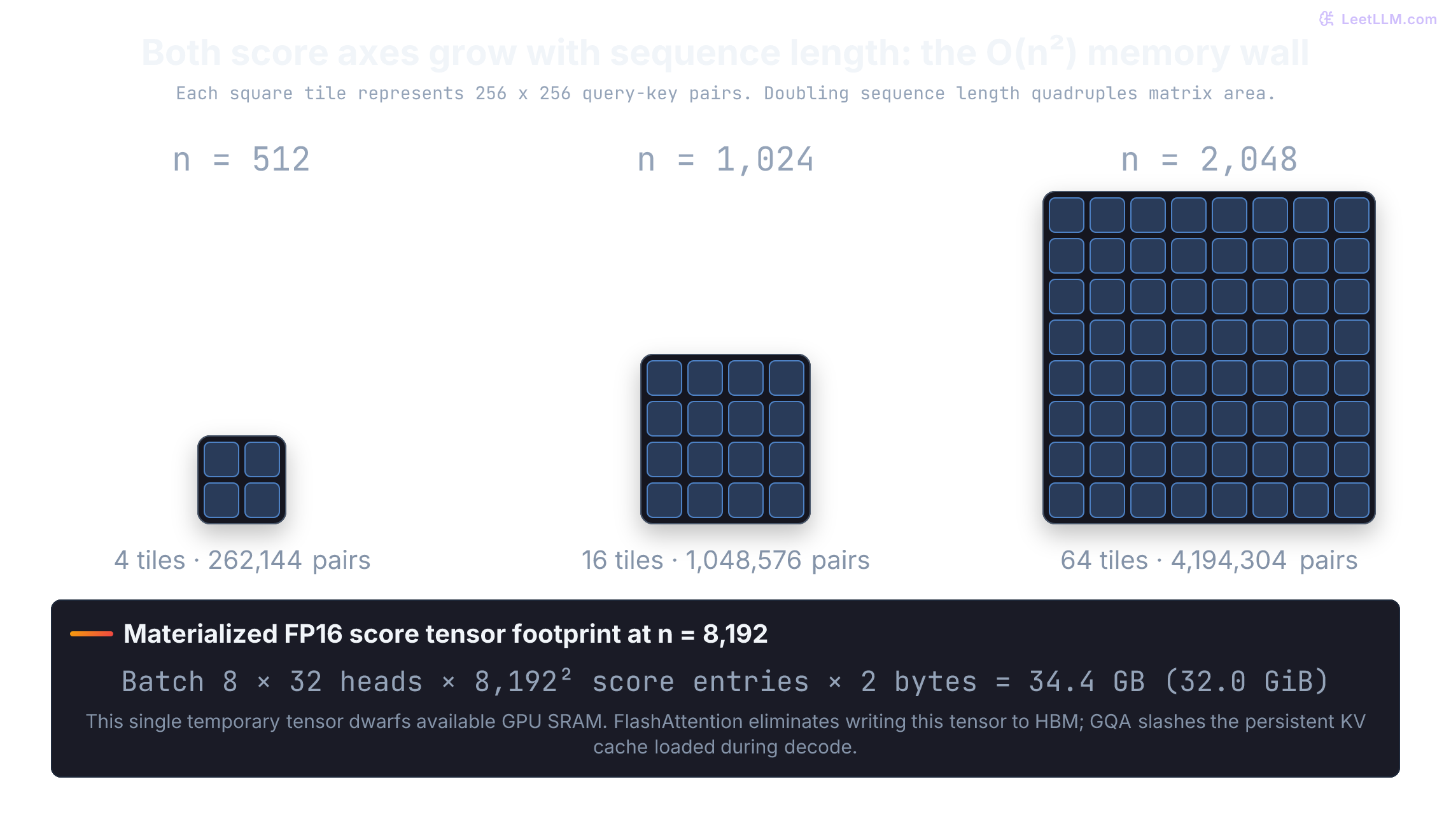
Concrete memory example
Batch of 8, 32 heads, , FP16 (16-bit floating point format):
How the numbers work
8 sequences in the batch x 32 attention heads x 8192² entries per attention map x 2 bytes per number (FP16) = about 34.4 GB of raw storage, or about 32 GiB, for one attention-score tensor before values needed for backpropagation, model weights, or optimizer state.
batch = 8
heads = 32
seq_len = 8192
bytes_per_fp16 = 2

bytes_total = batch * heads * seq_len**2 * bytes_per_fp16
gb = bytes_total / 1_000_000_000
gib = bytes_total / 1024**3

print(round(gb, 1), "GB")
print(round(gib, 1), "GiB")
print(round(gb, 1) == 34.4, round(gib, 1) == 32.0)34.4 GB
32.0 GiB
True TrueIn the naive formulation, temporary memory becomes a bottleneck for long sequences. Doubling sequence length makes one materialized score tensor four times larger. Fused kernels can avoid storing that full tensor, but exact dense attention still computes interactions across all query-key pairs.
If sequence length grows from 512 to 2048, why does naive attention memory grow by 16x instead of 4x?
Answer
The attention score matrix is . Increasing by 4x makes the matrix , which has 16x as many entries. This is the core quadratic memory wall.
Training vs. inference bottlenecks
Two attention workloads stress memory differently; model weights and other operations can also dominate:
- During training (or prompt prefill): All tokens are processed together. A naive implementation materializes the entire attention score matrix in GPU high-bandwidth memory (HBM), creating an memory wall.
- During autoregressive decoding: The model generates one token at a time. The query sequence length is just , so attention is a vector-matrix operation. The memory problem isn't score matrix storage; it's repeatedly loading the accumulated KV cache (all past keys and values) from HBM to on-chip SRAM for every single generated token.[8]
Head architectures: MHA, MQA, and GQA
To attack this decode bandwidth bottleneck, modern transformers modify how query heads route to key and value heads:
- Multi-Head Attention (MHA): query heads pair with key and value heads. Each head has separate K/V projections; raw cache payload scales with .
- Multi-Query Attention (MQA): query heads share one key head and one value head (). For fixed widths, precision, and cached lengths, raw cache payload shrinks by . Shazeer's tested translation models traded a small quality loss for faster decoding; that experiment doesn't establish a universal effect on reasoning or multilingual tasks.[8]
- Grouped-Query Attention (GQA): Each group of query heads shares one K/V head, with and divisible by . Intermediate group counts trade sharing against separate K/V projections; MQA and MHA are the endpoints. Ainslie et al. uptrained T5 checkpoints and found quality close to MHA on their tested tasks. Their results aren't a guarantee for every model.[9] As a concrete architecture, Llama 3.1 70B uses 64 query heads and 8 KV heads.[10]
Changing the head layout requires a checkpoint trained or uptrained for it. You can't turn an arbitrary MHA checkpoint into equivalent GQA by reshaping its cache. GQA also retains query distributions; it doesn't divide dense query-key interactions or a materialized score tensor by the KV sharing ratio.
Count the raw KV payload first
For identical layers, equally long cached sequences, equal key/value width , and bytes per stored coordinate, the raw dense payload is:
Breaking down every variable in the equation:
- : Stores both Key and Value tensors.
- : Number of transformer layers in the model.
- : Number of Key/Value heads ( in MHA, in MQA, in GQA).
- : Key and value width in this equal-width calculation.
- : Context sequence length (prompt tokens plus generated tokens).
- : Batch size (number of concurrent requests being served).
- : Bytes per coordinate ( for FP16/BF16, for FP8). Packed INT4 has an ideal bytes per coordinate before scales, metadata, and padding.
If widths differ, replace with . If cached lengths differ by request or layer, sum their payloads rather than pretending every slot is occupied equally. Actual device memory also includes page or allocator slack, quantization metadata, possible replicated shards, model weights, and working space.
Use the Llama 3.1 70B dimensions (, , ) for a hypothetical layout comparison, with , , and two-byte coordinates. The GQA row matches its head counts; the MHA and MQA rows are alternative shapes, not equivalent released checkpoints.[10]
| Layout | Ratio | Raw cache payload | What this establishes | ||
|---|---|---|---|---|---|
| MHA | 64 | 64 | 1:1 | 343.6 GB (320.0 GiB) | Cache alone exceeds 320 GB |
| GQA | 64 | 8 | 8:1 | 42.9 GB (40.0 GiB) | 8x less payload; total model fit still needs a budget |
| MQA | 64 | 1 | 64:1 | 5.4 GB (5.0 GiB) | 64x less payload; quality requires a trained model and evaluation |
The decode memory-bandwidth bottleneck
Why can a smaller cache accelerate decode? Each query head performs two products: scoring against K and mixing V. Counting a multiplication and addition as two FLOPs gives approximately FLOPs. With , that's , while reading one FP16 K/V head once transfers bytes.
The arithmetic intensity is:
If a grouped kernel reuses each loaded K/V head across its query group, the idealized ratio is:
For FP16, that is 1 FLOP/byte for MHA and 8 for an 8:1 GQA layout. This counts only the two attention products and one K/V read, excluding softmax, projections, other transfers, and repeated loads. A backend that expands shared K/V heads can lose the reuse benefit.
In a roofline estimate, achievable FLOPs/s is bounded by the smaller of compute capacity and bandwidth times arithmetic intensity. For illustrative capacities of 312 TFLOPs/s and 2 TB/s, the crossover is 156 FLOPs/byte. That suggests this simplified decode core is bandwidth constrained; it doesn't measure idle cycles or predict an 8x end-to-end speedup. Batch size, kernel reuse, other layers, and communication still matter.
Count raw payload and idealized core intensity together. This smaller fixture has one request, 32 layers, and 32 query heads; its GQA sharing ratio is 4:1:
layers = 32
tokens = 8192
head_dim = 128
bytes_per_value = 2  # FP16

def cache_gib(kv_heads: int) -> float:
    bytes_total = layers * tokens * kv_heads * head_dim * 2 * bytes_per_value
    return bytes_total / 1024**3

mha = cache_gib(32)
for label, kv_heads in [("MHA", 32), ("GQA", 8), ("MQA", 1)]:
    size = cache_gib(kv_heads)
    print(f"{label}: kv_heads={kv_heads:2d}, cache={size:.3f} GiB, reduction={mha / size:.0f}x")
    core_flops = 4 * tokens * 32 * head_dim  # scoring AND value mixing, one layer
    kv_bytes = 2 * tokens * kv_heads * head_dim * bytes_per_value
print(f" idealized core intensity={core_flops / kv_bytes:.0f} FLOPs/byte")MHA: kv_heads=32, cache=4.000 GiB, reduction=1x
idealized core intensity=1 FLOPs/byte
GQA: kv_heads= 8, cache=1.000 GiB, reduction=4x
idealized core intensity=4 FLOPs/byte
MQA: kv_heads= 1, cache=0.125 GiB, reduction=32x
idealized core intensity=32 FLOPs/byteFlashAttention and MQA/GQA target different bottlenecks. FlashAttention cuts temporary attention I/O during prompt processing and training, while MQA/GQA cut persistent KV-cache size during decoding.
Which optimization reduces temporary attention-matrix I/O, and which reduces persistent KV-cache bandwidth during decoding?
Answer
FlashAttention reduces temporary attention-matrix I/O by tiling attention and avoiding materializing the full matrix. MQA and GQA reduce persistent KV-cache bandwidth by sharing or grouping key/value heads during autoregressive decoding.
Softmax numerical stability
The two-token walkthrough already subtracted the row max before exp. That isn't a style choice.
Naive softmax overflows: grows so fast that a large positive logit becomes Inf, and Inf / Inf is NaN. Attention kernels need a stable form so large but valid scores don't corrupt routing weights.
The max-shift technique
Subtract the maximum value from the input vector before exponentiating:
Before running the example, predict what stays invariant: shifting by its maximum changes the numbers sent to exp, not the relative probabilities. The largest shifted logit should receive the largest weight, and the row should still sum to 1.
Subtracting shifts every logit by the same constant. That constant factors out of the exponentials and cancels between numerator and denominator, so the probabilities don't change.
For finite input logits, the largest exponent is , which blocks positive overflow. Very small terms can still underflow to zero, losing their tiny probability and gradient contributions. Max-shifting doesn't repair non-finite inputs or prevent a genuinely concentrated distribution.[11]
Online softmax (Milakov and Gimelshein, 2018) extends the same identity to a streaming pass. It tracks a running maximum and a running sum of exponentials, then rescales the sum when a larger maximum appears. That's the algebra FlashAttention uses to tile a query row without storing every score.[11]
import math

def stable_softmax(logits: list[float]) -> list[float]:
    shift = max(logits)
    exps = [math.exp(x - shift) for x in logits]
    total = sum(exps)
    return [x / total for x in exps]

probs = stable_softmax([1000.0, 1001.0, 999.0])
print([round(p, 4) for p in probs])
print(round(sum(probs), 6))
print(probs[1] == max(probs))[0.2447, 0.6652, 0.09]
1.0
TrueOverflow can happen before softmax
Max-shifting assumes the logits are still usable numbers. A manually materialized FP16 score can overflow during Q @ K.T, even when Q and K are finite. Casting that damaged result to FP32 before softmax preserves the infinity. Recompute the product in a wider type instead.
This CPU example uses head width 1 so scaling cannot obscure the failure. The exact scores are [90000, 0]. Check which operation first becomes non-finite, then compare casting after the product with casting before it:
import torch

q = torch.tensor([[300.]], dtype=torch.float16)
k = torch.tensor([[300.], [0.]], dtype=torch.float16)
half_scores = q @ k.T
late_cast = torch.softmax(half_scores.float(), dim=-1)
wide_scores = q.float() @ k.float().T
wide_weights = torch.softmax(wide_scores, dim=-1)
assert torch.isfinite(q).all() and torch.isfinite(k).all()
assert not torch.isfinite(half_scores).all()
assert not torch.isfinite(late_cast).all()
assert torch.isfinite(wide_weights).all()
print("FP16 scores:", half_scores.flatten().tolist())
print("late FP32 cast repairs weights:", torch.isfinite(late_cast).all().item())
print("FP32 recomputation:", wide_weights.flatten().tolist())FP16 scores: [inf, 0.0]
late FP32 cast repairs weights: False
FP32 recomputation: [1.0, 0.0]The repaired row is still saturated: [1, 0] reflects the huge score gap. Finite weights and useful routing gradients are separate checks. PyTorch documents FP32 intermediates for its SDPA math backend with FP16/BF16 inputs, so this manual materialization example doesn't predict every fused kernel's behavior.[2]
When debugging NaN attention, inspect Q/K/V finiteness, the scores before masking, and allowed-key counts before inspecting softmax. An invalid mask, score overflow, and a valid but concentrated distribution require different fixes.
FlashAttention: tiled exact attention
For long sequences, a materialized score matrix can become a major memory cost. It's an intermediate on the way to , so an implementation can compute the final output without storing the full matrix.
FlashAttention (Dao et al., 2022) uses tiling and recomputation to avoid writing the full score or probability matrix to high-bandwidth memory (HBM). Additional row statistics scale linearly with sequence length; Q, K, V, and the output still occupy their own storage. The computation remains dense attention, with floating-point differences rather than a sparse or low-rank approximation.[7]
As of October 10, 2026, the official repository also provides FlashAttention-4 in CuTe DSL for Hopper and Blackwell. The identity below explains the shared foundation. A call to framework SDPA doesn't establish that it uses this particular implementation.[12]
The GPU memory hierarchy bottleneck
The useful distinction is where intermediate data lives:
- HBM: Large device memory holding tensors that many compute blocks can access. Repeatedly writing and reading a quadratic intermediate costs bandwidth.
- On-chip shared memory and registers: Much smaller storage used by active compute blocks. Tiles must fit the resources available to those blocks; adding up SRAM across the whole GPU doesn't make it one shared tile buffer. GPU cores perform the arithmetic on these operands.
Consider a materializing implementation with three logical stages. Actual kernel counts also depend on scaling, masking, dropout, and fusion:
- Matrix multiplication 1: Reads and from HBM, computes raw scores , and writes the full tensor back to HBM ( write).
- Softmax kernel: Reads from HBM, computes , and writes back to HBM ( read and write).
- Matrix multiplication 2: Reads and from HBM, computes , and writes to HBM ( read).
Those score and probability reads and writes can dominate time even when the matrix products are efficient. A percentage of stalled cycles requires profiling a specific workload; the logical operation count doesn't tell you that percentage.
SRAM tiling and the online softmax trick
The forward computation fuses the stages using two core ideas:[7][11]
Here take and suppress batch/head axes to keep the tile shapes readable.
- SRAM Tiling: Instead of processing full sequences, FlashAttention partitions into blocks and streams blocks of sized to fit entirely within on-chip SRAM.
- Online Softmax Rescaling: Standard softmax requires computing the maximum over the entire sequence before evaluating exponentials. Online softmax (Milakov and Gimelshein, 2018) updates the row maximum and normalizer incrementally as blocks stream through SRAM.
To understand the identity, follow one query block while K/V blocks stream past it. Implementations can choose different loop orders and locations for saved state. The active block maintains:
- : the running maximum of dot-product scores.
- : the running sum of exponentials (the softmax normalizer).
- : the running weighted-value output accumulator.
When a new key-value block arrives with local scores and local row maximum :
When all key-value blocks have streamed through, the exact output vector is:
Initialize , , and . Skip an empty or entirely masked tile before applying the update: its local maximum would otherwise be , making undefined. A valid query must encounter at least one allowed key across all tiles.
Transient score and probability tiles are consumed on chip. The full matrices are never materialized in HBM. This removes quadratic score storage, not the quadratic number of dense query-key interactions.
Backward pass recomputation
A conventional backward implementation can save the probability matrix from the forward pass. That consumes quadratic memory; saving it isn't a mathematical requirement of backpropagation.
FlashAttention saves Q, K, V, the output, and linear row statistics needed for backward, rather than saving the full . Depending on the implementation, statistics may be stored as a maximum and normalizer or their log-sum-exp equivalent. Backward reloads the saved tensors and recomputes score and probability tiles on chip.[7]
Recomputation adds arithmetic while reducing HBM traffic. The original paper's experiments show how doing extra arithmetic can reduce elapsed time by avoiding large memory transfers.[7] That benefit depends on the device, dimensions, precision, mask, dropout, and comparison implementation. For a local measurement, record those conditions, time forward and backward separately, and compare outputs and gradients with a reference before interpreting the speedup.
| Property | Standard attention | FlashAttention |
|---|---|---|
| Additional saved attention state | probabilities per head in HBM | row statistics per head in HBM |
| HBM memory traffic | Writes and rereads large score matrices | Keeps tiles on chip; zero score I/O |
| Mathematical precision | Baseline | Exact (identical math up to FP rounding) |
| Backward pass | Reads saved from HBM | Recomputes tiles using on-chip working storage |

The streaming identity works identically on scalars or matrix tiles. In this example, the first tile contains score 1000 and value 2; the second contains scores 1001 and 999, with values 1 and 4:
import math

def online_attention(tiles):
    maximum, total, numerator = -math.inf, 0.0, 0.0
    for logits, values in tiles:
        logits, values = list(logits), list(values)
        if len(logits) != len(values):
            raise ValueError("each tile needs one value per logit")
        if any(math.isnan(x) or x == math.inf for x in logits):
            raise ValueError("logits must be finite or masked -inf")
        if any(not math.isfinite(v) for v in values):
            raise ValueError("values must be finite")
        if not logits or max(logits) == -math.inf:
            continue  # no contribution; avoids -inf - (-inf)
        updated_max = max(maximum, max(logits))
        correction = math.exp(maximum - updated_max)
        weights = [math.exp(x - updated_max) for x in logits]
        total = correction * total + math.fsum(weights)
        try:
            numerator = math.fsum([correction * numerator] +
                                  [w * v for w, v in zip(weights, values, strict=True)])
        except OverflowError as error:
            raise ValueError("weighted accumulator overflowed") from error
        if not math.isfinite(total) or not math.isfinite(numerator):
            raise ValueError("attention accumulator overflowed")
        maximum = updated_max
    if total == 0:
        raise ValueError("query needs at least one allowed key across all tiles")
    return numerator / total

scores, values = [1000.0, 1001.0, 999.0], [2.0, 1.0, 4.0]
exps = [math.exp(s - max(scores)) for s in scores]
full = sum(w * v for w, v in zip(exps, values)) / sum(exps)
split = online_attention([(scores[:1], values[:1]), (scores[1:], values[1:])])
reversed_tiles = online_attention([(scores[1:], values[1:]), (scores[:1], values[:1])])
assert abs(split - full) < 1e-12
assert abs(reversed_tiles - full) < 1e-12
with_blocked_tile = online_attention([([-math.inf], [20.0]), (scores, values)])
assert abs(with_blocked_tile - full) < 1e-12
print("full-row output:", round(full, 6))
print("two-tile output:", round(split, 6))
print("tile order agrees within tolerance:", abs(reversed_tiles - full) < 1e-12)
print("leading masked tile is skipped:", abs(with_blocked_tile - full) < 1e-12)full-row output: 1.51482
two-tile output: 1.51482
tile order agrees within tolerance: True
leading masked tile is skipped: TrueThe cell accepts finite logits or masked , requires matching finite values, and skips empty or entirely blocked tiles. It rejects a query with no allowed key and arithmetic that overflows its scalar accumulator. Even when the normalized answer would be representable, an unnormalized accumulator can overflow; a production kernel's precision strategy still matters.
You can use this through framework primitives without writing a custom CUDA kernel. Check which backend actually runs before attributing a speedup to FlashAttention.[2]
Mistakes that break attention
| Mistake | Symptom | Fix |
|---|---|---|
| Forgetting the K transpose | Shape error, or silently wrong scores when dimensions coincide | Compute Q @ K.transpose(-2, -1); expect shape (B, h, Nq, Nk). |
| Skipping scaling | Score spread rises with head width under the initialization model; attention may saturate | Divide scores by math.sqrt(d_k) before masking and softmax. |
| Mixing up attention memory and time | Bad long-context sizing estimates | Track attention-core FLOPs, projection FLOPs, temporary score memory, and KV-cache memory separately. |
| Treating FlashAttention and GQA as the same optimization | Wrong performance diagnosis | Use FlashAttention for temporary attention I/O; use MQA/GQA for persistent KV-cache traffic. |
| Forgetting padding masks in cross-attention | Decoder attends to fake source tokens | Mask padded encoder positions even though source positions don't need a causal mask. |
| Using local row indices with a KV cache | A new token reads only the start of its history | Build causal masks from absolute query/key positions. |
| Using naive softmax | Inf, NaN, or unstable probabilities | Subtract the row max, or use a framework primitive that already applies stable softmax. |
| Casting overflowing scores after the matrix multiply | Finite Q/K inputs but Inf scores and NaN weights | Recompute scores with a wider intermediate type, then check concentration separately. |
| Softmax on the wrong axis | Rows don't sum to 1; routing is meaningless | Apply softmax over the key dimension (dim=-1), not the query dimension. |
| Allowing a fully masked query row | Undefined textbook softmax; backend-dependent handling | Guarantee one valid key per active query, or zero/skip outputs for padded queries. |
Going deeper
"Why not use additive attention instead of dot-product?"
Bahdanau et al. (2015)[13] used additive attention: , where is a learned scoring vector, not the value vector. Both approaches learn compatibility. The Transformer paper favors dot products because they map efficiently to matrix multiplication, and introduces scaling to address the wider score distribution at large .[1]
"Can attention attend to nothing / everything equally?"
Before attention-weight dropout, equal allowed scores give a uniform distribution over allowed keys. If one dominates, context approaches that key's value. A valid softmax row can't assign zero weight to every key: weights sum to 1. Values can still cancel to a zero context vector, which is different from attending to nothing.
Practice drill
Keep attention-weight dropout disabled. Change both toy value rows to while keeping Q and K different. Predict the output and query gradient before running the attention and finite-difference cells. Then restore distinct values but permit only one key. Which gradient path remains active in both cases?
The output is independent of routing when all allowed values are identical. Query/key gradients vanish for this isolated attention operation, but changing the values still changes its output. That distinction is more informative than an attention heatmap alone.