Personalize this lesson
Adapt explanations and teaching visuals to your background and preferred voice.
Distillation trains a student from teacher signal. Model merging starts later: you already have useful fine-tuned checkpoints and want one checkpoint without another compute-heavy gradient training run.
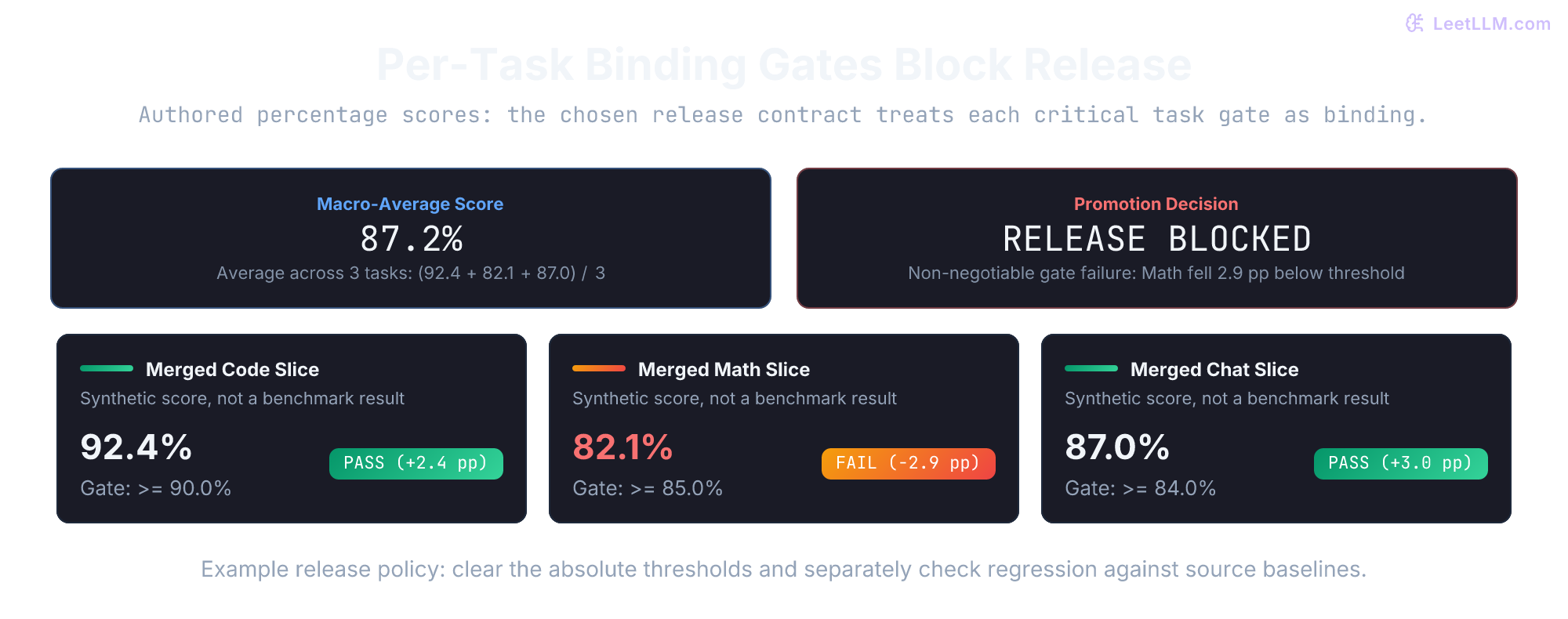
Picture your platform team serving three same-base 8B assistants: Code, Math, and Chat. Keeping all three full backbones resident requires about three times the weight storage of one backbone at the same precision. Total GPU memory and latency also depend on KV caches, concurrency, routing, and whether you swap models or share a backbone with adapters. In our synthetic release report, the first merge candidate writes successfully and reports a macro-average score of 87.2. Then the slice metrics arrive: code clears at 92.4, chat clears at 87.0, but math drops to 82.1 against an 85.0 gate. Keeping one unified model would simplify serving, but this candidate stays blocked. These scores illustrate our release decision rule: a high aggregate never excuses a declared critical gate failure.
Before picking a merge recipe, verify that parameter coordinates share identical semantic meaning. If token ID 417 maps to return in one tokenizer but <fim_prefix> in another, averaging row 417 in the embedding matrix blends unrelated output symbols into gibberish. Direct tensor interpolation demands compatible shapes and shared coordinates. Both embedding matrices () and language-model heads () depend on an explicit tokenizer policy. Mergekit can build a union tokenizer and assign fallback embeddings for missing tokens, but that's an output-space patch that needs empirical evaluation.[1] Same-base checkpoints serve as our conservative starting point because their coordinates share lineage. Matching shapes alone doesn't make a merge sound.
Keep Code, Math, and Chat as our running trio. We'll compare several recipes, from plain weight averaging to sparse, conflict-aware task-vector combinations. First ask whether a straight path through weight space is even usable.
When averaging weights is worth testing
If someone told you to average the internal numbers of two trained neural networks, skepticism is healthy. The useful question is narrower: do these nearby checkpoints share a low-loss basin? Weight averaging works in specific fine-tuning settings, but two good endpoints don't certify the points between them.
Fine-tuning nudges a checkpoint from a shared base through high-dimensional weight space. To test whether two checkpoints and can be linearly blended, we evaluate the 1D interpolation path:
Linear mode connectivity asks whether this straight path crosses a high-loss barrier. Barrier conventions differ: Frankle et al. subtract the mean endpoint error, while Entezari et al. subtract the endpoint chord at each coefficient. We use the latter convention:[2][3]
The expression is zero at both endpoints, so its supremum is nonnegative. A zero chord barrier means the path never rises above the endpoint chord; a small positive barrier may be acceptable under a declared tolerance. Neither condition proves a convex loss basin, or even convexity on this one-dimensional path. Model Soups reports useful averages of models fine-tuned from a shared pretrained initialization and studies their loss geometry.[4] That finding supports testing nearby same-lineage candidates. It doesn't certify our Code and Math pair.
Evaluate candidate points along rather than assuming the midpoint is usable. Code and Math can each pass alone and still interfere catastrophically along the path. Models with unrelated pretraining lineages are even poorer candidates because no common base preserved their parameter coordinates.
If both endpoints pass, does pass too? Our synthetic path has a failing midpoint despite passing endpoints. In a real run, each loss and score must come from evaluating the interpolated checkpoint on the same held-out examples. Here the arrays are hand-entered fixtures, and task_scores represents one required task slice. Passing five sampled points still wouldn't establish that every point between them passes.
alphas = [0.00, 0.25, 0.50, 0.75, 1.00]
losses = [0.18, 0.20, 0.61, 0.23, 0.19]
task_scores = [0.88, 0.86, 0.70, 0.85, 0.89]

max_accepted_loss = 0.30
min_accepted_score = 0.84

accepted = [
    alpha
    for alpha, loss, score in zip(alphas, losses, task_scores)
    if loss <= max_accepted_loss and score >= min_accepted_score
]

print("accepted_alphas:", accepted)
print("midpoint_passes:", 0.50 in accepted)
barriers = [loss - ((1 - alpha) * losses[0] + alpha * losses[-1])
            for alpha, loss in zip(alphas, losses)]
print("sampled chord barrier:", round(max(barriers), 3))

# This authored curve stays below its endpoint chord of 1 on [0, 1].
# Nevertheless, it violates the convexity inequality at 0.4, 0.5, 0.6.
def curve(alpha):
    return 1 - alpha * (1 - alpha) * (1 + 8 * (alpha - 0.5)**2)

print("below endpoint chord but not convex:",
curve(0.5) > (curve(0.4) + curve(0.6)) / 2)accepted_alphas: [0.0, 0.25, 0.75, 1.0]
midpoint_passes: False
sampled chord barrier: 0.425
below endpoint chord but not convex: True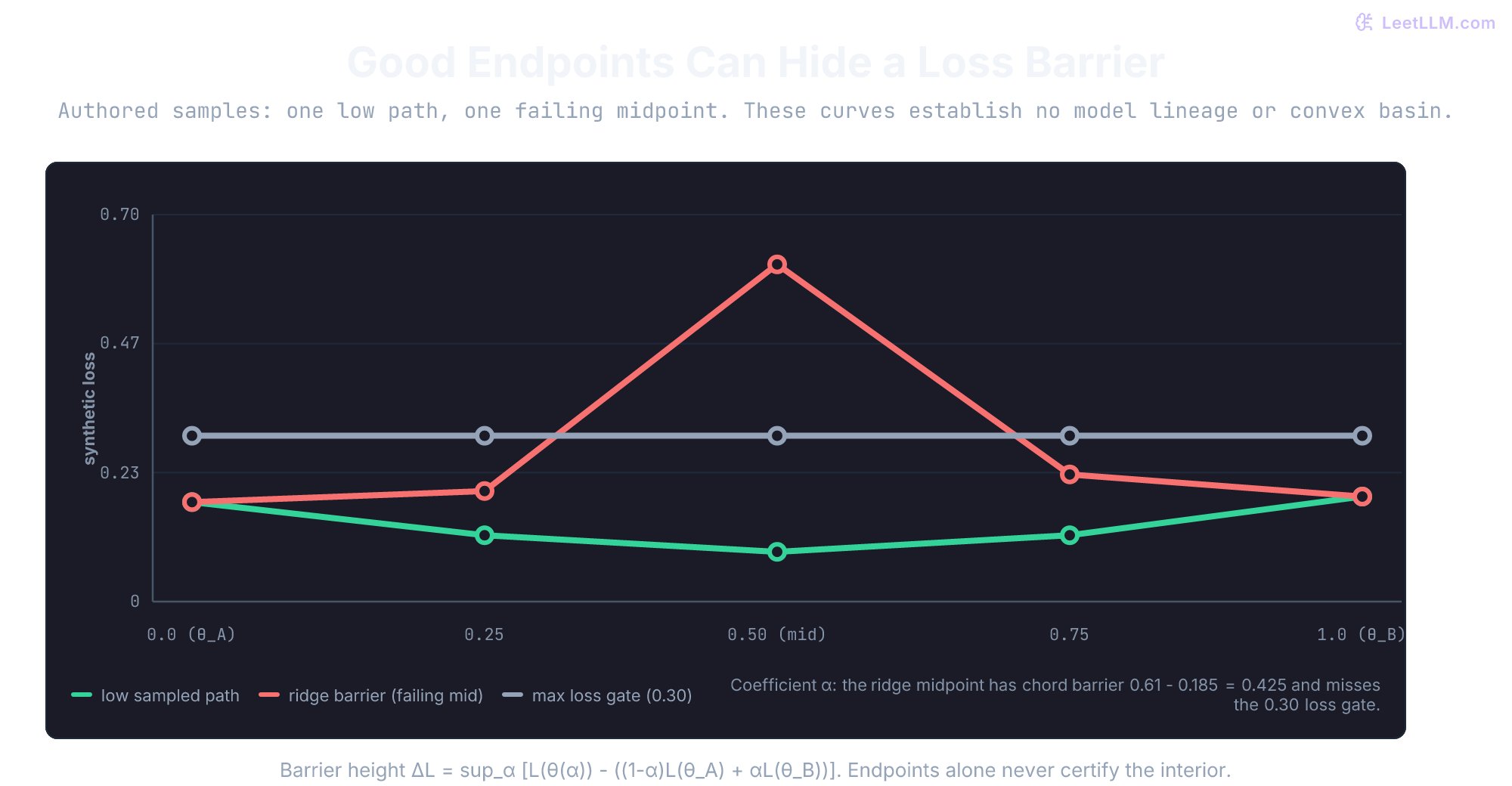
Same-base lineage: A shared base makes Code and Math worth testing together. It doesn't establish that either behavior survives. Per-task evaluation decides that.
The permutation invariance problem
Why can two networks that solve the exact same task disagree at nearly every coordinate? Neural networks exhibit permutation invariance: for any hidden layer with activation followed by , we can insert an arbitrary permutation matrix and its transpose :
For an elementwise activation, . The biases and nonlinearity therefore belong in the identity:[3]
A width- hidden layer admits permutation assignments, though identical units can make some assignments produce identical parameters. Independently trained networks may store corresponding features in different slots, or learn different features altogether. Averaging unmatched coordinates can destroy useful behavior.
Git Re-Basin[5] resolves this by finding a permutation that aligns hidden units across layers before averaging:
Weight matching seeks a collection of layer permutations that reduces parameter distance:
The global multilayer weight-matching problem is generally hard: the Git Re-Basin paper identifies its formulation as NP-hard for more than two layers. Its weight-matching algorithm repeatedly fixes the other layer permutations and solves one Linear Sum Assignment Problem (LSAP), accounting for the layer's incoming and outgoing weights. A Hungarian solver can optimize that coordinate step; it doesn't certify a globally optimal alignment. The paper's activation-matching method instead solves separate assignments from cross-model activation similarities.[5]
Use a tiny three-feature example to see the failure. Two checkpoints learn features A, B, and C but store them in different slot orders. Here stores B, C, A. Git Re-Basin searches for a permutation that restores A, B, C before averaging.
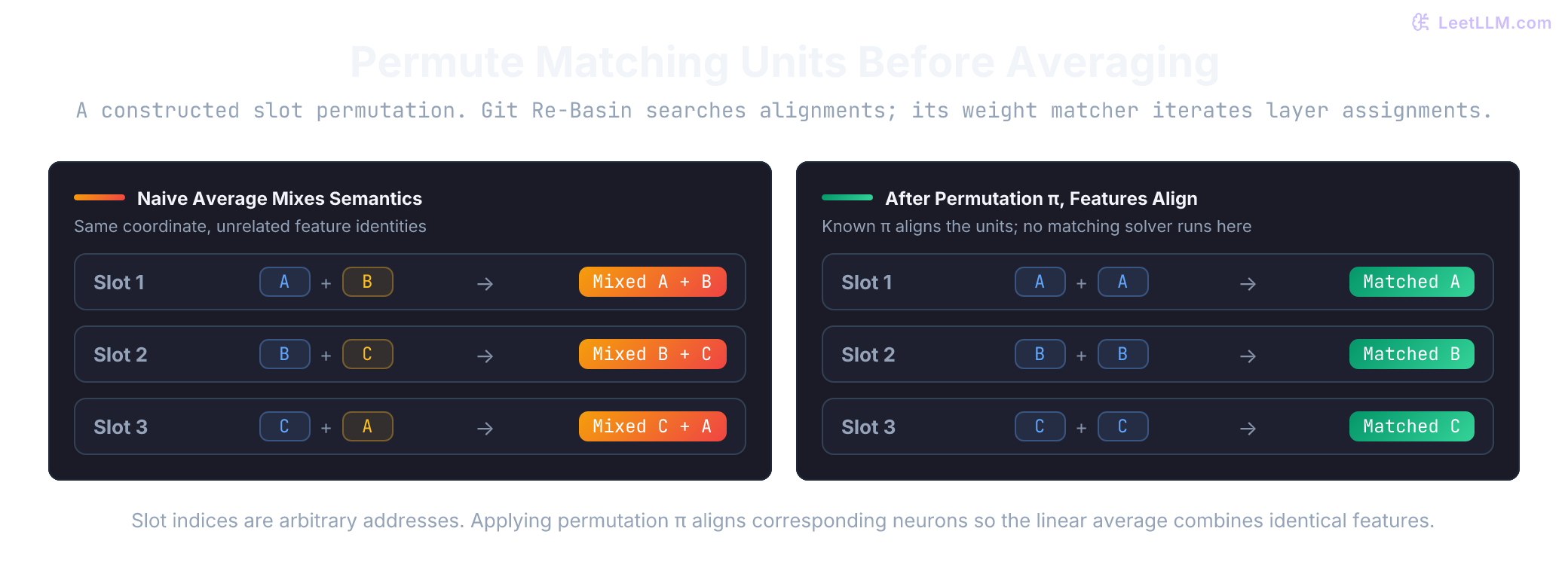
Git Re-Basin uses permutation matching and reports merged independently trained MLP, CNN, and ResNet models in its studied settings, including zero-barrier linear mode connectivity for sufficiently wide ResNets on CIFAR-10.[5] Alignment fixes coordinate permutation mismatch between vision models. It isn't an established repair pipeline for arbitrary large language models with attention heads, RMSNorm, and rotary embeddings, so same-base lineage plus downstream evaluation remain our LLM default.
You can isolate the alignment problem without training anything. This two-unit ReLU network computes . Swapping both incoming and outgoing weights preserves that function. Averaging the unaligned weights instead makes both incoming weights zero, destroying the function:
import numpy as np

x = np.array([-2.0, -1.0, 1.0, 2.0])
incoming = np.array([1.0, -1.0])
outgoing = np.array([2.0, -1.0])
permutation = np.array([1, 0])

def network(w_in, w_out):
    return np.maximum(x[:, None] * w_in, 0) @ w_out

b_in, b_out = incoming[permutation], outgoing[permutation]
naive = network((incoming + b_in) / 2, (outgoing + b_out) / 2)
inverse = np.argsort(permutation)
aligned = network((incoming + b_in[inverse]) / 2,
                  (outgoing + b_out[inverse]) / 2)
print("same_function:", np.allclose(network(incoming, outgoing), network(b_in, b_out)))
print("original:", network(incoming, outgoing).tolist())
print("naive_average:", naive.tolist())
print("aligned_average:", aligned.tolist())same_function: True
original: [-2.0, -1.0, 2.0, 4.0]
naive_average: [0.0, 0.0, 0.0, 0.0]
aligned_average: [-2.0, -1.0, 2.0, 4.0]The permutation here is known by construction. For independently trained networks, Git Re-Basin must search for a useful alignment; this example demonstrates only what happens after that alignment is known.
Why does Git Re-Basin apply before averaging?
Answer
Two models can represent the same function with neurons in different orders. The permutation aligns corresponding neurons first, so averaging combines matching features instead of unrelated ones.
From simple averages to conflict-aware methods
The first screen asks whether coordinates line up. The next asks what to do when they do: average endpoints, add deltas, filter conflicts, or change interpolation geometry. Choose against source lineage, observed delta conflict, and the evaluations the output must pass.
| Method | Mechanism | Pros | Cons | Best For |
|---|---|---|---|---|
| Model Soups / Linear | Uniform or weighted averaging | Simple baseline | Interference between conflicting parameters | Nearby checkpoints with representative evaluation |
| Task Arithmetic | Weighted task vectors | Separate coefficients per delta | Coefficients don't guarantee separate capabilities survive | Same-base task-vector experiments |
| TIES-Merging (Trim, Elect Sign, Merge) | Trim and aggregate-sign filtering | Explicitly handles conflicting delta signs | Density and scale need tuning | Conflicting same-base task vectors |
| DARE (sparsify first) | Random dropping and rescaling of task vectors | Sparse preprocessing evaluated by its paper | Not a complete merge rule on its own | Testing DARE plus a downstream merge |
| SLERP (Spherical Linear Interpolation) | Spherical interpolation in direction space | Has a norm-preserving geometric interpretation | Geometry alone doesn't establish task quality | Pairwise interpolation experiment |
Model soups (uniform averaging)
Start with the deliberately boring control: average the endpoint weights and see what behavior you lose. This is Model Soups[4], applied to multiple fine-tuned models:
Predict the tiny example before reading the code. If checkpoint A has a weight 2.0 and checkpoint B has 4.0, equal averaging returns 3.0. The dictionaries below stand in for tensor slices, so the arithmetic is visible without loading a checkpoint. A single coordinate still can't tell you whether Code, Math, or Chat behavior survived.
Model Soups evaluates models fine-tuned from a shared initialization over hyperparameter configurations and reports improved accuracy and robustness in its studied settings without the inference cost of an ensemble.[4] That evidence motivates a baseline for nearby candidates, not a blanket rule for specialists.
Uniform soups average all candidate checkpoints with equal weight. Greedy soups start from the best individual model and add a candidate when the resulting average doesn't decrease the chosen validation metric, including ties in the original algorithm. Our helper below uses a stricter improvement rule. Selection can improve the chosen metric without improving every distribution or task slice. The paper also studies learned soup coefficients optimized with gradients; the gradient-free claim applies to uniform and greedy averaging, not every soup variant.[4]
The next example really constructs each trial soup and evaluates it. Its tiny linear predictors estimate ; negative mean squared error is the selection metric, so larger is better. This is a deterministic mechanics fixture, not an estimate of generalization. Keep separate test data untouched when selecting real models.
import math

def uniform_merge(
    models: list[dict[str, list[float]]],
    weights: list[float] | None = None,
) -> dict[str, list[float]]:
    if not models or not models[0]:
        raise ValueError("Need nonempty models and parameters")
    for model in models:
        if model.keys() != models[0].keys():
            raise ValueError("Parameter keys must match")
        for key, values in model.items():
            if not values or len(values) != len(models[0][key]):
                raise ValueError("Parameter shapes must match and be nonempty")
            if not all(math.isfinite(value) for value in values):
                raise ValueError("Parameters must be finite")
    if weights is None:
        weights = [1.0 / len(models)] * len(models)
    if (len(weights) != len(models)
            or not all(math.isfinite(w) and w >= 0 for w in weights)
            or not math.isclose(sum(weights), 1.0, abs_tol=1e-9)):
        raise ValueError("Need one finite nonnegative weight per model, summing to 1")

    merged: dict[str, list[float]] = {}
    for key in models[0]:
        merged[key] = [
            sum(w * m[key][i] for w, m in zip(weights, models))
            for i in range(len(models[0][key]))
        ]
    return merged

def score(model):
    pairs = [(-1.0, 0.0), (0.0, 2.0), (1.0, 4.0)]
    return -sum((model["w"][0] * x + model["bias"][0] - y) ** 2
                for x, y in pairs) / len(pairs)

def greedy_soup(candidates):
    ordered = sorted(candidates, key=lambda name: score(candidates[name]), reverse=True)
    if not ordered:
        raise ValueError("Need at least one candidate")
    kept = [ordered[0]]
    soup = uniform_merge([candidates[kept[0]]])
    best = score(soup)
    for name in ordered[1:]:
        trial = uniform_merge([candidates[n] for n in kept + [name]])
        trial_score = score(trial)
        if trial_score > best:  # This teaching variant rejects exact ties.
            kept.append(name)
            soup, best = trial, trial_score
    return kept, soup

code_model = {"w": [2.0, 4.0], "bias": [1.0]}
math_model = {"w": [4.0, 2.0], "bias": [3.0]}
merged = uniform_merge([code_model, math_model])
candidates = {"low_bias": {"w": [2.0], "bias": [1.0]},
              "high_bias": {"w": [2.0], "bias": [3.0]},
              "bad": {"w": [8.0], "bias": [2.0]}}
kept, soup = greedy_soup(candidates)

print("weights_ok:", merged["w"] == [3.0, 3.0])
print("bias_ok:", merged["bias"] == [2.0])
print("merged w:", merged["w"])
print("merged bias:", merged["bias"])
print("greedy kept:", kept)
print("uniform MSE:", round(-score(uniform_merge(list(candidates.values()))), 4))
print("greedy MSE:", round(-score(soup), 4))weights_ok: True
bias_ok: True
merged w: [3.0, 3.0]
merged bias: [2.0]
greedy kept: ['low_bias', 'high_bias']
uniform MSE: 2.6667
greedy MSE: 0.0Averaging is cheap to implement and has no hyperparameters beyond optional weights. On our Code, Math, and Chat trio, a poor aggregate result tells you little about which task caused the loss. Conflicting parameters can cancel when specialists move in opposite directions. To keep those directions visible, the next recipe subtracts the shared base first.
Task arithmetic
The average baseline hides why specialists moved. Task arithmetic[6] keeps that reference point: a task vector is the difference between fine-tuned weights and the shared base model:
Here is the base model, are fine-tuned models, are per-task deltas, and are merge coefficients.
Capability addition and capability subtraction
Task vectors let us construct addition and subtraction candidates. Their behavioral meaning must be tested:
- Addition candidate: Adding scaled task vectors can combine improvements from complementary specialists:
- Negation candidate: Fine-tune an auxiliary model on a behavior, compute its delta, then subtract a scaled version:
In the original task-arithmetic experiment, negating a GPT-2 Large toxic-language delta reduced the measured toxic-generation fraction from 4.8% to 0.8%, while WikiText-103 perplexity changed from 16.4 to 16.9. Those historical measurements used 1,000 generations and a toxicity classifier.[6] The delta contains all effects of that fine-tuning run; it doesn't isolate a unique harmful-behavior subspace. Lower toxicity on those prompts doesn't certify safety, selective forgetting, or removal of copyrighted training data.
A concrete scalar walkthrough
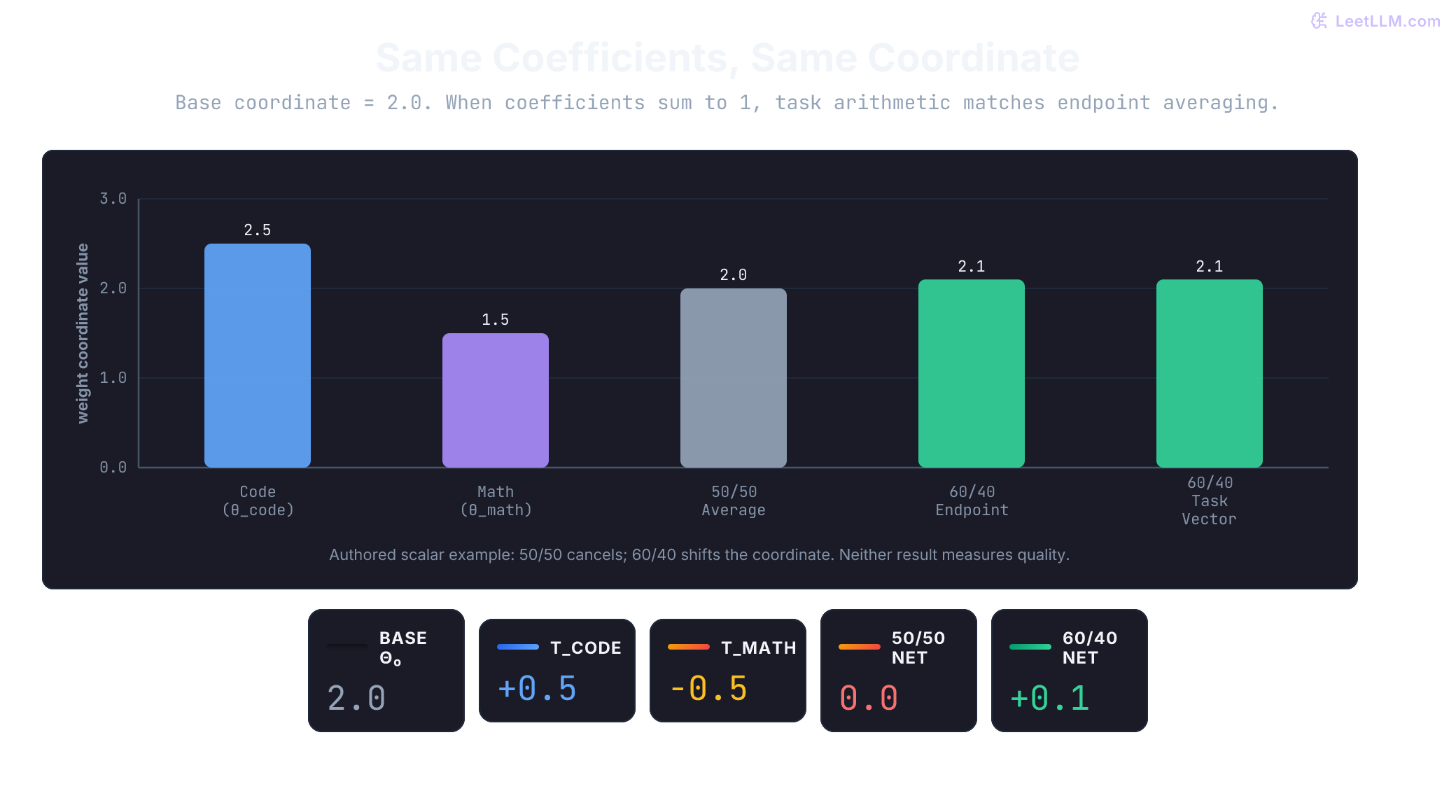
Before you run this on billion-parameter tensors, make one prediction on a single coordinate. Start with a base weight at 2.0. Code pushes it to 2.5, so its task vector is +0.5; Math pushes it to 1.5, so its task vector is -0.5. If Code gets and Math gets , does the merged coordinate land above or below the base?
The result, 2.1, is a positive change in a weight, not a quality improvement. Equal averaging gives 2.0, but weighting the endpoints by 0.6 and 0.4 also gives 2.1. Subtracting the base doesn't itself prevent cancellation. The difference in this example comes entirely from unequal coefficients:
When the coefficients sum to one, task arithmetic equals the corresponding weighted endpoint average. Otherwise, the base has a nonzero coefficient, and the result can lie outside the endpoints.
Why did absolute averaging cancel the two specialist deltas in the scalar example?
Answer
The code-generation fine-tune moved this coordinate up by +0.5 and the math-reasoning fine-tune moved it down by -0.5. Averaging final weights lands this coordinate back at the base value, cancelling both deltas here. Task evaluation determines the broader behavioral effect.
A second coefficient pair exposes a tuning detail. Suppose Code nudges the coordinate to 2.4 (task vector +0.4) and Math nudges it to 1.8 (task vector -0.2). Setting and gives 2.0 + 0.28 - 0.10 = 2.18. The coefficients need not form a convex average; they scale deltas. Capability retention still comes from evaluation.
task_arithmetic_merge subtracts the base to get task vectors, scales them, and adds them back:
import math

def task_arithmetic_merge(
    base_model: dict[str, list[float]],
    fine_tuned_models: list[dict[str, list[float]]],
    scaling_coefficients: list[float],
) -> dict[str, list[float]]:
    if not base_model or not fine_tuned_models or len(fine_tuned_models) != len(scaling_coefficients):
        raise ValueError("Need a base and one coefficient per source")
    if not all(math.isfinite(c) for c in scaling_coefficients):
        raise ValueError("Coefficients must be finite")
    for model in [base_model, *fine_tuned_models]:
        if model.keys() != base_model.keys():
            raise ValueError("Parameter keys must match")
        for key, values in model.items():
            if not values or len(values) != len(base_model[key]):
                raise ValueError("Parameter shapes must match and be nonempty")
            if not all(math.isfinite(v) for v in values):
                raise ValueError("Parameters must be finite")
    merged = {key: value[:] for key, value in base_model.items()}
    for model, coeff in zip(fine_tuned_models, scaling_coefficients):
        for key in merged:
            merged[key] = [
                merged_value + coeff * (tuned - base)
                for merged_value, tuned, base in zip(
                    merged[key], model[key], base_model[key]
                )
            ]
    return merged

shared_base = {"w": [2.0]}
code_ft = {"w": [2.5]}
math_ft = {"w": [1.5]}
merged = task_arithmetic_merge(
    base_model=shared_base,
    fine_tuned_models=[code_ft, math_ft],
    scaling_coefficients=[0.6, 0.4],
)

print("base:", shared_base["w"][0])
print("matches_expected:", all(abs(v - expected) < 1e-6 for v, expected in zip(merged["w"], [2.1])))
print("merged:", round(merged["w"][0], 2))base: 2.0
matches_expected: True
merged: 2.1Merging LoRA adapters: average which objects?
An adapter stores factors, not the effective weight update. For the same base weight, a standard LoRA adapter contributes , including its configured scale .[7] If you want , separately averaging the and factors generally gives the wrong matrix: multiplying those averages introduces cross terms.
Predict the rank in this two-coordinate example. Each adapter changes one different diagonal entry. Their equal-weight combination changes both entries and has rank two, so a rank-one adapter cannot represent it exactly.
import numpy as np

a1, a2 = np.array([[1., 0.]]), np.array([[0., 1.]])
b1, b2 = a1.T, a2.T
desired = 0.5 * (b1 @ a1) + 0.5 * (b2 @ a2)
factor_average = ((b1 + b2) / 2) @ ((a1 + a2) / 2)

# Concatenation absorbs coefficients into B and keeps each original product.
b_concat = np.concatenate([0.5 * b1, 0.5 * b2], axis=1)
a_concat = np.concatenate([a1, a2], axis=0)
print("desired delta:", desired.tolist())
print("factor-average delta:", factor_average.tolist())
print("concatenation is exact:", np.allclose(b_concat @ a_concat, desired))
print("required rank:", np.linalg.matrix_rank(desired))desired delta: [[0.5, 0.0], [0.0, 0.5]]
factor-average delta: [[0.25, 0.25], [0.25, 0.25]]
concatenation is exact: True
required rank: 2Concatenation can represent the summed update at rank at most . Compressing it to a lower rank with SVD introduces approximation error. PEFT exposes multiple adapter-combination methods, so specify the actual method instead of calling every factor operation “averaging.”[8] Check the base revision, target modules, scaling, and tokenizer compatibility. This matrix calculation executes no PEFT API and establishes no task-quality guarantee.
Scaling task vectors still doesn't resolve a coordinate where Code and Math ask for opposite directions. That conflict motivates TIES.
TIES-Merging (trim, elect sign, merge)
TIES studies two sources of interference: aggregating small updates and combining opposite update signs. At one coordinate, and cancel under addition. That is a coordinate-level fact, not proof that both specialists' capabilities disappear.
TIES-Merging[9] trims smaller-magnitude deltas, elects an aggregate sign, and averages the surviving updates aligned with that sign. Small magnitude doesn't prove an update is irrelevant or noisy, and sign filtering doesn't eliminate every interaction across parameters.
The paper's PEFT analysis found that keeping the top 20% of updates by magnitude approximately preserved the average performance in its studied settings.[9] Treat that as empirical evidence for those models and tasks, not a universal density recommendation.
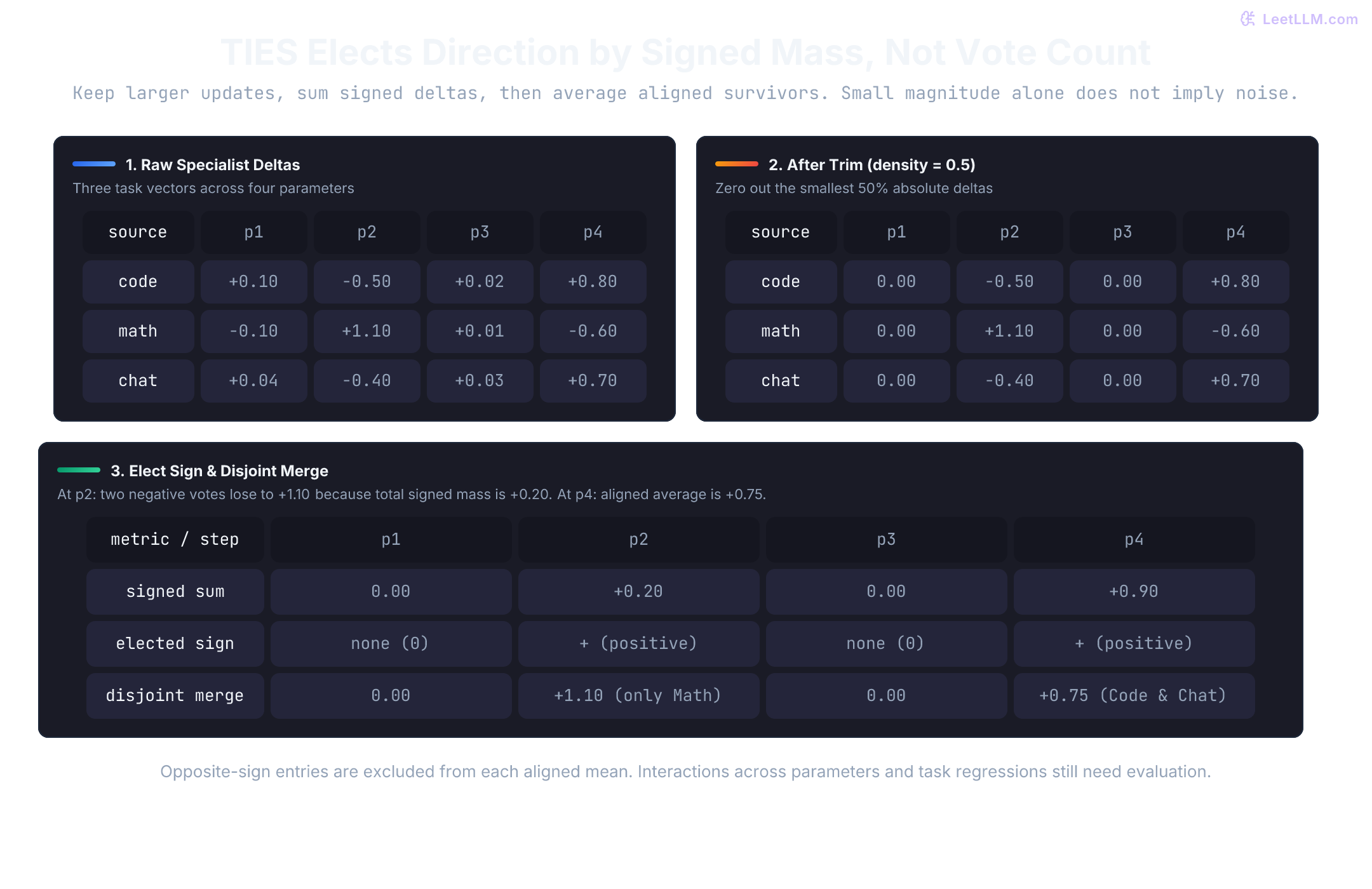
Use the three specialist rows in the figure as a prediction exercise. At parameter p2, the two negative entries total -0.90, while the positive entry is +1.10. Which sign wins? Positive signed mass wins, and only the aligned +1.10 survives the disjoint merge. The resulting task vector still gets added back to the base, scaled by a global coefficient .
Step 1: Trim
Trim keeps the largest-magnitude fraction of each task vector. With four values and density=0.5, the two largest absolute updates survive. For this helper, keep exactly floor(n * density) entries, breaking equal-magnitude ties by earlier index. Density zero keeps nothing; density one keeps everything. Small tensors make rounding policies visible, so record your implementation's convention.
import math

def trim(task_vector: list[float], density: float = 0.2) -> list[float]:
    if not math.isfinite(density) or not 0 <= density <= 1:
        raise ValueError("density must be in [0, 1]")
    if not task_vector or not all(math.isfinite(v) for v in task_vector):
        raise ValueError("Need a nonempty finite task vector")
    k = math.floor(len(task_vector) * density)
    keep = set(
        sorted(range(len(task_vector)), key=lambda i: abs(task_vector[i]), reverse=True)[:k]
    )
    return [value if i in keep else 0.0 for i, value in enumerate(task_vector)]

task_vector = [0.1, -0.5, 0.02, 0.8]
trimmed = trim(task_vector, density=0.5)

print("matches_expected:", trimmed == [0.0, -0.5, 0.0, 0.8])
print("trimmed:", trimmed)matches_expected: True
trimmed: [0.0, -0.5, 0.0, 0.8]Step 2: Elect sign
When multiple task vectors update one parameter, TIES-Merging resolves conflicting directions with .[9] Sum the trimmed signed deltas and take the resulting sign. This isn't a majority vote: one large update can outweigh two smaller opposing updates. Our explicit tie policy is zero signed sum means no update. Implementations can use another tie policy, so don't assume bit-for-bit agreement with a library.
import math

def sign(value: float) -> float:
    if value > 0:
        return 1.0
    if value < 0:
        return -1.0
    return 0.0

def elect_sign(trimmed_vectors: list[list[float]]) -> list[float]:
    if not trimmed_vectors or not trimmed_vectors[0]:
        raise ValueError("Need nonempty task vectors")
    width = len(trimmed_vectors[0])
    if any(len(v) != width or not all(math.isfinite(x) for x in v)
           for v in trimmed_vectors):
        raise ValueError("Task vectors must be rectangular and finite")
    aggregate = [sum(vector[i] for vector in trimmed_vectors) for i in range(width)]
    return [sign(total) for total in aggregate]

trimmed_vectors = [
    [0.0, -0.5, 0.0, 0.8],
    [0.0, 1.1, 0.0, -0.6],
    [0.0, -0.4, 0.0, 0.7],
]
elected = elect_sign(trimmed_vectors)
print("two_negative_votes_at_p2:", sum(v[1] < 0 for v in trimmed_vectors) == 2)
print("positive_mass_wins_at_p2:", elected[1] == 1.0)
print("matches_expected:", elected == [0.0, 1.0, 0.0, 1.0])
print("elected signs:", elected)two_negative_votes_at_p2: True
positive_mass_wins_at_p2: True
matches_expected: True
elected signs: [0.0, 1.0, 0.0, 1.0]Step 3: Disjoint merge
Now average only non-zero updates that agree with the elected sign. Trimmed zeros stay out of the mean, so a discarded proposal can't dilute the surviving direction:
import math

def sign(value: float) -> float:
    if value > 0:
        return 1.0
    if value < 0:
        return -1.0
    return 0.0

def disjoint_merge(
    trimmed_vectors: list[list[float]],
    elected_signs: list[float],
) -> list[float]:
    if not trimmed_vectors or not elected_signs:
        raise ValueError("Need vectors and elected signs")
    width = len(trimmed_vectors[0])
    if (len(elected_signs) != width or any(s not in (-1, 0, 1) for s in elected_signs)
            or any(len(v) != width or not all(math.isfinite(x) for x in v)
                   for v in trimmed_vectors)):
        raise ValueError("Need matching finite vectors and signs in {-1, 0, 1}")
    merged = [0.0] * width
    counts = [0.0] * width
    for vector in trimmed_vectors:
        for i, value in enumerate(vector):
            agrees = (
                value != 0.0
                and elected_signs[i] != 0.0
                and sign(value) == elected_signs[i]
            )
            if agrees:
                merged[i] += value
                counts[i] += 1.0
    return [
        total / count if count > 0 else 0.0
        for total, count in zip(merged, counts)
    ]

trimmed_vectors = [
    [0.0, -0.5, 0.0, 0.8],
    [0.0, 1.1, 0.0, -0.6],
    [0.0, -0.4, 0.0, 0.7],
]
elected_signs = [0.0, 1.0, 0.0, 1.0]
merged = disjoint_merge(trimmed_vectors, elected_signs)

print("matches_expected:", merged == [0.0, 1.1, 0.0, 0.75])
print("merged task vector:", merged)matches_expected: True
merged task vector: [0.0, 1.1, 0.0, 0.75]TIES-Merging outperforms compared baselines in the paper's evaluated vision and T5 task-vector settings, and its analysis identifies sign interference.[9] For our LLM trio, use it as a candidate when delta signs conflict. Keep plain task arithmetic in the comparison so any gain has a visible baseline.
DARE (drop and rescale)[10]
TIES chooses a direction among surviving updates. DARE asks a different question first: how many update entries need to survive at all? It randomly drops entries from each task vector and rescales the survivors before a downstream merge. Rescaling preserves an entry's expected delta under the random mask; it doesn't prove that the model preserves a capability.
Redundancy and parameter collision avoidance
DARE finds that many coordinates can be dropped from its evaluated SFT deltas while retaining useful performance. This is empirical redundancy, not a proof that every SFT delta is low-rank or that low rank implies tolerance of random coordinate dropping.[10]
Consider a coordinate that is initially nonzero in two task vectors. If their masks independently drop entries with probability , the probability that both updates survive is:
The denominator matters. Neither update survives with probability , exactly one survives with probability , and at least one survives with probability . Among active coordinates, exactly one survives in , and both survive in . Two surviving updates needn't disagree in sign. Dropping reduces overlap; it doesn't certify the absence of interference. Once the sparse delta is added to a dense base, the output model still has dense weights.
Expectation and variance scaling
To prevent the masked task vector from shrinking toward zero, DARE divides surviving parameters by their survival probability :
where each keep-mask entry . This rescaling guarantees that each coordinate remains mathematically unbiased in expectation:
However, unbiased expectation carries a variance penalty:
At , coordinate variance is ; at , it is . The paper reports useful performance after dropping 99% of WizardMath-70B's delta entries, but also reports substantial AlpacaEval degradation for WizardLM-70B at 90% dropping.[10] Parameter count alone therefore doesn't determine a safe drop rate. DARE is a sparsification preprocessor, not a standalone merger: combine its sparse deltas with a downstream rule such as task arithmetic or TIES.
DARE's tested continued-pretraining deltas were larger and less tolerant of dropping than its SFT deltas.[10] That is a warning about transfer to a different training regime, not a universal numerical cutoff. One candidate pipeline is DARE-TIES: randomly sparsify each delta, then resolve directional conflicts among survivors. Mergekit exposes dare_ties; random sparsification replaces magnitude trimming in that implementation rather than applying a second top-magnitude filter.[1]
Why does DARE divide by after dropping weights?
Answer
Only a fraction of task-vector entries survive. Dividing by keeps each randomly masked delta entry unbiased in expectation; retained task quality still requires evaluation.
dare_sparsify applies a keep-mask and the rescale. DARE chooses its mask randomly; this example fixes the mask so you can check the arithmetic. With , the last two entries survive and double: 0.1 becomes 0.2 and 0.6 becomes 1.2. Predict those values before running it.
import math
from itertools import product

def dare_sparsify(
    task_vector: list[float],
    drop_rate: float,
    keep_mask: list[int],
) -> list[float]:
    keep_prob = 1.0 - drop_rate
    if not 0.0 < keep_prob <= 1.0:
        raise ValueError("drop_rate must be in [0, 1)")
    if len(keep_mask) != len(task_vector):
        raise ValueError("keep_mask must match task_vector")
    if not task_vector or not all(math.isfinite(v) for v in task_vector):
        raise ValueError("Need a nonempty finite task vector")
    if any(type(kept) is not int or kept not in (0, 1) for kept in keep_mask):
        raise ValueError("keep_mask entries must be integer 0 or 1")
    return [
        value / keep_prob if kept else 0.0
        for value, kept in zip(task_vector, keep_mask)
    ]

task_vector = [0.2, -0.4, 0.1, 0.6]
sparsified = dare_sparsify(task_vector, drop_rate=0.5, keep_mask=[0, 0, 1, 1])
invalid_drop_rate_rejected = False
try:
    dare_sparsify(task_vector, drop_rate=1.0, keep_mask=[1, 1, 1, 1])
except ValueError as exc:
    invalid_drop_rate_rejected = "drop_rate" in str(exc)

print("shape_ok:", len(sparsified) == len(task_vector))
print("finite_ok:", all(value == value and abs(value) != float("inf") for value in sparsified))
print("matches_expected:", sparsified == [0.0, 0.0, 0.2, 1.2])
print("invalid_drop_rate_rejected:", invalid_drop_rate_rejected)
print("original nonzero:", sum(value != 0.0 for value in task_vector))
print("sparsified nonzero:", sum(value != 0.0 for value in sparsified))
print("sparsified:", sparsified)

# At p=0.5, all 16 masks are equally likely. Enumerate, do not sample.
outcomes = [dare_sparsify(task_vector, 0.5, list(mask))
            for mask in product((0, 1), repeat=4)]
mean = [sum(row[i] for row in outcomes) / len(outcomes) for i in range(4)]
mean_squared_norm = sum(sum(x*x for x in row) for row in outcomes) / len(outcomes)
print("mean_equals_original:", all(math.isclose(a, b) for a, b in zip(mean, task_vector)))
print("original_squared_norm:", round(sum(x*x for x in task_vector), 2))
print("mean_squared_norm:", round(mean_squared_norm, 2))

drop = 0.9
both, exactly_one = (1 - drop)**2, 2 * drop * (1 - drop)
print("exactly one among active (%):", round(100 * exactly_one / (1 - drop**2), 1))
print("both among active (%):", round(100 * both / (1 - drop**2), 1))

# Even one nonlinear unit needn't preserve its expected output.
relu_outputs = [max(0, -0.75 + delta)
                for delta in (0.0, 2.0)]  # delta=1, p=0.5
print("original ReLU / expected masked ReLU:", 0.25, sum(relu_outputs) / 2)

# Emulate the pinned library's realized-L1 rescale on a two-entry tensor.
library_outcomes = []
for mask in product((0, 1), repeat=2):
    masked = [value * kept for value, kept in zip([1., 3.], mask)]
    norm = sum(abs(value) for value in masked)
    library_outcomes.append([value * 4 / norm for value in masked] if norm else masked)
print("realized-L1 mean delta:",
[sum(row[i] for row in library_outcomes) / 4 for i in range(2)])shape_ok: True
finite_ok: True
matches_expected: True
invalid_drop_rate_rejected: True
original nonzero: 4
sparsified nonzero: 2
sparsified: [0.0, 0.0, 0.2, 1.2]
mean_equals_original: True
original_squared_norm: 0.57
mean_squared_norm: 1.14
exactly one among active (%): 94.7
both among active (%): 5.3
original ReLU / expected masked ReLU: 0.25 0.625
realized-L1 mean delta: [1.25, 1.75]On the SFT models and tasks it evaluates, DARE finds substantial redundancy in task-vector entries and improves several downstream merge methods after drop-and-rescale preprocessing.[10] For a new checkpoint family, density remains a tuned parameter. Compare unsparsified and DARE-preprocessed candidates on every required task slice before deciding whether sparsity helped.
The first enumeration verifies the paper's unbiased delta, not an unbiased full-network output: even the single ReLU counterexample has expected output 0.625 instead of 0.25. The paper's expectation argument applies to a fixed linear transformation; composing nonlinear layers doesn't inherit that equality.[10]
At mergekit commit 9eeb539892c6753b032ea164e818b44a8c7a401b, checked September 22, 2026, enabled rescaling restores the realized L1 norm of the masked tensor when both norms exceed its small-value cutoff. It doesn't apply the paper's fixed . An all-zero mask stays zero. Our final enumeration emulates that rule: the mean delta is [1.25, 1.75], not the original [1, 3]. It executes an authored calculation, not mergekit itself. The library's dare_ties defaults are rescale: true and normalize: false; record both.[11][12]
SLERP (spherical linear interpolation)
SLERP changes the path geometry, not the evidence standard. It follows an angular arc between normalized vector directions rather than the straight chord used by linear interpolation. It isn't an algorithm for discovering a low-loss path around an incompatible-model ridge.
When a linear midpoint contracts the norm
High dimension alone doesn't make two fine-tuned checkpoints orthogonal. If both are near a common base, the base can dominate their absolute-weight dot product. Model Soups analyzes angles between fine-tuning deltas, not a universal orthogonality rule for absolute checkpoint weights.[4]
When you compute the linear midpoint between two orthogonal vectors of equal norm :
The 29.3% contraction applies to this equal-norm, orthogonal pair. More generally, equal-norm endpoints at angle have midpoint norm . Nearby directions contract much less. Neither calculation establishes a particular change in transformer activations, attention, or task scores.
Geodesic interpolation on hyperspheres
SLERP[13] avoids norm contraction by interpolating along the great-circle arc (the geodesic on the hypersphere) with constant angular velocity:
For nonzero endpoints and , sweeps from 0 to 1. When both endpoint norms equal , the ideal arc has constant radius . Unequal norms don't share one radius, and parallel, antipodal, or zero-vector cases require a separate convention.
SLERP was introduced for computer graphics to interpolate rotations represented as quaternions.[13] That source establishes its geometry, not downstream quality for neural-network weight merges. Use a SLERP checkpoint as another candidate and measure loss and required tasks just as you would for a linear merge.
The helper below follows mergekit's angular-coefficient convention: compute the angle from normalized vectors, then apply coefficients to the original vectors.[14] Nearly parallel or opposite directions use a linear fallback at abs(dot) > 0.9995. Exactly opposite unit vectors have no unique shortest arc; this fallback returns zero at their midpoint. Our explicit zero-vector linear fallback is a teaching choice and differs from the pinned library's small-norm handling. Mergekit applies its method to individual weight tensors; it doesn't construct a single geodesic for the entire flattened model.
Make the geometry concrete before running it. For equal-norm vectors [1, 0] and [0, 1], a linear midpoint is [0.5, 0.5] with norm about 0.707; SLERP should land at [0.707, 0.707] with norm 1.0. That prediction is about shape, not model quality.
import math

def slerp(v0: list[float], v1: list[float], t: float) -> list[float]:
    def magnitude(vector: list[float]) -> float:
        return math.hypot(*vector)

    if not v0 or len(v0) != len(v1):
        raise ValueError("Vectors must have equal nonzero length")
    if not all(math.isfinite(x) for x in [*v0, *v1, t]) or not 0 <= t <= 1:
        raise ValueError("Need finite vectors and t in [0, 1]")

    mag0 = magnitude(v0)
    mag1 = magnitude(v1)
    if mag0 == 0.0 or mag1 == 0.0:
        return [(1 - t) * a + t * b for a, b in zip(v0, v1)]

    d0 = [value / mag0 for value in v0]
    d1 = [value / mag1 for value in v1]
    dot = max(-1.0, min(1.0, sum(a * b for a, b in zip(d0, d1))))
    omega = math.acos(dot)
    sin_omega = math.sin(omega)
    if abs(dot) > 0.9995:
        return [(1 - t) * a + t * b for a, b in zip(v0, v1)]

    w0 = math.sin((1 - t) * omega) / sin_omega
    w1 = math.sin(t * omega) / sin_omega
    return [w0 * a + w1 * b for a, b in zip(v0, v1)]

v0 = [1.0, 0.0]
v1 = [0.0, 1.0]
mid = slerp(v0, v1, t=0.5)
antipodal_mid = slerp(v0, [-value for value in v0], t=0.5)
expected = 2**-0.5

print("unit_norm:", abs(math.sqrt(sum(x * x for x in mid)) - 1.0) < 1e-6)
print("matches_45_degree:", all(abs(a - b) < 1e-6 for a, b in zip(mid, [expected, expected])))
print("antipodal_fallback_finite:", all(math.isfinite(value) for value in antipodal_mid))
print("antipodal_midpoint:", antipodal_mid)
print("unequal_norm_midpoint:", [round(v, 4) for v in slerp(v0, [0.0, 2.0], 0.5)])
print("midpoint:", [round(value, 4) for value in mid])
print("norm:", round(math.sqrt(sum(x * x for x in mid)), 4))unit_norm: True
matches_45_degree: True
antipodal_fallback_finite: True
antipodal_midpoint: [0.0, 0.0]
unequal_norm_midpoint: [0.7071, 1.4142]
midpoint: [0.7071, 0.7071]
norm: 1.0In the equal-norm orthogonal-vector example above, the SLERP midpoint remains on the unit circle while a linear midpoint would have smaller norm. Keep the distinction clear: geometry explains the candidate's path; task and safety evaluations decide whether it ships. For a pair of checkpoints, score linear and spherical candidates against the same release gates.
Running a merge with mergekit
The concepts now become one artifact. mergekit[1] is an open-source toolkit for merging language-model checkpoints. Its documented CLI supports YAML-defined merges with CPU or limited-VRAM execution, and mergekit-multi can run multi-stage recipes where later merges consume earlier outputs.[1]
Carry the trio into a YAML recipe. The names below are placeholders, not downloadable models. Replace them with authorized checkpoints from a verified shared base and pin model revisions plus the mergekit package version or source commit in the run manifest. Record licenses, tokenizer files, template, random seed, dtype, and evaluation IDs alongside the output. No model download or full-model merge is needed to run this lesson's CPU examples.
models:
  - model: your-org/base-8b-code
    parameters:
      weight: 0.35
      density: 0.5       # retained fraction for this task vector
  - model: your-org/base-8b-math
    parameters:
      weight: 0.35
      density: 0.5
  - model: your-org/base-8b-chat
    parameters:
      weight: 0.30
      density: 0.5

merge_method: dare_ties
base_model: your-org/base-8b
tokenizer:
  source: base           # switch to union if you must preserve extra tokens
chat_template: auto      # selects the most common input template; audit the result
parameters:
  normalize: true        # explicit weighted mean among sign-aligned survivors
  rescale: true          # pinned implementation uses realized-L1 rescaling
  lambda: 1.0            # scale the combined delta before adding it to the base
dtype: float32           # cast input tensors for merging; budget RAM/VRAM
out_dtype: bfloat16      # cast the output afterward; evaluate this saved artifact
For dare_ties, density = 1 - p is the keep probability. The pinned implementation applies source weights before sign election, chooses positive on a zero signed sum, and, with normalize: true, divides by the weights of the aligned contributors. These conventions differ from our unweighted TIES helper's zero-sum policy. The global lambda then scales the combined delta.[15][12]
dtype casts inputs for merging; out_dtype casts the output afterward. Some methods use wider intermediates, so these fields aren't a complete peak-memory formula. Pairwise slerp requires exactly two total input models, including its designated base, rather than two specialists plus a third base. The separately named Multi-SLERP method has a different multi-input construction.[16] chat_template: auto picks the most common input template; inspect and pin it because selection doesn't reconcile incompatible prompt formats.
Input and output precision also change the arithmetic. Bfloat16 has seven stored fraction bits: the next representable value above 1.0 is 1.0078125.[17] Predict what happens to an authored specialist weight 1.002 and its halfway merge with base 1.0. Casting the specialist to bfloat16 first erases this delta. Computing the merge in float32 preserves 1.001 internally, but saving that result in bfloat16 erases the change too.
import torch

base = torch.tensor([1.0], dtype=torch.float32)
specialist = torch.tensor([1.002], dtype=torch.float32)
wide_merge = base + 0.5 * (specialist - base)
rounded_inputs_merge = base + 0.5 * (
    specialist.to(torch.bfloat16).float() - base.to(torch.bfloat16).float()
)
saved_merge = wide_merge.to(torch.bfloat16).float()
step_above_one = torch.finfo(torch.bfloat16).eps

assert float(wide_merge) > 1.0
assert torch.equal(rounded_inputs_merge, base) and torch.equal(saved_merge, base)
print(f"bf16 step above 1={step_above_one:.7f}")
print(f"float32 halfway merge={float(wide_merge):.6f}")
print(f"round inputs before merging={float(rounded_inputs_merge):.6f}")
print(f"round merged output to bf16={float(saved_merge):.6f}")bf16 step above 1=0.0078125
float32 halfway merge=1.001000
round inputs before merging=1.000000
round merged output to bf16=1.000000This is one coordinate, not evidence that bfloat16 makes real model merging fail. Representable spacing depends on magnitude, and task sensitivity depends on the model. A float32 cast can't reconstruct information already lost in a low-precision source. Measure candidate quality on the saved and reloaded output dtype, and retain adapter deltas separately when that is the artifact your serving path actually applies.
The tokenizer alignment invariant
Tokenizer choice changes the output contract. In language models, parameter tensors have no intrinsic concept of letters or words: matrix row in the embedding layer and language model head maps strictly to vocabulary index .
If checkpoints disagree on vocabulary indices, direct row averaging blends unrelated symbols. The pinned mergekit tokenizer pipeline maps token strings to each source's IDs and aligns vocabulary-axis tensors to the output vocabulary. This includes input embeddings, output heads, and supported output biases; selecting the base vocabulary doesn't merely assume every source already has the base's row IDs.[18]
tokenizer.source: baseselects the base vocabulary. Added specialist tokens outside it are omitted, which can break prompts or behaviors that depend on them.tokenizer.source: unionretains the base tokenization pipeline and adds missing token strings. It doesn't reconcile arbitrary differences in normalization, segmentation, or added-token attributes.
For a missing embedding, the documented fallback uses the base's row when available, otherwise the sole available donor, otherwise the average of available donors. The implementation can use zeros when no donor supplies a valid row. These are copied or combined values, not necessarily randomly initialized “untrained embeddings.” They still need evaluation in the merged model.[16][19]
Check actual tokenizer artifacts and all affected vocabulary-axis tensors before choosing a policy. The pinned loader can warn and assume the base tokenizer when an input tokenizer fails to load. Inspect those warnings; an assumed tokenizer isn't evidence of compatibility. Non-vocabulary dimensions must still be compatible.
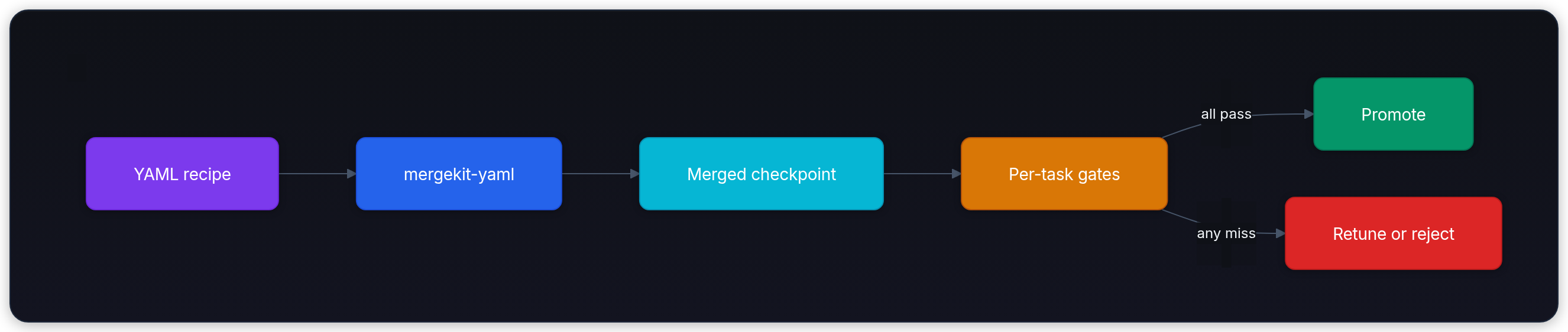
A written checkpoint is still a candidate. Run the YAML through mergekit-yaml, score every required slice, and promote only after all gates pass.
⚠️ Common mistake: Assuming all specialist checkpoints use the same tokenizer because they began from the same base. If the Code checkpoint added fill-in-the-middle tokens such as
<fim_prefix>, choosingbasedrops those added output entries while choosingunionintroduces filled embeddings for models that lack them. Verify tokenizer vocabularies, choose the output policy explicitly, and test code-completion prompts that require those tokens.
This set-based sketch checks token-string coverage only. It can't check token IDs, segmentation, added-token attributes, embedding rows, or output-head alignment. Inspect and test the actual tokenizer artifacts before merging:
def output_vocab(base_vocab, source_vocabs, policy):
    if policy == "base":
        return set(base_vocab)
    if policy == "union":
        return set(base_vocab).union(*source_vocabs)
    raise ValueError("policy must be 'base' or 'union'")

base_vocab = {"<bos>", "def", "return"}
code_vocab = base_vocab | {"<fim_prefix>"}
required_tokens = {"def", "<fim_prefix>"}

base_output = output_vocab(base_vocab, [base_vocab, code_vocab], "base")
union_output = output_vocab(base_vocab, [base_vocab, code_vocab], "union")

print("base_missing_required:", sorted(required_tokens - base_output))
print("union_missing_required:", sorted(required_tokens - union_output))
print("union_requires_added_embedding_eval:", "<fim_prefix>" not in base_vocab)base_missing_required: ['<fim_prefix>']
union_missing_required: []
union_requires_added_embedding_eval: TrueAfter validating the real inputs, the command below would write a new model directory. It isn't part of the local teaching checks. Omit --cuda for CPU execution; CPU merging still needs enough RAM and disk for the chosen checkpoints:
mergekit-yaml merge_config.yml ./output_model --cuda --random-seed 42For hardware-specific and memory-saving flags, check mergekit-yaml --help because supported options vary by version.[1]
Per-task binding release gates
A successful write to disk proves that the recipe executed and matrix operations completed. It says nothing about whether Code, Math, or Chat capabilities survived.
A pervasive trap in model evaluation is relying on macro-average metrics. In our synthetic evaluation: On an overall dashboard, an 87.2% macro-average looks like an unqualified victory. But when you inspect the individual slice gates:
- Code scores 92.4% against a 90.0% threshold (PASS).
- Chat scores 87.0% against an 84.0% threshold (PASS).
- Math scores 82.1% against an 85.0% threshold (FAIL by 2.9 pp).
For this authored release policy, each declared critical gate is binding. We also choose a maximum regression of 1 percentage point relative to the relevant source specialist. That margin is an example contract, not an industry standard; set real margins using task stakes, baseline uncertainty, and product requirements. Passing an absolute threshold doesn't imply passing a regression check.
Make the release call before reading the helper. Does an 87.2 aggregate outweigh Math's 82.1? No. An aggregate ranks candidates, but a release decision fails on any critical threshold miss:
import math

def failed_release_gates(scores, thresholds, source_scores=None, max_regression_pp=None):
    if not thresholds:
        raise ValueError("No release gates configured")
    if any(not math.isfinite(v) or not 0 <= v <= 100 for v in thresholds.values()):
        raise ValueError("Thresholds must be finite percentages")
    if (source_scores is None) != (max_regression_pp is None):
        raise ValueError("Supply both source scores and a regression margin")
    if max_regression_pp is not None and (
        not math.isfinite(max_regression_pp) or max_regression_pp < 0
    ):
        raise ValueError("Regression margin must be finite and nonnegative")

    def fails(task, minimum):
        candidate = scores.get(task)
        if candidate is None or not math.isfinite(candidate) or not minimum <= candidate <= 100:
            return True
        if source_scores is None:
            return False  # Absolute thresholds only when no baseline policy is supplied.
        source = source_scores.get(task)
        return (source is None or not math.isfinite(source) or not 0 <= source <= 100
                or source - candidate > max_regression_pp)

    return {
        task: (scores.get(task), minimum)
        for task, minimum in thresholds.items()
        if fails(task, minimum)
    }

scores = {"code": 92.4, "math": 82.1, "chat": 87.0}
thresholds = {"code": 90.0, "math": 85.0, "chat": 84.0}
source_scores = {"code": 93.0, "math": 88.0, "chat": 87.5}
failures = failed_release_gates(scores, thresholds, source_scores, max_regression_pp=1.0)

print("aggregate_score:", round(sum(scores.values()) / len(scores), 1))
print("failed_tasks:", sorted(failures))
print("promote:", not failures)
print("missing_blocks:", bool(failed_release_gates({}, thresholds)))
print("nan_blocks:", bool(failed_release_gates({"math": float("nan")}, {"math": 85.0})))
print("absolute_pass_can_still_regress:", bool(failed_release_gates(
    {"code": 91.5}, {"code": 90.0}, {"code": 93.0}, max_regression_pp=1.0)))
print("missing_baseline_blocks:", bool(failed_release_gates(
{"code": 92.4}, {"code": 90.0}, {}, max_regression_pp=1.0)))aggregate_score: 87.2
failed_tasks: ['math']
promote: False
missing_blocks: True
nan_blocks: True
absolute_pass_can_still_regress: True
missing_baseline_blocks: TrueFinding good coefficients automatically
The blocked Math slice gives coefficient search a concrete objective. Searching merge coefficients and layer selections by hand can be expensive. Evolutionary model merging[20] searches merge recipes against a supplied fitness evaluation. The search space can include per-layer source choices, interpolation weights, and whether to merge in parameter space, data-flow space, or both.
Sakana AI's 2024 work uses CMA-ES, which adapts a sampling distribution over recipes rather than merely retaining the best random mutation. Its parameter-space search optimizes per-layer DARE-TIES settings; its data-flow search selects and scales paths through source layers. The original EvoLLM-JP experiment uses translated GSM8K examples for search and disjoint MGSM examples for final evaluation.[20][21] These are historical experiments, not current rankings or a promise of compute-free optimization. The search inherits its objective's coverage and blind spots.
Before reaching for evolution, use a small grid as a transparent baseline. Four coefficient choices for each of three task vectors already require candidates. Select on validation slices covering code generation, math, and instruction following, then run the selected candidate on untouched release data. Repeatedly tuning against the final release set turns it into another validation set. Compare source baselines and report slice denominators and uncertainty, not just point scores.
Passthrough and frankenmerging
Not every merge averages weights. Mergekit's passthrough method copies selected tensors or layer ranges from source models into the output checkpoint.[1] This is model splicing rather than interpolation: tensor dimensions must compose, while useful behavior across the splice remains an evaluation result.
Suppose a recipe copies layers 0-19 from Code and layers 20-31 from Math. Compatible dimensions make that artifact constructible; they don't show that Math's later layers can interpret the hidden states produced by Code's earlier layers.
Use passthrough as an experiment with explicit source lineage, layer boundaries, and the same per-task gates used for any other candidate. A successful build proves shape compatibility only.
Merging pitfalls and hard limits
Direct weight merging requires aligned parameter meaning, shape, and output-space assumptions. You can't directly interpolate a 7-billion-parameter checkpoint with a 70-billion-parameter checkpoint, or silently combine incompatible vocabulary mappings and treat token IDs as equivalent. A generated artifact is a candidate, not evidence of retained quality.
Use these stop signs before spending time tuning coefficients. Some block construction; others block release even when construction and average quality look good.
Avoid direct interpolation when:
- Incompatible tensor roles or layouts: Corresponding tensors need matching shapes and architectural meaning, including layer layout and attention configuration. A model-family name or equal parameter count isn't a sufficient check. Direct coordinate-wise interpolation can't pair an 8B model's tensors with unrelated 70B tensors.
- Different tokenizers: Direct interpolation assumes aligned embeddings and next-token heads. Mergekit can help with tokenizer union in compatible cases, but it doesn't make arbitrary vocabulary mismatches disappear.[1]
- Mismatched prompt formats or chat templates: These usually won't block the raw tensor merge, but they can make the merged checkpoint look broken at inference time because the prompt serialization no longer matches the behaviors learned during tuning.
- Quantized-only checkpoints: Prefer original floating-point weights for these recipes, then quantize and evaluate the final artifact. Dequantization recovers an approximation, not the original unrounded weights. A specialized tool may support other workflows, but directly adding packed integer representations doesn't implement the real-valued delta equations above. Treat the merged checkpoint as a new model and re-run quantization calibration and evals.
- Distant fine-tuning trajectories: Models fine-tuned on divergent data or with large update magnitudes may be poor interpolation candidates. Git Re-Basin demonstrates permutation alignment in studied MLP, CNN, and ResNet settings; it isn't an established repair step for arbitrary LLM merges.[5]
- Critical precision tasks: Don't ship a merge when a required slice misses its threshold, even if an aggregate metric rises. A specialist baseline remains part of the comparison.
Diagnosing a broken merge
Diagnose in order. First verify the artifact contract: keys, shapes, tokenizer, output head, and chat template. Then compare behavior with source baselines on each task slice. Only after those checks should you tune coefficients or choose another merge rule.
When a merge goes wrong, the model usually tells you quickly:
| Symptom | Possible Causes | Next Check |
|---|---|---|
| Output is incoherent or random tokens | Tokenizer/output mapping, prompt template, or architecture mismatch | Verify output vocabulary policy, chat template, and layer shapes |
| Model loops repetitive text | Prompt serialization, decoding/runtime issues, or harmful parameter interference | Compare source and merged models with the same audited template and decoder; then test a small coefficient grid |
| Merged model is worse than every source | Source interference or incompatible lineage | Check source lineage and tokenizer policy; prefer compatible sources and retune or reject the merge |
The original Model Soups gains in shared-initialization ImageNet experiments justify trying an average. They don't predict that this Code, Math, and Chat merge will pass.[4] Promotion still requires a clean artifact, retained behavior, and every binding gate.