Personalize this lesson
Adapt explanations and teaching visuals to your background and preferred voice.
A real-time voice agent must listen, answer, and stop speaking without losing track of the conversation. Alex calls an incident hotline and asks, "What is incident four two one nine?" Two seconds later, incoming audio frames still reach the server, but no answer has reached the speaker. To Alex, a slow model and a dropped call sound much the same.
The serving lessons explained time-to-first-token, caching, and streaming. Here, the last event that matters is playback at Alex's device, not a token leaving the server. We'll design a cascaded speech-to-text, LLM, and text-to-speech path, then compare native audio. The Python examples are CPU simulations of timing and state contracts, not recordings, speech-model calls, or measured service benchmarks.
In a study of question-response sequences across ten languages, Stivers et al. found a mean response offset of 208ms, with language-specific means within about 250ms of it.[1] That's context for a design objective, not a universal threshold of acceptable delay. This hotline will use an illustrative 500ms first-audio SLO, measured separately for each supported network and device group.
What makes voice agents harder than text chat?
Answer
Voice is continuous and time-sensitive. Silence, overlap, jitter, and interruptions are part of the interface, so the system must stream every stage and maintain state about what the user actually heard.
The latency illusion
If the agent takes too long to reply, Alex assumes it didn't hear the question and repeats it. That second attempt overlaps the late first answer, and the call unravels.
Before picking a model, name the clock you need to win. If acoustic speech ends at 0ms but endpointing commits at 300ms, no decoder can recover those 300ms. If first audio is late after a quick commit, look at generation, synthesis, transport, and playout instead.
A useful product target for this incident line is a measured time-to-first-audio (TTFA) budget around 500ms on the network and device slices you intend to support. Endpoint policy, tools, model choice, and jitter move the distribution, so ship from p50/p95, not from one lucky trace. Research systems such as AudioPaLM and SpeechGPT showed that speech-native models can collapse some of the speech-recognition, language-model, and speech-synthesis hops,[2][3] but cascaded pipelines remain the right default when you need inspectable transcripts, vendor swaps, or deterministic tool gates.
Why might a team set a 500ms first-audio target instead of accepting a 2-second pause?
Answer
Human turn-taking expects quick feedback. A measured first-audio target near 500ms can preserve conversational flow on supported paths; a two-second silent tail is much more likely to be perceived as a missed turn or failed call.
One packet through the incident-status agent
Follow Alex's utterance through those handoffs and ask where the first audible clause can start. Then put numbers on both clocks and let an interruption test whether state reflects what Alex heard.
The audio passes through four steps before Alex hears a response:
- Listen (Voice Activity Detection): The system detects when Alex starts speaking and when Alex stops. VAD gates speech boundaries; a separate noise-suppression stage reduces noise mixed with speech.
- Transcribe (Speech-to-Text): The audio is converted to text. This must happen while Alex is still speaking (streaming), rather than waiting until Alex finishes.
- Think (Large Language Model): The model may prepare from stable partial transcripts, but the orchestrator must not speak a factual answer or execute a side effect until turn-commit policy accepts the input. Once committed, it streams the answer in speakable chunks.
- Speak (Text-to-Speech): The voice synthesis engine reads the first few words as soon as they arrive from the LLM, without waiting for the full sentence.
The first design question is timing, not model brand: which work can overlap before Alex hears a response, and which work must wait for a committed turn? Set that budget before choosing components.
The latency budget: a worked example
The incident line needs a near-full-duplex call: Alex can interrupt at any time, the agent looks up incident state, and first audio still lands inside the measured budget.
What Alex's call has to do
- Keep a near-full-duplex line: Alex can interrupt while the agent is speaking.
- Turn speech into a committed incident query, not a guess from the first partial.
- Look up incident 4219 and summarize severity without blocking the first spoken clause.
- Start speaking as soon as a stable clause exists.
- Mute playback the moment Alex talks over the answer.
Example service objectives
- Speech-end to first audio: Track p50 and p95 from the acoustic end of user speech to first played assistant audio. This is the user-visible end-to-end clock; an operations line might start with a p95 target of 500ms on declared network slices.
- Commit to first audio: Track the internal clock from accepted turn commitment to first played audio. A route might start with a p95 target of 400ms. This excludes endpointing delay and makes post-commit LLM, TTS, and playout regressions easier to isolate.
- Mute on barge-in: Track user-speech onset to muted playback; a product might set a p95 target of 100ms.
- Concurrency: Size media and inference tiers from forecast active sessions and measured per-session work, rather than assuming
10k+. - Audio path: Negotiate supported codecs and sample rates, then measure jitter, loss, and intelligibility by device class.
- Availability: Choose an error budget for the call product and include media-connect, model, and tool failure modes.
Latency budget breakdown
Use 500ms speech-end TTFA and 400ms commit-to-audio as example targets, not laws of physics. A deployed route must report both distributions rather than promise one illustrative trace.
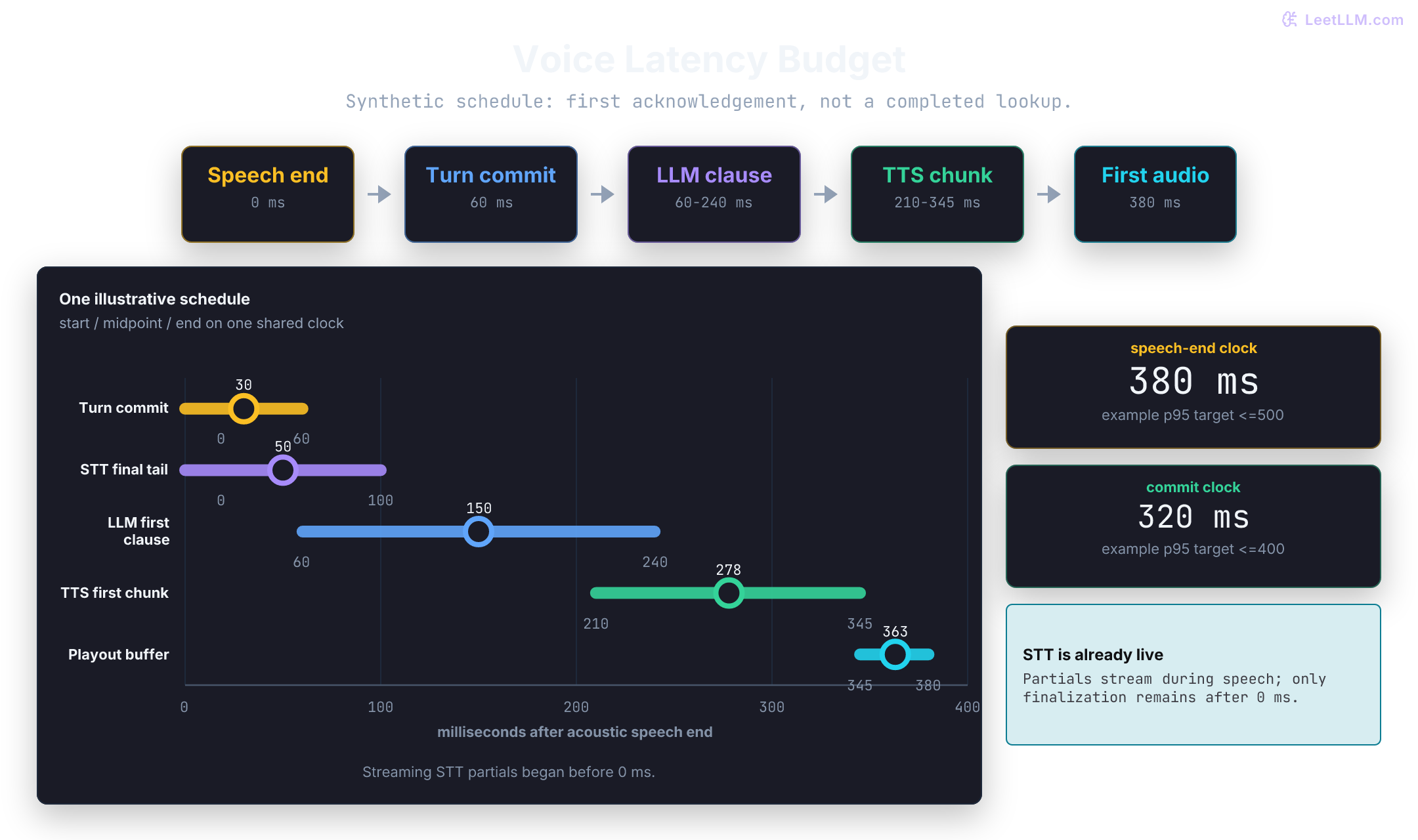
Trace the ranges from one shared event: acoustic speech end at 0ms. Streaming STT has already been consuming frames during the utterance, so only its finalization tail remains after speech ends. Read-only preparation may also be warm before commit. TTS starts only after an accepted turn yields a stable speakable clause.
Keep the two clocks separate. Speech-end TTFA includes endpointing and commit delay. Commit-to-audio starts at the accepted boundary and measures the internal response path. Streaming STT begins during speech rather than waiting for either clock.
Use this invented schedule for Alex's query. At 60ms the endpoint policy accepts that the turn ended, but STT finalization continues to 100ms. The first clause is an acknowledgement such as "I'll check that," not a claim about an incident whose identifier or tool result is still unresolved:
| Stage | Position relative to acoustic speech end | What's happening |
|---|---|---|
| Streaming STT partials | Begin during speech, often before 0ms | Decoder emits "What is incident" while Alex is still talking |
| Turn commit | 0-60ms | Semantic end-of-turn (or hybrid policy) accepts that Alex's turn is complete; not a pure silence-threshold wait |
| STT finalization tail | 0-100ms | Final transcript catches up with audio already streamed during speech |
| First speakable LLM tokens / clause fragment | 60-240ms | Post-commit generation streams tokens; a speakable fragment can be ready before the full clause ends |
| First TTS chunk | 210-345ms | Synthesizer starts on the first speakable fragment (here at 210ms), while the clause may still finish at 240ms |
| Playout buffer | 345-380ms | Jitter buffer smooths network variance before the speaker |
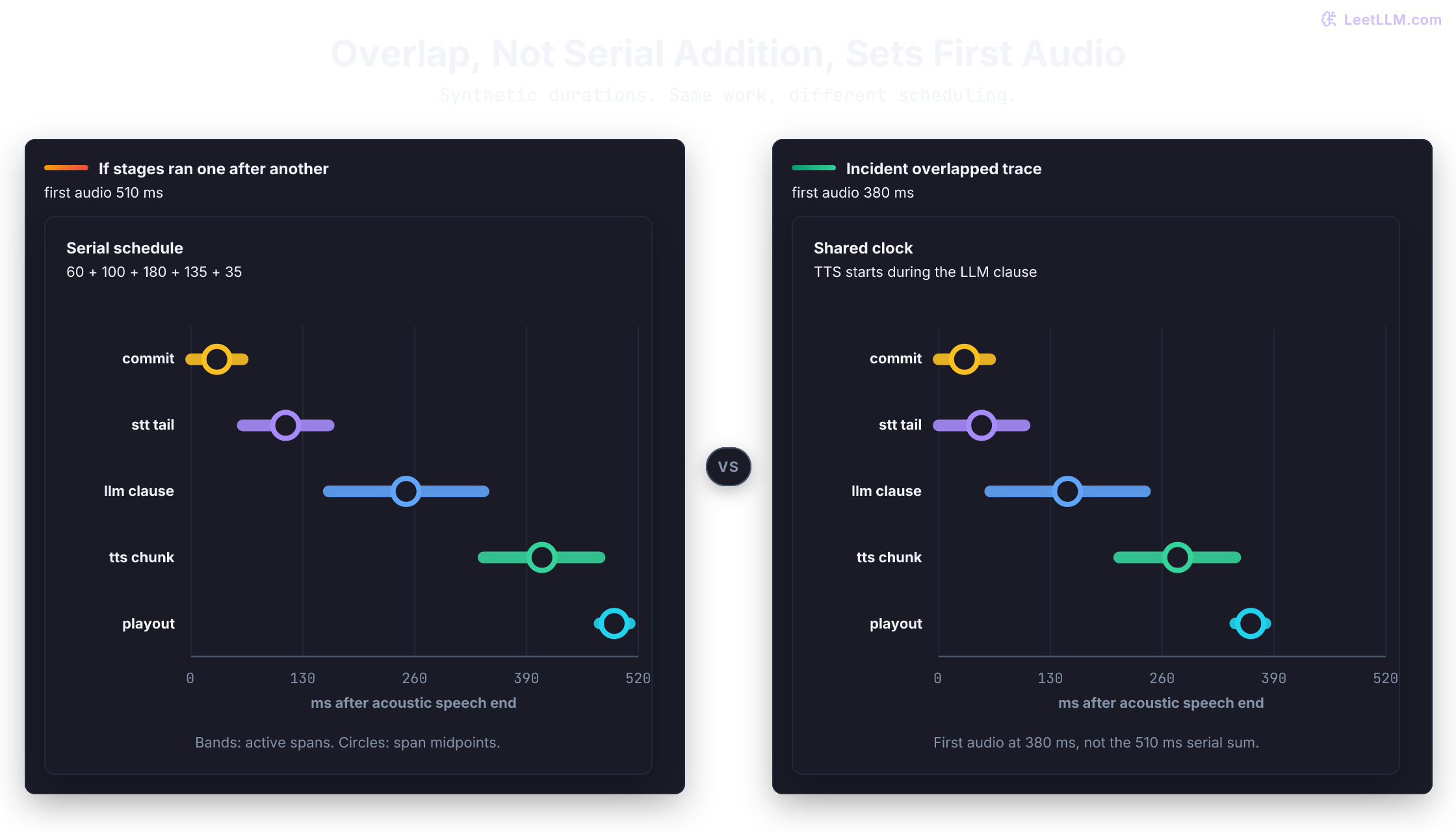
If the post-speech spans ran one after another, their durations would add to about 510ms. In practice:
- STT started decoding before Alex finished the word "incident," so its full decoding cost isn't added after speech end.
- The orchestrator can pre-classify intent or start a cancellable read-only lookup from stable words; it can't commit an incident number, speak a result, or perform a side effect from an unstable transcript.
- After turn commitment, TTS starts synthesizing a speakable acknowledgement such as "I'll check that," before the full clause is finished. This overlap lets the TTS window open at 210ms while the LLM clause window still ends at 240ms. Finding the incident remains a separate tool result.
- The
0-60mscommit window assumes semantic end-of-turn or an early-commit policy, not a fixed ~300ms silence threshold alone. Pure silence endpointing that waits ~300ms after speech end can't hit a 60ms commit; use the longer silence budget only when semantic EOT is unavailable or unreliable.
This candidate trace plays first audio 380ms after acoustic speech end and 320ms after turn commit. Those numbers describe one path, not a rollout decision. Ship only after measuring p50/p95 for both clocks alongside incorrect-commit rate, endpointing aggressiveness, model size, and network jitter.
import json

# One synthetic schedule, in milliseconds after acoustic speech end.
spans = {
    "endpoint_commit": (0, 60),
    "stt_finalization": (0, 100),
    "llm_first_clause": (60, 240),
    "tts_first_chunk": (210, 345),
    "playout_buffer": (345, 380),
}
speech_end_ms = 0
turn_commit_ms = spans["endpoint_commit"][1]
first_audio_ms = spans["playout_buffer"][1]
speech_end_target_ms = 500
commit_target_ms = 400

print(json.dumps({
    "sequential_sum_ms": sum(end - start for start, end in spans.values()),
    "speech_end_to_first_audio_ms": first_audio_ms - speech_end_ms,
    "commit_to_first_audio_ms": first_audio_ms - turn_commit_ms,
    "speech_end_target_ms": speech_end_target_ms,
    "commit_target_ms": commit_target_ms,
    "meets_speech_end_trace_target": first_audio_ms - speech_end_ms <= speech_end_target_ms,
    "meets_commit_trace_target": first_audio_ms - turn_commit_ms <= commit_target_ms,
    "ship_decision_requires_p95": True,
}, indent=2)){
"sequential_sum_ms": 510,
"speech_end_to_first_audio_ms": 380,
"commit_to_first_audio_ms": 320,
"speech_end_target_ms": 500,
"commit_target_ms": 400,
"meets_speech_end_trace_target": true,
"meets_commit_trace_target": true,
"ship_decision_requires_p95": true
}Why is the sequential latency sum misleading?
Answer
Production voice pipelines overlap stages. STT starts during speech, reversible preparation can start from stable partials, and TTS can synthesize the first accepted clause before the full answer is done. Measure speech-end-to-audio for user experience and commit-to-audio for the internal response path.
How the pieces fit together
The architecture usually separates three concerns: client-side capture and playback, a latency-sensitive media edge, and the inference pipeline. Picture a call where the LLM p95 stays flat but mobile callers begin hearing gaps. That points first to packet timing, echo, or playout state at the media edge, not to model execution. Decoupling transport from inference makes that diagnosis possible.
In many deployments, a media gateway terminates WebRTC (Web Real-Time Communication) or SIP (Session Initiation Protocol), handles jitter buffers and routing, then forwards audio to inference over an internal low-latency link.[4] Not every system needs a full SFU (Selective Forwarding Unit) for a 1:1 assistant, but most serious deployments still benefit from a dedicated ingress tier close to the user.
Within inference, the voice pipeline orchestrates turn detection, STT or native-audio encoding, LLM reasoning, tool calls, and TTS or audio decoding. A conversation state manager sits alongside the pipeline, keeping track of dialogue turns, client playout offsets, and tool results so the model only commits to what the user heard.
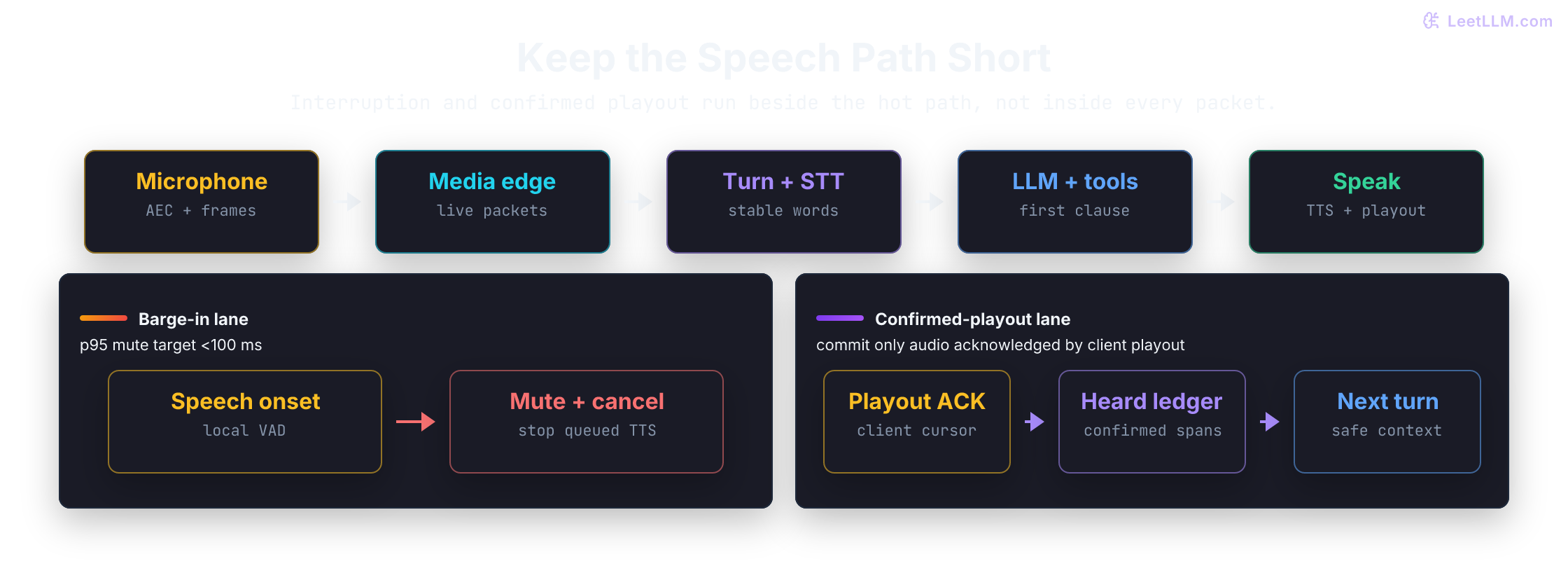
The top row is the hot path. The bottom lanes are control planes: mute as soon as local VAD hears Alex, then record only audio whose playout the client acknowledged. A healthy model can't repair a media path that has already missed its playout deadline.
Why split media transport from inference orchestration?
Answer
Audio transport handles jitter, packet loss, echo, routing, and playback timing. Inference handles STT, tools, LLM, and TTS. Their failure modes and scaling profiles differ.
Knowing when to listen: voice activity detection
Voice Activity Detection (VAD) gives the system frame-level evidence that the user is speaking. In Alex's incident-status call, that evidence can start capture and trigger a fast mute, but it can't by itself say that Alex's question is complete.
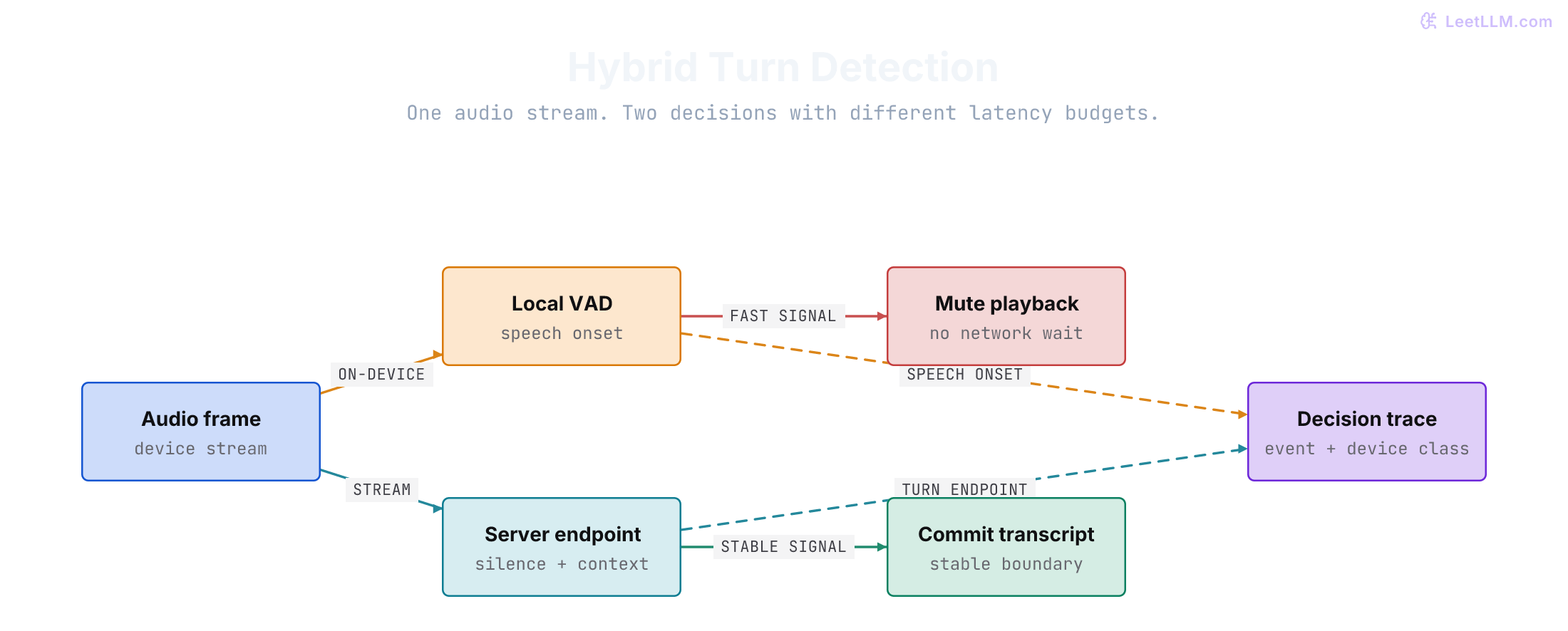
VAD isn't the same thing as turn detection. VAD estimates speech presence in audio windows. Turn detection (endpointing) decides when the user's turn has finished. A hybrid policy can combine silence duration, transcript stability, and a model's estimate of semantic completeness. That permits different waits for "incident four ..." and "thank you," rather than treating every pause alike.[5] Local VAD can still provide the fast interruption signal.
Test the boundary with Alex saying, "incident four ... two ... one ... nine" and pausing between digits. Frame-level VAD may see silence after four; an endpoint that commits there sends an incomplete identifier downstream. Semantic endpointing can hold the turn through those pauses, then commit once the request is complete. The faster signal should mute playback, while the richer signal owns transcript and tool commitment.
Client-side VAD can mute without a network round trip; withholding silence from upload is a separate capture policy. Server-side detection centralizes tuning and can use richer context. The next example consumes invented probabilities, not microphone samples. A real backend such as Silero VAD has its own supported sample rates and input window sizes; these 20ms fixture frames are not its API contract.[6]
from collections import deque
from dataclasses import asdict, dataclass
import json
import math

@dataclass
class VADEvent:
    type: str
    frame: int
    audio_ms: int

class VoiceActivityDetector:
    """Detect speech boundaries from one probability per 20ms audio frame."""

    def __init__(
        self,
        frame_ms: int = 20,
        speech_threshold: float = 0.5,
        silence_duration_ms: int = 60,
        prefix_padding_ms: int = 40,
    ):
        if any(type(value) is not int for value in (frame_ms, silence_duration_ms, prefix_padding_ms)):
            raise ValueError("durations must be integer milliseconds")
        if frame_ms <= 0 or silence_duration_ms <= 0 or prefix_padding_ms < 0:
            raise ValueError("invalid frame, silence, or padding duration")
        if not math.isfinite(speech_threshold) or not 0 <= speech_threshold <= 1:
            raise ValueError("threshold must be finite and in [0, 1]")
        self.frame_ms = frame_ms
        self.speech_threshold = speech_threshold
        self.silence_frames_required = (silence_duration_ms + frame_ms - 1) // frame_ms
        self.pre_roll = deque(maxlen=(prefix_padding_ms + frame_ms - 1) // frame_ms)
        self.next_frame = 0
        self.speech_frames: list[int] = []
        self.in_speech = False
        self.trailing_silence = 0

    def process_frame(self, frame_id: int, probability: float) -> VADEvent | None:
        """Return speech boundary events for one audio frame."""
        if type(frame_id) is not int or frame_id != self.next_frame:
            raise ValueError("frames must be contiguous from zero")
        if type(probability) not in (int, float) or not math.isfinite(probability) or not 0 <= probability <= 1:
            raise ValueError("probability must be finite and in [0, 1]")
        self.next_frame += 1
        if probability >= self.speech_threshold:
            if not self.in_speech:
                self.in_speech = True
                self.speech_frames = list(self.pre_roll)
                self.speech_frames.append(frame_id)
                self.trailing_silence = 0
                return VADEvent("speech_start", frame_id, len(self.speech_frames) * self.frame_ms)
            self.speech_frames.append(frame_id)
            self.trailing_silence = 0
            return None

        if not self.in_speech:
            self.pre_roll.append(frame_id)
            return None

        self.speech_frames.append(frame_id)
        self.trailing_silence += 1
        if self.trailing_silence < self.silence_frames_required:
            return None

        utterance_frames = self.speech_frames[:-self.trailing_silence]
        self.in_speech = False
        self.speech_frames = []
        self.trailing_silence = 0
        self.pre_roll.clear()
        self.pre_roll.extend(range(frame_id - self.silence_frames_required + 1, frame_id + 1))
        return VADEvent("speech_end", frame_id, len(utterance_frames) * self.frame_ms)

probabilities = [0.04, 0.08, 0.66, 0.74, 0.69, 0.22, 0.15, 0.09]
detector = VoiceActivityDetector()
assert VoiceActivityDetector(silence_duration_ms=61).silence_frames_required == 4
events = []

for frame_id, probability in enumerate(probabilities):
    event = detector.process_frame(frame_id, probability)
    if event:
        events.append(asdict(event))

print(json.dumps(events, indent=2))[
{
"type": "speech_start",
"frame": 2,
"audio_ms": 60
},
{
"type": "speech_end",
"frame": 7,
"audio_ms": 100
}
]The demo uses 60ms of silence so its output fits in eight frames. audio_ms counts retained frames, including pre-roll; it isn't the amount of detected speech. A 61ms threshold needs four 20ms frames (80ms), so the code rounds up. It also rejects missing or reordered frames rather than silently shortening time. A live implementation needs a policy for gaps, maximum utterance length, and flushing when the stream closes.
A phone support bot might experiment with 300ms, then tune false cutoffs against lag. Semantic endpointing can hold through a pause inside an incident number or commit earlier when the request appears complete. It can also make mistakes; it doesn't guarantee both lower latency and fewer cutoffs. Evaluate pause-heavy speech, accents, noise, and supported languages together.[5]
VAD deployment: client vs. server
Choosing where to run VAD changes responsiveness, bandwidth, and operational control.
| Feature | Client-Side VAD | Server-Side Detection |
|---|---|---|
| Barge-in reaction | Can mute local playout without a network round trip | Includes transport delay before server action reaches playback |
| Bandwidth | Can suppress silence if upload policy uses its output | Receives the configured upstream stream continuously |
| Operational control | Requires testing across device/browser classes | Centralizes threshold and model tuning |
| Turn consistency | Device signals may differ | Can apply one server-side commit policy |
| Data exposure | Reduced only if capture/upload policy withholds silent frames | Depends on retained audio and server policy |
Many production systems use both: local VAD to mute playback without a network round trip, plus server-side turn detection to accept turn boundaries. A local false positive is an interruption defect; a server false positive can truncate a number or fire a tool. Log each event with its type and device class: speech onset and turn completion are different events, so their timestamp difference alone isn't a disagreement.
Why run both local VAD and server-side turn detection?
Answer
Local VAD can mute local playback quickly and can suppress silence before upload when configured to do so. Server-side detection (silence endpointing plus a semantic end-of-turn model) gives centralized boundaries and richer context for deciding when the turn is truly complete, beyond the moment audio goes quiet.
Acoustic echo cancellation (AEC)
Acoustic echo cancellation (AEC) prevents the agent from hearing itself. When the agent speaks and the user interrupts, the microphone picks up both the user's voice and the agent's own output playing from the speaker. Without AEC, the VAD would trigger on the agent's voice, creating an echo loop where the agent transcribes its own speech and responds to it.
Modern browser capture stacks expose echo-cancellation constraints so applications can request microphone input with system or remote audio removed before it reaches VAD and STT.[7] The browser or device owns that processing, and implementations vary. Treat the constraint as a request, then test the resulting audio path across speaker volume, microphone placement, rooms, and device classes.
One common failure is deploying voice agents without AEC testing in real acoustic environments. Laptop speakers and microphones placed close together, as in mobile phones, create strong echo that untested AEC configurations may fail to suppress. The symptom is brutal: the agent interrupts itself.
What happens if echo cancellation fails during agent playback?
Answer
The microphone can capture the agent's own voice, VAD treats it as user speech, STT transcribes it, and the agent can interrupt or respond to itself.
From sound to text: speech-to-text
Two primary approaches exist for real-time STT. In Alex's call, streaming STT lets the system recognize "What is incident" before Alex finishes saying "incident." That early text is useful only if the orchestrator knows which actions are safe to reverse.
Streaming STT (recommended for latency)
Streaming STT sends partial transcripts as audio arrives, allowing the LLM to pre-read the turn and start cancellable, read-only preparation before the utterance is complete. Provider SDKs differ, but the state machine must separate unstable interim text from committed text that may enter history, trigger tools, or reach TTS.
from dataclasses import asdict, dataclass
import json

@dataclass
class TranscriptEvent:
    kind: str
    text: str
    stable_prefix: str

def common_prefix(left: str, right: str) -> str:
    shared = []
    for left_word, right_word in zip(left.split(), right.split()):
        if left_word != right_word:
            break
        shared.append(left_word)
    return " ".join(shared)

def emit_transcript_events(partials: list[tuple[str, bool]]) -> list[TranscriptEvent]:
    events = []
    previous_text = ""

    for text, is_final in partials:
        if type(is_final) is not bool:
            raise ValueError("is_final must be boolean")
        stable_prefix = text if is_final else common_prefix(previous_text, text)

        if is_final:
            events.append(TranscriptEvent("final", text, stable_prefix))
        else:
            events.append(TranscriptEvent("interim", text, stable_prefix))
        previous_text = text

    return events

partials = [
    ("What is", False),
    ("What is incident", False),
    ("What is incident number four two", False),
    ("What is incident number four two one nine?", True),
]

print(json.dumps([asdict(event) for event in emit_transcript_events(partials)], indent=2))[
{
"kind": "interim",
"text": "What is",
"stable_prefix": ""
},
{
"kind": "interim",
"text": "What is incident",
"stable_prefix": "What is"
},
{
"kind": "interim",
"text": "What is incident number four two",
"stable_prefix": "What is incident"
},
{
"kind": "final",
"text": "What is incident number four two one nine?",
"stable_prefix": "What is incident number four two one nine?"
}
]The shared-prefix heuristic is intentionally conservative: it only exposes words repeated across two successive hypotheses. Even that prefix is tentative because a provider can revise earlier words later. Ask what should happen when the partial reads Close incident four two one nine: classify it and prefetch a read-only record, but don't write history, speak a result, or close anything. The commit boundary matters most when a partial transcript changes meaning. An incident lookup may be safe to prefetch and discard; closing an incident or promising mitigation status isn't.
import json

def permitted_actions(text: str, committed: bool) -> list[str]:
    if type(committed) is not bool:
        raise ValueError("committed must be boolean")
    actions = ["classify_intent"]
    if "incident" in text.lower():
        actions.append("prefetch_read_only_status")
    if committed:
        actions.extend(["write_history", "speak_response"])
        if "close" in text.lower():
            actions.append("ask_for_close_confirmation")
    return actions

events = [
    {"text": "Close incident four two one nine", "committed": False},
    {"text": "Show incident four two one nine", "committed": True},
    {"text": "Show incident four two one nine", "committed": "false"},
]

decisions = []
for event in events:
    try:
        decisions.append({"committed": event["committed"], "actions": permitted_actions(**event)})
    except ValueError as error:
        decisions.append({"committed": event["committed"], "error": str(error)})

assert "speak_response" not in permitted_actions(events[0]["text"], False)
assert "speak_response" in permitted_actions(events[1]["text"], True)
assert "error" in decisions[2]
print(json.dumps(decisions, indent=2))[
{
"committed": false,
"actions": [
"classify_intent",
"prefetch_read_only_status"
]
},
{
"committed": true,
"actions": [
"classify_intent",
"prefetch_read_only_status",
"write_history",
"speak_response"
]
},
{
"committed": "false",
"error": "committed must be boolean"
}
]JSON false is a boolean; "false" is a nonempty string and therefore truthy in Python. The third event must be rejected rather than admitting speech and history. Validate the adapter's flags before this gate; a well-typed flag still needs an authoritative turn/transcript decision and caller authorization.
End-of-utterance STT
Using a batch recognizer such as Whisper[8] after an endpoint event is much simpler, but it adds the endpoint wait and full decode after the user stops talking.
import json

def batch_stt_timeline(speech_ms: int, endpoint_ms: int, decode_ms: int) -> dict[str, int | str]:
    acoustic_speech_end_ms = speech_ms
    turn_commit_ms = acoustic_speech_end_ms + endpoint_ms
    transcript_ready_ms = turn_commit_ms + decode_ms
    return {
        "approach": "end-of-utterance",
        "speech_ms": speech_ms,
        "endpoint_ms": endpoint_ms,
        "decode_ms": decode_ms,
        "acoustic_speech_end_ms": acoustic_speech_end_ms,
        "turn_commit_ms": turn_commit_ms,
        "first_transcript_ms": transcript_ready_ms,
    }

print(json.dumps(batch_stt_timeline(speech_ms=1200, endpoint_ms=300, decode_ms=450), indent=2)){
"approach": "end-of-utterance",
"speech_ms": 1200,
"endpoint_ms": 300,
"decode_ms": 450,
"acoustic_speech_end_ms": 1200,
"turn_commit_ms": 1500,
"first_transcript_ms": 1950
}| Approach | Latency | Complexity |
|---|---|---|
| Streaming STT | Measure first partial, stable text, and final transcript separately | Revisions and turn state |
| End-of-utterance | Endpoint wait plus decode; 750ms after speech in this fixture | Simpler scheduling |
When is batch STT acceptable, and when is it a bad fit?
Answer
Batch STT suits recordings and may suit short commands or prototypes whose latency budget permits it. For a live call, measure the endpoint wait plus decode cost before accepting the simpler design.
Speak a first clause, not a full plan
After turn commitment, the LLM should emit a stable first speakable clause without waiting for a long response plan. Before commitment, the system may only do reversible preparation. That makes Time-to-First-Token (TTFT) relevant without letting an unstable transcript become spoken truth. The serving mechanics are in Inference Mechanics.
Long reasoning and slow tools are a poor fit for the acknowledgement path unless measurements still meet the TTFA objective. The agent can say an honest status quickly, run the slow work in the background, and speak the result when it lands.
Give the first clause one job: tell Alex something true and useful now. Separate the spoken channel from display text: avoid reading Markdown syntax aloud, pronounce incident digits deliberately, and keep clauses short. This template example formats an already verified status; it doesn't call an LLM or stream tokens.
import json

def voice_chunks(incident_status: dict[str, str]) -> list[str]:
    status = incident_status["status"]
    if status not in {"open", "closed"}:
        raise ValueError("a verified open or closed status is required")
    spoken_status = "still open" if status == "open" else "closed"
    reply = (
        f"Incident {incident_status['id']} is {spoken_status}. "
        f"Severity is {incident_status['severity']}. "
        "I can text you the incident link."
    )
    clauses = [part.strip() + "." for part in reply.split(".") if part.strip()]
    return clauses

transcript = "What is incident number four two one nine?"
chunks = voice_chunks(
    incident_status={"id": "4219", "severity": "sev-two", "status": "open"},
)

assert voice_chunks({"id": "4219", "severity": "sev-two", "status": "closed"})[0] == "Incident 4219 is closed."
print(json.dumps({
    "contains_incident": "incident" in transcript.lower(),
    "max_words_per_clause": max(len(clause.split()) for clause in chunks),
    "streamed_clauses": chunks,
}, indent=2)){
"contains_incident": true,
"max_words_per_clause": 7,
"streamed_clauses": [
"Incident 4219 is still open.",
"Severity is sev-two.",
"I can text you the incident link."
]
}The formatter now uses the supplied status; a closed record must not become “still open.” Its caller supplies an authorized, current tool result and verifies that offering to text a link is a supported capability. For this hotline, also test how TTS pronounces 4219 and sev-two: correct text that sounds like the wrong identifier can still send Alex to the wrong incident.
Slow tools don't get to steal the first word
A status lookup, page request, or ticket creation can finish quickly or stall. Human acknowledgement is a separate event from a service accepting a page. If a result isn't ready by the first-clause deadline, speak an honest acknowledgement and continue the work asynchronously. Don't narrate a result you don't have yet.
Don't predict a successful result from a fast latency estimate. The next helper takes an actual tool state supplied by the application: pending, succeeded, or failed. Its 200ms decision point leaves an illustrative 200ms for synthesis, transport, and playout inside the 400ms post-commit budget. That reserve must be measured in a real service.
import json

COMMIT_TO_AUDIO_BUDGET_MS = 400
SPEECH_PATH_RESERVE_MS = 200

def first_speakable(intent: str, tool_state: str, *, authorized: bool,
                    confirmed: bool = False, status: str | None = None) -> str:
    if tool_state not in {"pending", "succeeded", "failed"}:
        raise ValueError("unknown tool state")
    if authorized is not True:
        return "I can't perform that request with this session's permissions."
    if intent in {"page_owner", "close_incident"} and confirmed is not True:
        return "Please confirm that action and incident number."
    if tool_state == "failed":
        return "That request failed. I haven't confirmed a change."
    if intent == "lookup_status" and tool_state == "succeeded" and status in {"open", "closed"}:
        return f"Incident 4219 is {status}."
    if intent == "page_owner" and tool_state == "succeeded":
        return "The paging service accepted the page."
    if intent == "close_incident" and tool_state == "succeeded":
        return "The incident service confirmed the close."
    return "I'm checking the request. I'll tell you when I have a result."

print(json.dumps([
    first_speakable("lookup_status", "succeeded", authorized=True, status="open"),
    first_speakable("page_owner", "pending", authorized=True, confirmed=True),
    first_speakable("close_incident", "succeeded", authorized=True),
], indent=2))
assert COMMIT_TO_AUDIO_BUDGET_MS - SPEECH_PATH_RESERVE_MS == 200
assert "failed" in first_speakable("page_owner", "failed", authorized=True, confirmed=True)[
"Incident 4219 is open.",
"I'm checking the request. I'll tell you when I have a result.",
"Please confirm that action and incident number."
]Why separate spoken output from display formatting?
Answer
Markdown syntax and long preambles can sound awkward when read aloud. Produce short spoken clauses, and test identifier pronunciation separately from display text.
What should the agent say if paging the owner takes 2.4 seconds?
Answer
After authorization and any required confirmation, acknowledge that the request is pending. Continue the tool asynchronously, and report acceptance or failure only after the service returns a result. A page being accepted doesn't prove that a human read it.
The helper only chooses words; it performs no operation and provides no authorization enforcement. The executor must bind a confirmed action to the authenticated caller, incident, tool arguments, and request ID. Caller ID alone isn't authentication. Recheck authorization before execution, deduplicate retries with an idempotency key, and preserve the service result separately from the spoken transcript. Muting "I paged the owner" can't undo a page already sent. After a timeout, reconcile the original operation rather than submitting a second page blindly.[9]
Serving optimizations that matter in voice
Live voice sessions stress inference differently from chat. TTFT matters more than long-form throughput because TTS can't speak until the first stable clause arrives. Session length also matters because a 20-minute call can accumulate enough context to make KV-cache management part of the latency budget, not a background infrastructure concern. If TTFT rises only on long calls, inspect context growth and cache pressure before swapping models.
- Paged KV caches: Long-lived sessions fragment memory if every request expects one contiguous KV-cache region. PagedAttention-style allocators let serving systems grow and trim per-session context without constant copying, which helps keep latency stable across many simultaneous calls.[10]
- Speculative decoding: A draft model proposes tokens that the target model verifies in parallel, reducing decode latency when acceptance and implementation overhead are favorable.[11] It isn't an automatic TTFT improvement; benchmark TTFA and total clause latency on the served model pair.
- Aggressive context hygiene: Don't keep every interim transcript forever. Preserve final transcripts, tool results, and only the portion of assistant audio the user heard before barge-in.
Prompt caching is prefix economics
Prefix reuse needs matching leading tokens and a cached endpoint the next request can look up. Keep stable policy and examples first, volatile state later. OpenAI's guide, checked October 10, 2026, distinguishes earlier implicit caching from GPT-5.6-and-later explicit/implicit breakpoints.[12] These Responses API rules aren't automatically the rules of a stateful audio session.
Build the prompt in this order:
- Stable policy, output style, and safety instructions.
- Stable tool definitions and few-shot examples.
- Conversation history that grows by appending committed turns.
- Dynamic call state such as current incident result, timestamp, or playback acknowledgement.
Putting current_time=... or a rolling account balance near the top changes early tokens and can turn every later request into a cache miss. Keep volatile facts in a suffix or tool result, but never move instructions merely to chase hits when doing so changes model behavior or the authorization boundary.
Stable text alone isn't sufficient. In the documented GPT-5.6-and-later case, an implicit write through [stable policy][dynamic request A] doesn't separately cache the shorter policy prefix. Replacing A with B misses that entry. An explicit breakpoint after the stable content can write a reusable endpoint; both requests must preserve that boundary and meet minimum length. A prompt_cache_key doesn't create the missing entry.[12]
Measure economics directly:
Use disjoint read, write, and ordinary-input counts. Some routes charge cache writes separately; OpenAI's current guide reports cached_tokens and cache_write_tokens for the newer mechanism.[12] Each C is a price per token; divide a per-million price by one million. Sum text and audio costs separately. Where writes carry the ordinary rate, fold them into ordinary input. Measure total call cost and TTFA alongside hit fraction; a hit doesn't repair endpointing, tools, TTS, or playout.
Why should the current incident status appear after stable voice instructions and tool schemas?
Answer
The status changes often, so placing it near the top changes early tokens. Preserve the stable prefix and, where required, its cache-write/lookup breakpoint. Verify usage metadata, write/read costs, latency, and unchanged behavior on the actual route.
Why should interim transcripts not live forever in voice-agent context?
Answer
Interim text can be wrong and bloats long sessions. Keep final transcripts, tool results, and assistant audio actually heard; drop unstable partials and truncated speech.
Speaking without waiting for the full answer: TTS with streaming
Begin speaking before the full response is generated. The TTS engine receives a stream of text tokens, buffers them into sentences or phrases, and synthesizes audio chunks on the fly. The first chunk should answer the immediate question; later chunks can carry detail.
Waiting for the LLM to finish an entire sentence or paragraph before starting TTS can add seconds of latency. Stream tokens and synthesize clause-by-clause instead.
There are two bad schedules to predict: a full paragraph delays first audio, while one TTS call per token makes the voice stutter. Buffer punctuation or a short character limit, then measure whether the clause sounds natural and arrives inside TTFA.
import json

def flush_speakable_clauses(tokens: list[str], max_chars: int = 52) -> list[str]:
    if type(max_chars) is not int or max_chars <= 0:
        raise ValueError("max_chars must be a positive integer")
    buffer = ""
    flushed = []

    for token in tokens:
        buffer += token
        stripped = buffer.strip()
        if stripped.endswith((",", ".", "!", "?")):
            flushed.append(stripped)
            buffer = ""
        elif len(stripped) >= max_chars:
            # A soft limit: never cut an unfinished word at a token boundary.
            split_at = buffer.rfind(" ", 0, max_chars + 1)
            if split_at > 0:
                flushed.append(buffer[:split_at].strip())
                buffer = buffer[split_at + 1:]

    if buffer.strip():
        flushed.append(buffer.strip())

    return flushed

tokens = [
    "Incident ", "4219 ", "is ", "still ", "open, ",
    "severity ", "is ", "sev-two. ",
    "I ", "can ", "text ", "the ", "incident ", "link."
]

print(json.dumps(flush_speakable_clauses(tokens), indent=2))[
"Incident 4219 is still open,",
"severity is sev-two.",
"I can text the incident link."
]This punctuation heuristic is deliberately small. It doesn't understand decimal numbers, abbreviations, code-switching, or prosody, and its size limit is soft. A real adapter needs provider-specific chunking, cancellation, and a bounded queue. If synthesis outruns playback, stop or pause production before queued audio creates a long interruption tail. Measure audio generation rate against playback duration as well as first-chunk latency.
How parallel execution reduces latency
The end-to-end target starts at acoustic speech end. The internal target starts at turn commit. Those clocks only close if stages overlap:
- VAD runs continuously, watching frames as they arrive and contributing a speech-end signal to endpointing.
- Streaming STT is already running during speech. Silence doesn't start recognition; it helps the endpoint policy decide when the current turn may commit.
- Reversible LLM preparation can start from stable STT partials. Spoken or side-effecting work still waits for turn commitment.
- TTS begins synthesizing as soon as the committed response has a stable speakable clause, which may be well before the LLM finishes.
- Audio playback begins as soon as the first TTS chunk is ready.
On the incident trace, first audio is 380ms after speech end. If the same span durations ran one after another, first audio would be 510ms. The gain comes from schedule overlap: STT works during speech, and TTS starts while the LLM is still finishing its clause.
Why synthesize clauses instead of individual tokens or full paragraphs?
Answer
Token-level TTS sounds choppy, while paragraph-level TTS adds seconds. Clause buffering gives natural phrasing while keeping first audio fast.
When the user interrupts: barge-in handling
When the user speaks over the agent ("barge-in"), the system has to react immediately. Alex asks about an incident, the agent starts explaining mitigation, and Alex cuts in with "Wait, page the owner." The agent must stop talking, cancel leftover generation, and remember only what actually played. Treat this as a state transition, not as a UI mute: the next turn must start from the heard boundary.
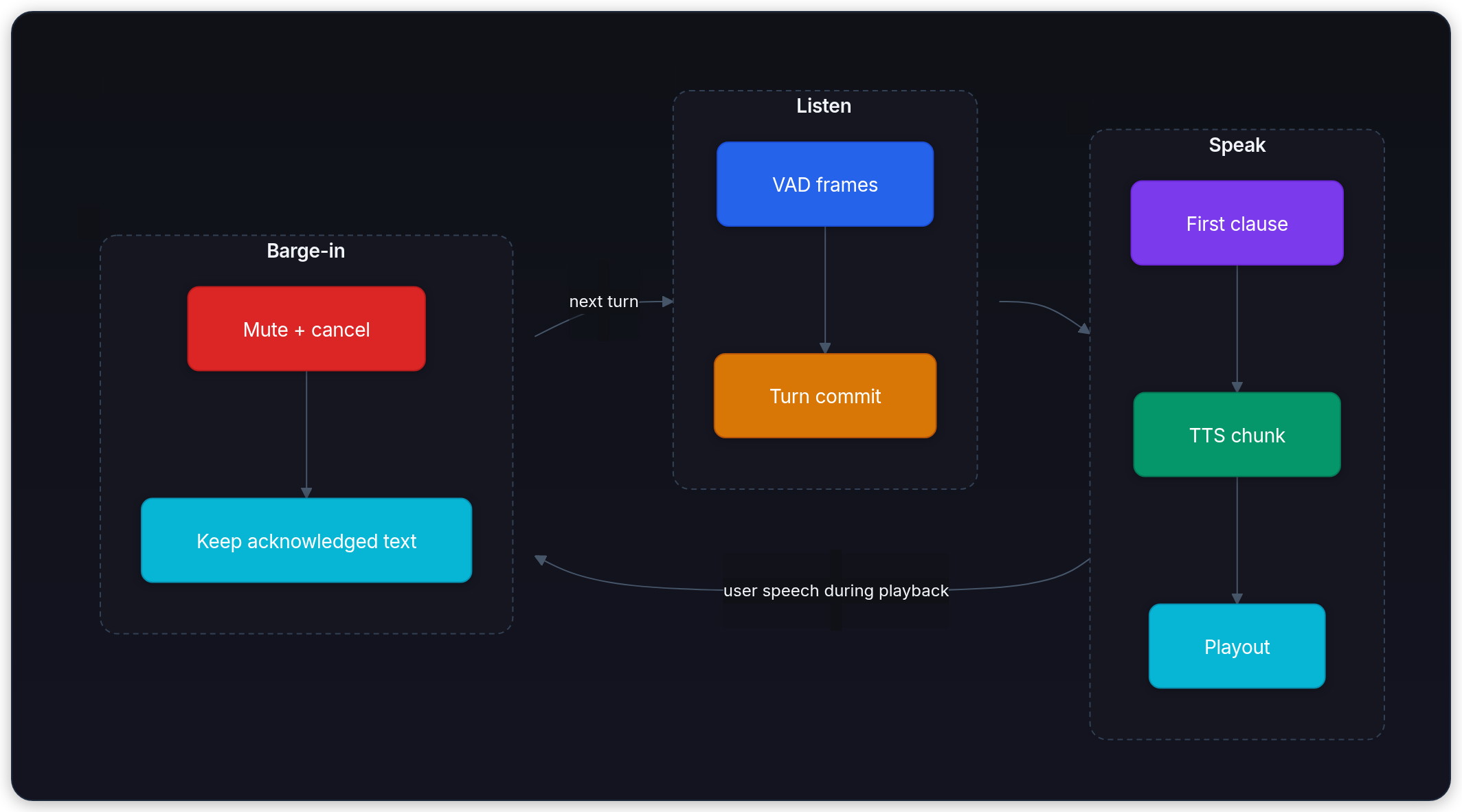
Local VAD fires the mute. Server endpointing still decides when the new user turn is committed. Those signals form one control loop: fast local action first, authoritative transcript boundary second.
- Stop Playback: Halt the audio output. A support product might begin with a p95 mute target below 100ms, then tune against measured paths.
- Cancel Generation: Abort in-flight TTS and LLM requests to save cost and compute.
- State Reconciliation: Update conversation context to reflect only what the user heard.
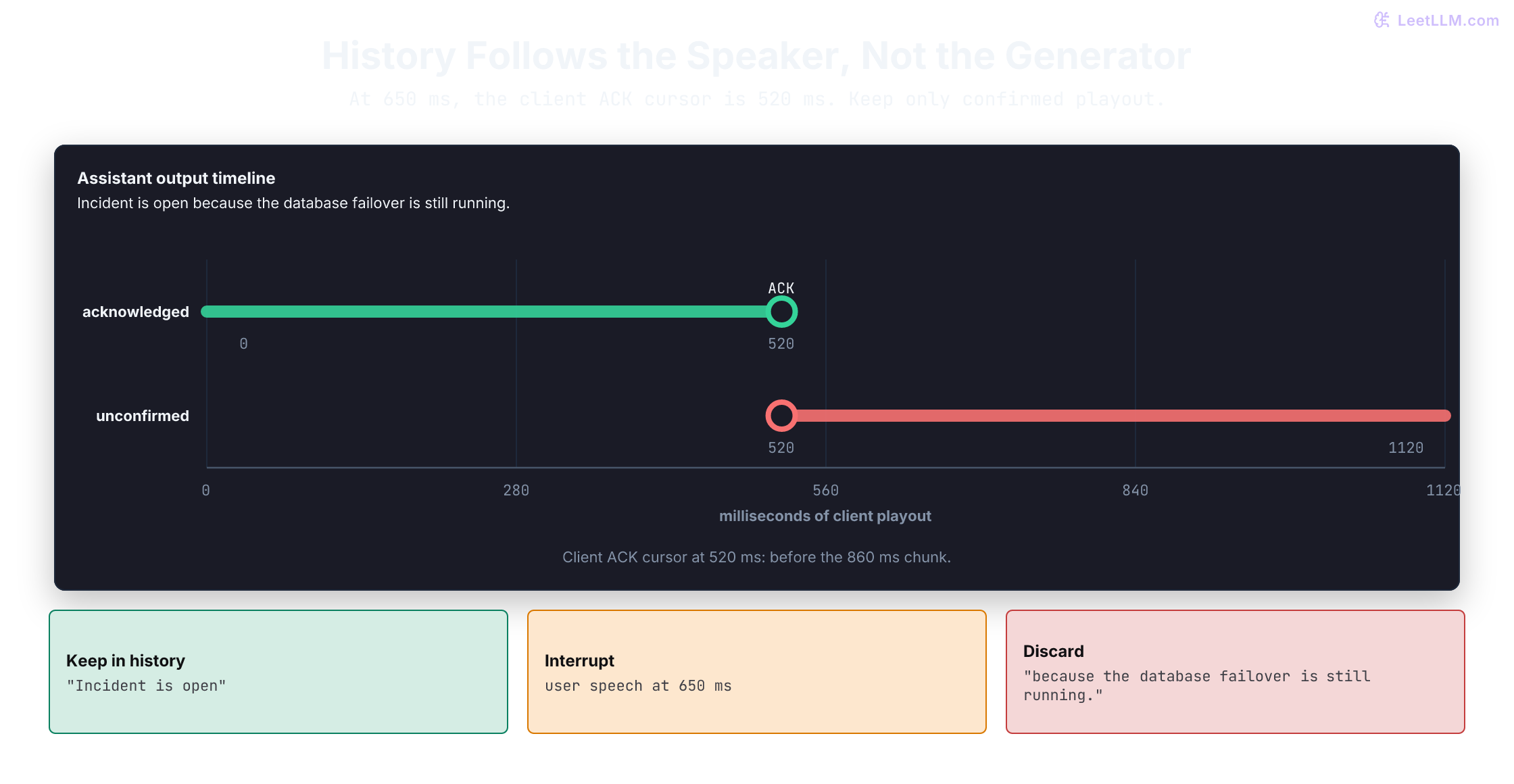
Stopping the speaker is only half of barge-in. Suppose Alex interrupts at 650ms and the latest client playout acknowledgement reports a cursor of 520ms. The next model call should remember the clause through that cursor, not the mitigation text that was still buffered or in flight.
Use conservative reconciliation at audio-chunk boundaries. When VAD detects fresh user speech during agent playback, stop playout, cancel in-flight generation, and truncate assistant text to the portion confirmed by the latest client playout acknowledgement. Finer timestamps can reduce the amount discarded, but they must still describe playout, not output receipt or generation.
from dataclasses import dataclass
import json

@dataclass
class PlayoutChunk:
    text: str
    text_end_char: int  # Exclusive end offset in pending_text.
    playout_end_ms: int

class InterruptionHandler:
    def __init__(self, pending_text: str, playout_chunks: list[PlayoutChunk], response_id: str = "reply-1"):
        if "".join(chunk.text for chunk in playout_chunks) != pending_text:
            raise ValueError("chunks must reconstruct the pending text")
        chars = previous_ms = 0
        for chunk in playout_chunks:
            chars += len(chunk.text)
            if (type(chunk.text_end_char) is not int or type(chunk.playout_end_ms) is not int
                    or chunk.text_end_char != chars or chunk.playout_end_ms <= previous_ms):
                raise ValueError("invalid text alignment or playout ordering")
            previous_ms = chunk.playout_end_ms
        self.pending_text = pending_text
        self.playout_chunks = playout_chunks
        self.response_id = response_id
        self.cancelled = False
        self.frozen_cursor = None

    def accept_audio(self, response_id: str) -> bool:
        return response_id == self.response_id and not self.cancelled

    def reconcile(self, playout_cursor_ms: int, *, response_id: str) -> dict[str, object]:
        if response_id != self.response_id:
            raise ValueError("playback acknowledgement belongs to a different response")
        duration = self.playout_chunks[-1].playout_end_ms if self.playout_chunks else 0
        if type(playout_cursor_ms) is not int or not 0 <= playout_cursor_ms <= duration:
            raise ValueError("invalid response-local playout cursor")
        if self.frozen_cursor is None:
            self.frozen_cursor = playout_cursor_ms
        self.cancelled = True
        playout_cursor_ms = self.frozen_cursor
        heard_chars = self._chars_heard(playout_cursor_ms)
        spoken_text = self.pending_text[:heard_chars].rstrip()
        discarded_text = self.pending_text[heard_chars:].strip()
        return {
            "history_to_keep": [{"role": "assistant", "content": spoken_text}] if spoken_text else [],
            "discarded_generated_text": discarded_text,
        }

    def _chars_heard(self, playout_cursor_ms: int) -> int:
        heard_chars = 0
        for chunk in self.playout_chunks:
            if chunk.playout_end_ms <= playout_cursor_ms:
                heard_chars = chunk.text_end_char
            else:
                break
        return heard_chars

pending = "Incident is open because the database failover is still running."
chunks = [
    PlayoutChunk("Incident is", 11, 240),
    PlayoutChunk(" open", 16, 520),
    PlayoutChunk(" because the database", 37, 860),
    PlayoutChunk(" failover is still running.", 64, 1120),
]

# At the 650ms interrupt, the latest client acknowledgement is 520ms.
handler = InterruptionHandler(pending, chunks)
assert handler.accept_audio("reply-1") and not handler.accept_audio("old-reply")
result = handler.reconcile(playout_cursor_ms=520, response_id="reply-1")
assert not handler.accept_audio("reply-1")
assert handler.reconcile(1120, response_id="reply-1") == result  # A late event cannot extend the cancelled reply.
try:
    InterruptionHandler("Incident is open", [PlayoutChunk("Incident is open", 16.0, 520)])
except ValueError:
    pass
else:
    raise AssertionError("float text offset must be rejected before slicing")
new_reply = InterruptionHandler(pending, chunks, response_id="reply-2")
try:
    new_reply.reconcile(520, response_id="reply-1")
except ValueError as error:
    assert str(error) == "playback acknowledgement belongs to a different response"
else:
    raise AssertionError("old response ACK must not cancel the new reply")
assert not new_reply.cancelled and new_reply.frozen_cursor is None
print(json.dumps(result, indent=2)){
"history_to_keep": [
{
"role": "assistant",
"content": "Incident is open"
}
],
"discarded_generated_text": "because the database failover is still running."
}The fixture validates that chunk text reconstructs the 64-character reply and that integer offsets increase with integer playout time. A float offset such as 16.0 compares equal to 16 but cannot slice a Python string, so reject it during alignment validation. Offset 16 keeps pending_text[:16], or "Incident is open". Zero acknowledged audio produces no assistant-history entry. Cancellation freezes the cursor and rejects late audio for that response; each new reply needs a new ID and state object.
A delayed reply-1 acknowledgement can carry a valid 520ms cursor after reply-2 starts. Checking the number alone would cancel the new reply and attach its words to the old playback event. The regression rejects that response mismatch before freezing any cursor or changing cancellation state. The adapter must also bind these events to the authenticated session.
"Heard" here means client-confirmed playout, not proof of human perception. Muted speakers, lost acknowledgements, and partially played chunks make that distinction important. The latest ACK is a conservative lower bound. A live interruption protocol can obtain a final cursor after stopping the audio sink; it must bind that cursor to the correct session and response before updating history. RTP receipt alone isn't a playout acknowledgement. Keep tool execution records even when their spoken description is discarded.
Why must barge-in history use "heard" text, not generated text?
Answer
The user may interrupt before playback finishes. If history includes unheard generated text, the model assumes shared context that the user never received, causing confusing follow-ups.
Cascaded pipeline vs. native audio
Design reviews often ask you to compare two families: cascaded STT -> LLM -> TTS pipelines and native speech-to-speech models. Early research systems such as AudioPaLM and SpeechGPT showed the idea was viable.[2][3] Native audio is now a production API option. OpenAI's Realtime API supports live speech-to-speech sessions.[13] Google's Gemini Live API is a stateful WebSocket session with native audio, automatic voice-activity detection, barge-in, transcripts, and tool use.[14]
Choose transport from where the audio lives: WebRTC for browser and mobile capture, a WebSocket session when your server already has PCM, and SIP when the caller is on the phone network. If the speech model only speaks WebSocket, terminate WebRTC at the media edge and forward PCM. Provider model catalogs change quickly, so verify current aliases when you implement the route.
Native models reduce model handoffs and can retain prosodic signals that a text-only boundary loses. They don't remove transport, VAD, AEC, or state-management problems. Gemini's capabilities guide still labels Live API Preview when checked October 10, 2026.[15] Check each provider's history semantics: Gemini documents retaining information already sent to the client after interruption, which may include buffered, unplayed output. That isn't this application's confirmed-playout rule. Stop queued playback and define how to reconcile future context.[15] OpenAI cautions that asynchronous input transcription is guidance, not an exact account of what its audio model perceived.[16]
Make the choice with a failure question: if a caller disputes what the agent said, can you inspect the transcript, tool decision, and exact played audio? Cascading exposes those boundaries and makes component swaps easier. Native audio may shorten the model path, but it still needs those side channels when policy, auditability, or deterministic tools matter.
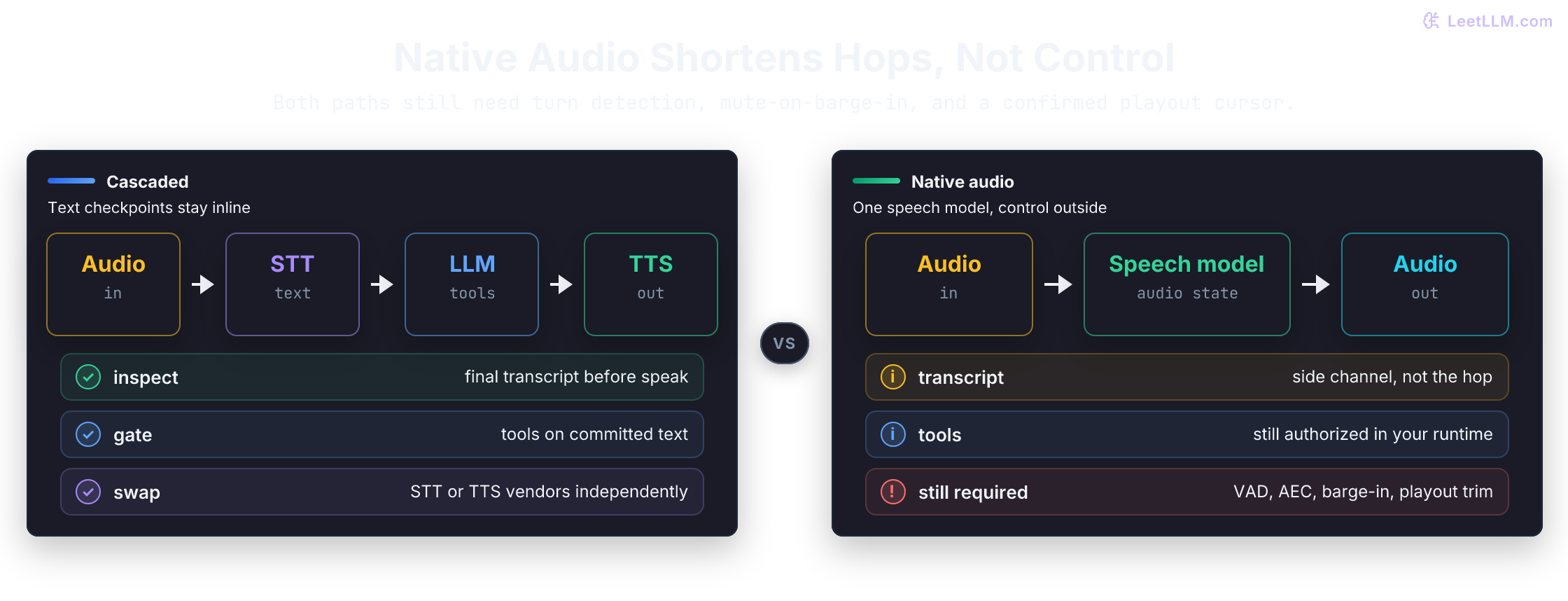
⚠️ Common mistake: Treating a model's WebSocket connection as a complete browser-audio stack. Direct WebSocket designs are possible, but capture, echo control, playout, and buffering still need an owner. A WebRTC media edge is one way to provide that boundary, not a prerequisite imposed by the model API.
Many commercial native-audio APIs use stateful sessions, not one-shot request/response calls. The client streams audio frames in, then receives incremental audio and transcript events back.
Session shape
In this single-response simulation, audio_delta means output reached a client buffer, not a speaker. playback_ack is an invented application event emitted after the audio sink consumes a range; it isn't a provider event name. Both counters are response-local milliseconds. Real adapters must also track session, response, item, and audio-part IDs, plus duplicate events and cancellation.
Gemini can return multiple output parts in one server message. Process every part and applicable control field; an if/elif parser that handles only audio can silently miss a transcript, interruption, or tool event.[15]
OpenAI's conversation.item.truncate accepts an assistant item_id, content_index (currently documented as 0), and audio_end_ms. The API documents deleting server-side transcript text when truncating audio, not returning a precisely word-aligned prefix. Wait for its acknowledgement and handle errors. The local text-alignment fixture above is a separate application contract, not a reproduction of this provider's internal state.[16]
from collections import defaultdict
import json

events = [
    {"type": "transcript_delta", "text": "Incident is"},
    {"type": "audio_delta", "audio_ms": 160},
    {"type": "playback_ack", "playout_cursor_ms": 160},
    {"type": "transcript_delta", "text": " still open."},
    {"type": "audio_delta", "audio_ms": 220},
    {"type": "tool_call", "name": "send_incident_link"},
]

state = defaultdict(list)
received_audio_ms = 0
confirmed_playout_ms = 0

for event in events:
    if event["type"] == "audio_delta":
        if type(event["audio_ms"]) is not int or event["audio_ms"] <= 0:
            raise ValueError("audio duration must be a positive integer")
        received_audio_ms += event["audio_ms"]
    elif event["type"] == "playback_ack":
        cursor = event["playout_cursor_ms"]
        if type(cursor) is not int or cursor < confirmed_playout_ms or cursor > received_audio_ms:
            raise ValueError("playback acknowledgement must be monotonic and <= received audio")
        confirmed_playout_ms = cursor
    elif event["type"] == "transcript_delta":
        state["transcript"].append(event["text"])
    elif event["type"] == "tool_call":
        state["tool_calls"].append(event["name"])

print(json.dumps({
    "transcript_side_channel": "".join(state["transcript"]),
    "received_audio_ms": received_audio_ms,
    "confirmed_playout_ms": confirmed_playout_ms,
    "received_not_confirmed_ms": received_audio_ms - confirmed_playout_ms,
    "tool_calls": state["tool_calls"],
}, indent=2)){
"transcript_side_channel": "Incident is still open.",
"received_audio_ms": 380,
"confirmed_playout_ms": 160,
"received_not_confirmed_ms": 220,
"tool_calls": [
"send_incident_link"
]
}The client received 380ms of output but confirmed only 160ms of playout. The remaining 220ms may be buffered, played but not yet acknowledged, or cancelled. This fixture conservatively excludes it. A tool-call event is only a proposal: collecting its name never authorizes execution. Keep provider credentials on a trusted server or use the provider's supported short-lived client credential flow; don't put a long-lived service key in a browser bundle. Scope session access and retention of recordings, transcripts, and identifiers to the call product's policy.
Tool scheduling also depends on the selected model. The current Gemini guide lists nonblocking function calls for Gemini 3.8 Live and sequential calls for Gemini 3.1 Flash Live Preview.[15] Cancellation can discard a pending proposal; it can't undo a page that your executor already submitted. Keep operation records independently of spoken context.
Sample rates belong to the audio contract
Gemini's overview lists little-endian 16-bit PCM, native 16kHz input and 24kHz output.[14] Its capabilities guide also accepts other input rates when correctly declared and resamples them.[15] Decode any transport codec before a PCM handoff. A MIME label describes the actual samples; changing the label isn't resampling.
How long is a 480-sample chunk? At 24kHz it is 20ms; at 16kHz it is 30ms. This matters both to playback and to the cursor used for interruption. The example counts mono sample frames and bytes, without generating or resampling speech:
import json
from fractions import Fraction

chunk_ms = 20
input_rate = 16_000
output_rate = 24_000
bytes_per_sample = 2  # Mono, 16-bit PCM; excludes protocol overhead.
input_samples = input_rate * chunk_ms // 1000
output_samples = output_rate * chunk_ms // 1000
actual_output_ms = Fraction(output_samples * 1000, output_rate)
mislabeled_output_ms = Fraction(output_samples * 1000, input_rate)

assert input_samples == 320 and output_samples == 480
assert actual_output_ms == 20 and mislabeled_output_ms == 30
print(json.dumps({
    "native_input_20ms_bytes": input_samples * bytes_per_sample,
    "output_20ms_bytes": output_samples * bytes_per_sample,
    "output_samples": output_samples,
    "correct_output_duration_ms": int(actual_output_ms),
    "duration_if_mislabeled_16khz_ms": int(mislabeled_output_ms),
}, indent=2)){
"native_input_20ms_bytes": 640,
"output_20ms_bytes": 960,
"output_samples": 480,
"correct_output_duration_ms": 20,
"duration_if_mislabeled_16khz_ms": 30
}At a wrong 16kHz playback setting, those output samples last 50% longer and the inferred cursor no longer matches intended time. Use the correct output rate or an actual resampler for the sink. Other channel counts and codecs need their own accounting; these byte counts describe this mono PCM fixture.
Audio tokenization
Published native-audio systems commonly avoid feeding raw PCM directly into a transformer. AudioPaLM and SpeechGPT use discrete speech representations rather than modeling every waveform sample as its own sequence element.[2][3] AudioPaLM's w2v-BERT variant produces 25 semantic-token positions per second; its separate acoustic stages generate SoundStream codec tokens and then waveform audio. Those 25 positions aren't PCM packets or a billing rule for current APIs.[2]
The model emits audio tokens or latents, acoustic decoding reconstructs waveform chunks, and the client plays them with a jitter buffer. Representation choice and voice conditioning determine which tone, pacing, and other paralinguistic cues survive; compression alone doesn't guarantee their preservation.
Trade-offs
Native audio can avoid some model handoffs and retain paralinguistic features such as tone, hesitation, and emphasis that a strict text bottleneck removes. Whether it produces faster or better interactions is an evaluation result, not an architectural guarantee.
Native audio is also harder to debug and harder to control. Without a clean intermediate transcript, it's tougher to inspect failures, run deterministic tool policies, or align partially spoken output with conversation history. Modular pipelines are still easier to observe, test, and swap component by component.
When should you prefer a cascaded STT-LLM-TTS pipeline over native audio?
Answer
Prefer cascaded pipelines when observability, deterministic tool policy, component swaps, transcript inspection, or compliance logs matter more than maximum prosody and theoretical latency.
Moving audio across the internet
When moving live audio across the internet, transport choice sets baseline latency and jitter. For browser and mobile voice agents, WebRTC prefers a media-timed UDP path when available, but ICE/TURN deployments need relay and TCP/TLS fallback paths for restricted networks (RFC 8835).
WebSockets remain useful for signaling, transcription-only streams, and server-to-server audio when the application owns media buffering. The comparison below uses WebSocket over TCP. RFC 9220 also defines WebSocket over HTTP/3; verify the negotiated path instead of assuming every WebSocket uses TCP. Reliable ordering within its audio stream still differs from deadline-aware datagram delivery.
TCP provides reliable, ordered byte delivery with sequence numbers, acknowledgments, and retransmission. That's great for text and file transfer, but it creates head-of-line blocking for live audio. If one segment is lost, later bytes wait behind recovery. In voice, that often shows up as stuttery playout or latency spikes.
On a WebRTC UDP media path, loss handling is deadline-aware: the stream can keep moving while packet-loss concealment fills short gaps. For conversation, concealing a short lost frame may be preferable to delaying later audio for recovery; verify this trade-off under the network slices you serve.
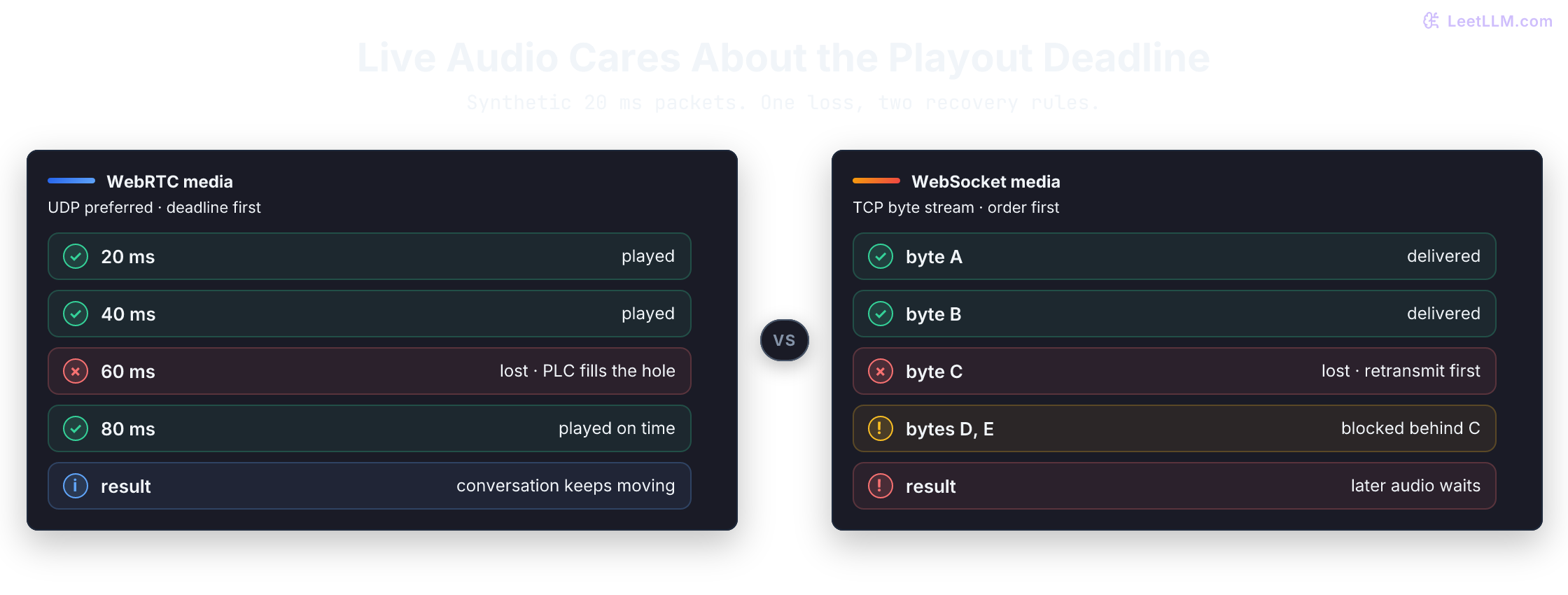
The deadline changes the protocol choice. RTP recovery helps only while a packet can still improve playout; TCP recovery must preserve byte order even if the voice moment has already passed. If a call is clean on wired networks but stutters on a mobile slice, compare packet arrival, buffer depth, concealment, and playout delay before blaming the model.
Jitter buffers and packet loss concealment
Network jitter is variation in packet delay and arrival spacing. A receiver's jitter buffer holds packets before playback. A team might begin experiments around 20-60ms, then measure the delay/underrun tradeoff on supported paths: a larger buffer can hide more arrival variation while increasing conversational delay.
- Static Jitter Buffer: Fixed size (e.g., 50ms). Simple but risks underruns if jitter exceeds buffer size.
- Adaptive Jitter Buffer: Dynamically resizes based on network conditions. Expands during congestion (adding latency) and shrinks during stability (reducing latency).
Browser WebRTC stacks already include adaptive jitter buffers and packet loss concealment (PLC). NetEQ is a well-known WebRTC receiver implementation of this idea.[17] When packets arrive late or disappear, the receiver can stretch buffered audio, extrapolate from recent audio, or ask the decoder to synthesize concealment frames instead of stalling playout.
Protocol comparison: WebRTC vs. WebSocket
| Feature | WebRTC Media (UDP Preferred, Fallbacks Possible) | WebSocket over TCP |
|---|---|---|
| Transport | UDP preferred; relay or TCP/TLS fallback paths possible | TCP |
| Reliability Model | Media-timed (may use NACK/FEC, but playout stays time-bounded) | Byte-stream reliable (lost bytes block later bytes) |
| Latency Behavior | Low and stable when tuned | Can spike under loss |
| Congestion Control | Media-aware adaptation via RTP/RTCP feedback (implementation-dependent) | Managed by the TCP stack, not by media playout deadlines |
| Encryption | Mandatory media encryption via DTLS-SRTP | TLS for wss://; plain ws:// isn't encrypted |
| Typical use here | Browser live media | Signaling or server PCM with application buffering |
WebRTC media is richer than "UDP means drop packets." On UDP media paths it layers RTP (Real-time Transport Protocol) / RTCP (RTP Control Protocol) feedback, jitter buffers, packet loss concealment (PLC), and sometimes NACK (Negative Acknowledgment) or FEC (Forward Error Correction).[4] ICE and TURN can select relay or fallback paths when direct UDP is unavailable (RFC 8835). The design goal is timeliness: recover loss when it can still help, otherwise keep audio moving.
Using WebSockets as a drop-in replacement for WebRTC in browser live audio creates hidden work. You can ship with WebSockets, but you must own chunking, playout buffering, backpressure, and worse behavior under packet loss.
Why does WebRTC usually beat WebSockets for browser live audio?
Answer
WebRTC uses media-timed transport with jitter buffers, RTP/RTCP feedback, packet loss concealment, and time-bounded playout. TCP WebSockets can stall later audio behind lost bytes.
Scaling to thousands of conversations
Suppose 10,000 callers connect during an incident drill. Connection count alone misses the work each session creates: media state, turn timing, model requests, and bursty GPU demand. The ingress tier usually needs sticky routing or consistent hashing so packets for one conversation keep landing on the same media worker.
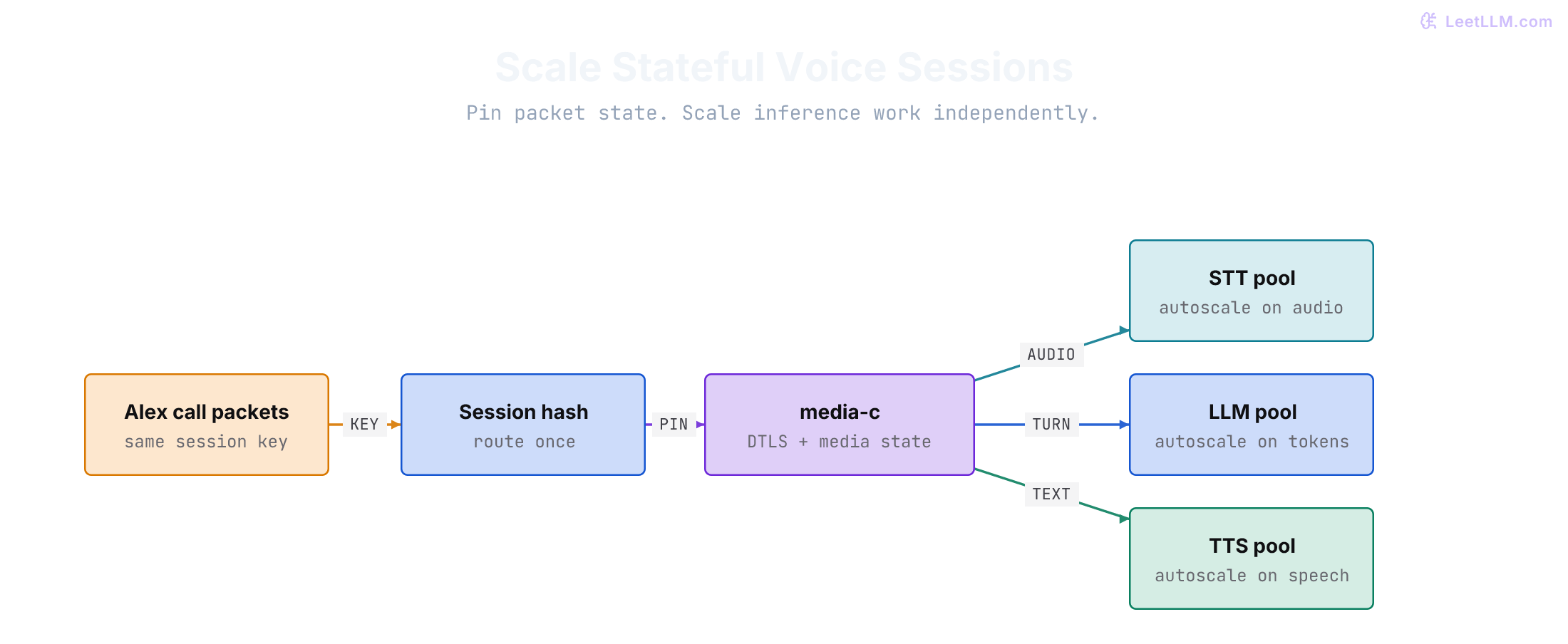
The media tier scales by active sessions and network state. Inference scales by model pressure, which is why separating these tiers usually beats one giant "voice server" process. The routing sketch uses a stable modulo hash only to show affinity with a fixed worker set. A production router should define what happens when workers join or fail, often with connection-aware routing or consistent hashing to limit remapping.
Don't turn 10k+ into a capacity promise. Load-test a declared call mix: session duration, utterance and pause lengths, arrival bursts, output lengths, tool rate, codec, and network loss. Record media CPU, GPU queue time, active streams, reconnects, first-audio p50/p95, mute p95, and error rate. The operating point is where those SLOs hold with headroom, not where a dashboard first reaches a session count.
WebRTC connections carry session state. A specific media worker holds Datagram Transport Layer Security (DTLS) keys, Secure Real-time Transport Protocol (SRTP) state, jitter-buffer state, and often the client playout cursor. If a naive round-robin load balancer routes packets to a different worker mid-session, decryption and timing state break immediately.
Behind media workers, inference components should scale independently because their compute profiles differ. Turn detection and some STT stages often fit on CPU. Largest speech or LLM models usually need GPU. Independent scaling keeps GPU utilization high without overprovisioning lighter tiers. If one media worker dies, preserve the call's heard cursor and reconnect state where possible; otherwise make the recovery explicit, rebuild the session, and tell the caller what happened.
import hashlib
import json

workers = ["media-a", "media-b", "media-c"]

def route(session_id: str) -> str:
    digest = int(hashlib.sha256(session_id.encode()).hexdigest(), 16)
    return workers[digest % len(workers)]

session_id = "call-alex-4219"
packet_routes = [route(session_id) for _ in range(4)]
failed_worker = packet_routes[0]

print(json.dumps({
    "packet_routes": packet_routes,
    "single_worker_during_session": len(set(packet_routes)) == 1,
    "failed_worker": failed_worker,
    "recovery": "reconnect_and_rebuild_session",
}, indent=2)){
"packet_routes": [
"media-c",
"media-c",
"media-c",
"media-c"
],
"single_worker_during_session": true,
"failed_worker": "media-c",
"recovery": "reconnect_and_rebuild_session"
}Why do WebRTC sessions need sticky routing?
Answer
A media worker holds DTLS keys, SRTP state, jitter buffers, and the client playout cursor. Moving packets to a different worker mid-session breaks decryption and timing state.
Review the voice design
A tight first-audio objective depends on every handoff. A demo that answers incident 4219 once proves little: the design also needs an explicit response to jitter, interruptions, uncertain turn boundaries, and tools that can't finish inside the budget.
| Check | Pass when |
|---|---|
| Speech-end TTFA | p50 and p95 are measured on declared network slices, not inferred from one 380ms trace |
| Commit-to-audio | Isolated from endpointing so LLM, TTS, and playout regressions are visible |
| Turn detection | Local VAD mutes fast; server endpointing combines silence, stable words, and semantic completeness |
| Transcript commit | Unstable partials may prefetch reads; they may not write history, speak facts, or fire side effects |
| Slow tools | First audio is an honest acknowledgement; paging and closes wait for results or confirmation |
| Barge-in | p95 mute meets the product target, and history keeps text through confirmed playout only |
| Echo | AEC is tested on real devices, speaker volumes, and rooms |
| Transport | The negotiated path and loss behavior are measured; WebRTC or the application owns capture, buffering, and playback |
| Native audio | Chosen only after measuring latency, prosody, policy control, and the same confirmed-playout cursor rule |
| Prefix cache | Stable policy/tool content and usable cache boundaries; write/read usage, costs, and latency are checked |
Start with clean, interrupted, and degraded-network traces, then repeat over a declared workload. Include unsuccessful turns and timeouts in the attainment denominator; a p95 computed only over successful replies hides silence. Separate time to acknowledgement from time to useful answer so a fast filler phrase can't conceal a slow incident lookup. Compare endpoint false cutoffs, identifier accuracy, unauthorized tool attempts, mute latency, and task completion alongside speed.
Follow-up questions
- A 300ms silence rule precedes a 320ms post-commit path. What is speech-end TTFA, and which changes could bring it below 500ms?
- A page succeeded, but the caller interrupted before hearing the acknowledgement. What survives in tool state and conversation history?
- How would you reject a delayed audio chunk or playout acknowledgement from a previous response after reconnecting?
Evaluation rubric
- Distinguishes acoustic speech end, accepted turn, stable transcript, and client playout clocks.
- Calculates overlap without hiding endpointing, transport, failures, or the useful-answer delay.
- Separates transcript confidence, caller authorization, action confirmation, and service outcome.
- Reconciles interruptions with response-scoped playout state while preserving real tool effects.
- Justifies transport, model architecture, and capacity from measured workload and failure cases.