Personalize this lesson
Adapt explanations and teaching visuals to your background and preferred voice.
Hugging Face Transformers connects a model's saved weights to the code and input processing needed to use them. A successful load is only the first check. After an upgrade, the same model ID might still generate text while starting assistant turns with the wrong control tokens. Did the weights change, or did the tokenizer format the conversation differently?
PyTorch gave you tensors, kernels, and autograd. That still isn't a loadable language model. A Hub name has to resolve to one revision, that revision's config.json has to pick a class, the class has to receive tensors with expected names, and text has to become the token IDs that class was trained on. Hugging Face Transformers packages those contracts.
It isn't one architecture, and it isn't the Hub. It's a model-definition library: a checkpoint, its configuration, preprocessing rules, and forward pass travel together. The same definition can then load in a notebook, a PyTorch trainer, FSDP, vLLM, or SGLang without every team rewriting the family from scratch.[1][2]
Use tiny-decoder as a hypothetical checkpoint, not as a Hub repo you'd download. Its fixed dimensions let us check AutoClass lookup, chat rendering, and KV-cache bytes by hand. Later, a smaller randomly initialized Llama runs the real library on CPU without downloading model weights. Those checks establish mechanics, not language quality or serving performance.
1{
2  "model_type": "llama",
3  "hidden_size": 1024,
4  "num_hidden_layers": 16,
5  "num_attention_heads": 16,
6  "num_key_value_heads": 4,
7  "vocab_size": 32000,
8  "max_position_embeddings": 4096,
9  "dtype": "bfloat16"
10}
hidden_size / num_attention_heads is the head dimension: . Grouped-query attention here uses key/value heads, not 16. Carry those values through each later check.
What does Transformers standardize when it doesn't standardize one architecture?
Answer
It standardizes the boundary: configuration, model classes, pretrained weight loading, tokenizers or processors, output types, and generation conventions. A Llama, ViT, Whisper, or vision-language model still has its own architecture inside that boundary.
Four contracts around one checkpoint
Before opening weight shards, predict what a successful load must establish: identity, shape, parameters, and input/output semantics. A model repository is a versioned set of contracts, not one giant weight file. For tiny-decoder those pieces are:
| Contract | Typical files or classes | Job | A broken contract looks like |
|---|---|---|---|
| Identity | Hub repo ID, revision, commit | Select one immutable snapshot | Code and weights come from different versions |
| Configuration | config.json, PreTrainedConfig | Describe architecture, dimensions, tokens, and options | Wrong head size or layer count |
| Parameters | model.safetensors shards and index | Restore learned tensors into modules | Missing, unsafe, or mismatched tensors |
| Input/output | tokenizer, processor, ModelOutput | Map user data to tensors and outputs | Token IDs, masks, or pixels have the wrong semantics |
The library keeps these contracts separate so each can evolve. Tokenizers may add a chat template without changing weights. Model code can add a cache path while old checkpoints stay loadable. A Hub revision may point at new configuration while older snapshots remain available for rollback.
If output is wrong, inspect the boundary that produced it. Don't rewrite attention kernels when the tokenizer added a different special token, and don't blame a prompt when the class loaded the wrong revision.
A family directory under src/transformers/models/ holds configuration and modeling code, often with tokenizer or processor files. Shared AutoClass mappings and output types live elsewhere in the package. PreTrainedConfig records hyperparameters and options without creating model parameters. PreTrainedModel subclasses torch.nn.Module and supplies the loading and initialization lifecycle:[3]
- Instantiation (
__init__): Builds the neural network module hierarchy using dimensions from the config. - Weight initialization (
_init_weights): Defines parameter initialization formulas (such as normal distributions scaled byconfig.initializer_rangeand zeroed biases) for fresh training. - Post-initialization (
post_init): Collects model properties and initializes weights, including any configured weight tying. Tying can make input embeddings and the output LM head share parameters; it isn't enabled for every family or configuration. - Checkpoint restoration (
from_pretrained): Resolves artifact files, instantiates the architecture, parses.safetensorsweights, casts precisions, validates tensor keys, and sets evaluation mode. - Persistence (
save_pretrained): Saves model configuration and weights, with a shard index when needed and generation configuration for generative models. Save the tokenizer or processor separately; saving the model doesn't capture preprocessing automatically.
The lifecycle explains what a downstream runtime can reuse. It can replace selected kernels while keeping parameter names and tokenizer behavior, but only when that backend supports the family.
Hub identity and from_pretrained
from_pretrained() is a resolver, not a simple constructor. Given a local directory or Hub ID, it finds configuration and weight files, resolves a revision, downloads missing bytes, builds the class, and loads tensors into matching parameter names.[3]
When a load works on one machine but not another, first ask what revision each cache resolved. A branch such as main is convenient and mutable; a commit hash identifies one snapshot. The Hub cache keeps refs/ (branch or tag to commit), content-addressed blobs/, and snapshots/ that symlink the exact files for one revision while sharing unchanged blobs across revisions.[4]
Choose the model and tokenizer revisions, dtype, tensor format, and remote-code policy before calling the loader. This API sketch deliberately uses a nonexistent repo and placeholder revision. For a deployment, select a real commit from the repository history; for a local executable check, use the no-download CPU lab below.
1import torch
2from transformers import AutoModelForCausalLM, AutoTokenizer
3
4repo_id = "org/tiny-decoder"
5revision = "<commit-sha-from-model-card>"
6
7tokenizer = AutoTokenizer.from_pretrained(repo_id, revision=revision)
8model = AutoModelForCausalLM.from_pretrained(
9    repo_id,
10    revision=revision,
11    dtype=torch.bfloat16,
12    use_safetensors=True,
13    trust_remote_code=False,
14)
dtype=torch.bfloat16 makes precision explicit in v5; older examples use the legacy torch_dtype name. The current loading guide resolves an omitted dtype from configuration, then from the first floating-point checkpoint weight. That can load bf16 or fp16 when older application code assumed fp32. Pin the library version as well as the checkpoint, and inspect the loaded parameter dtype.[3]
use_safetensors=True makes the storage choice explicit. Safetensors stores tensors without pickle's arbitrary Python deserialization. It doesn't make custom model code safe.[5]
A safe parse still says nothing about tensor names, shapes, dtype, or architecture. The checkpoint can fail after parsing, or load into a semantically wrong class if those contracts were not checked.
trust_remote_code is a security boundary. AutoClass docs default it to false. When a repository needs custom Python classes, inspect the files, pin both model and code revisions, review dependencies, and run in a constrained environment before enabling it. Never turn it on just to silence an unknown-model error.[6]
Why should a deployment pin a Hub commit instead of loading main every time?
Answer
main can change configuration, tokenizer files, custom code, and weights without an application code change. A commit revision gives one auditable snapshot. Roll forward by selecting another commit and keep the old revision as a rollback target.
A load failure is evidence about one layer
Use the first error to narrow the boundary. A loader can fail before reading bytes, during tensor restoration, or only when the first prompt reaches the model:
| Symptom | Likely layer | First check |
|---|---|---|
KeyError for model type | Auto mapping or config | config.json model_type, installed library support |
| Unexpected missing keys | Weight index or class names | Shard index, tied weights, conversion notes |
| Size mismatch | Config or checkpoint variant | Vocabulary, hidden size, tensor-parallel export |
safetensors parse error | Artifact integrity | Download checksum, incomplete snapshot, file format |
| Code execution prompt | Dynamic module | trust_remote_code, code revision, audit result |
| Output has wrong roles | Tokenizer or chat template | Special tokens and apply_chat_template |
| Numerics shifted after an upgrade | Dtype default | Explicit dtype, config dtype, first weight dtype |
The same method works for multimodal checkpoints. Separate missing image files, processor shape errors, model class selection, and generation bugs before changing weights. Each symptom points to a different receipt.
Multi-device dispatch and device_map="auto"
When a model would exceed one GPU's VRAM, ordinary construction can exhaust memory before weights even load. Hugging Face integrates with Accelerate to build an empty skeleton, split a model across GPUs, CPU RAM, and NVMe disk, and stream weights with device_map="auto".[7]
Predict the memory timeline before choosing a map: first create shapes without parameter storage, then place shard bytes, then move each layer's inputs and weights to its execution device. The dispatch path has four coordinated stages:
- Meta device skeleton (
init_empty_weights): Parameter tensors have shapes and dtypes but no tensor-data storage. Python modules and metadata still occupy RAM, and buffer handling depends on the initialization context. This avoids allocating a full randomly initialized parameter copy. - Device map calculation (
infer_auto_device_map): Accelerate inspects the footprint of each submodule, calculates available memory per GPU (max_memory), and plans placement acrosscuda:0,cuda:1,cpu, anddisk. It respects_no_split_modules(such as["LlamaDecoderLayer"]) so individual attention blocks aren't fractured across device boundaries. - Checkpoint loading: The loader places tensors according to the map instead of requiring a complete CPU copy first. Accelerate exposes
load_checkpoint_and_dispatchfor this workflow; Transformers also has its own evolving loading implementation. Don't assume one universal shard order or that peak memory equals final parameter bytes. - Dynamic execution hooks (
AlignDevicesHook):dispatch_modelattaches execution hooks to each submodule. During forward, hooks move input tensors to the current module's device. For layers offloaded to CPU or disk, weights move to the execution device for the forward and are offloaded afterward.
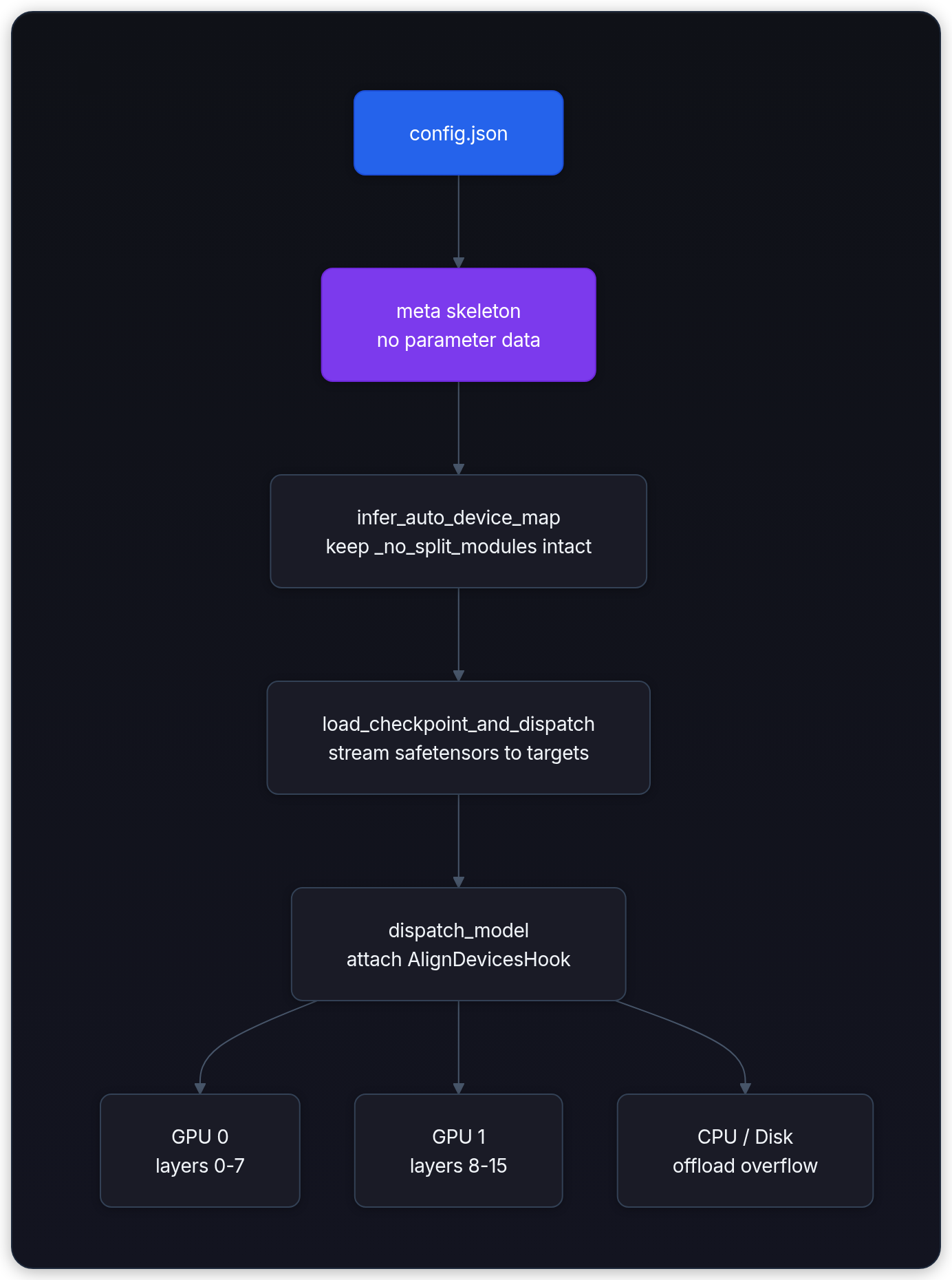
The hooks solve inference fit and placement, not distributed training sharding. Accelerate documents this big-model path for inference. For multi-GPU training, use a supported FSDP or DeepSpeed configuration; the chosen strategy determines which parameters, gradients, and optimizer states are sharded.[7]
AutoClass dispatch turns metadata into Python types
If config.json says llama but the shards came from another family, which stage should catch it? The Auto* family hides model-family imports while preserving a deterministic lookup. A causal-language-model load does roughly this:
AutoConfig.from_pretrainedreadsconfig.jsonand takesmodel_type.- A lazy mapping converts that type into a module name and config class.
AutoModelForCausalLMlooks up the task head associated with the config class.from_pretrainedon that concrete class allocates modules and restores tensors.
At source commit b3a36037d3feb22e3f0174b3dd4248fcc0f0f722, CONFIG_MAPPING_NAMES lives in src/transformers/models/auto/auto_mappings.py. configuration_auto.py wraps it in _LazyConfigMapping and implements AutoConfig.from_pretrained. The built-in path requires model_type; missing or unknown types raise ValueError at the public loader. Authorized custom-code dispatch is a separate branch. None of these selections infer the architecture by examining tensor bytes. modeling_auto.py owns task maps such as MODEL_FOR_CAUSAL_LM_MAPPING_NAMES, where llama maps to LlamaForCausalLM.[8]
The mapping is the public extension story. A new family registers a config and model class, adds family files, writes conversion tests, and exposes a stable model_type. A 2022 design note argued for keeping each family readable in one modeling file. Later releases added a modular contributor path: write one modular file, then generate the expanded source the loader imports.[9][2]
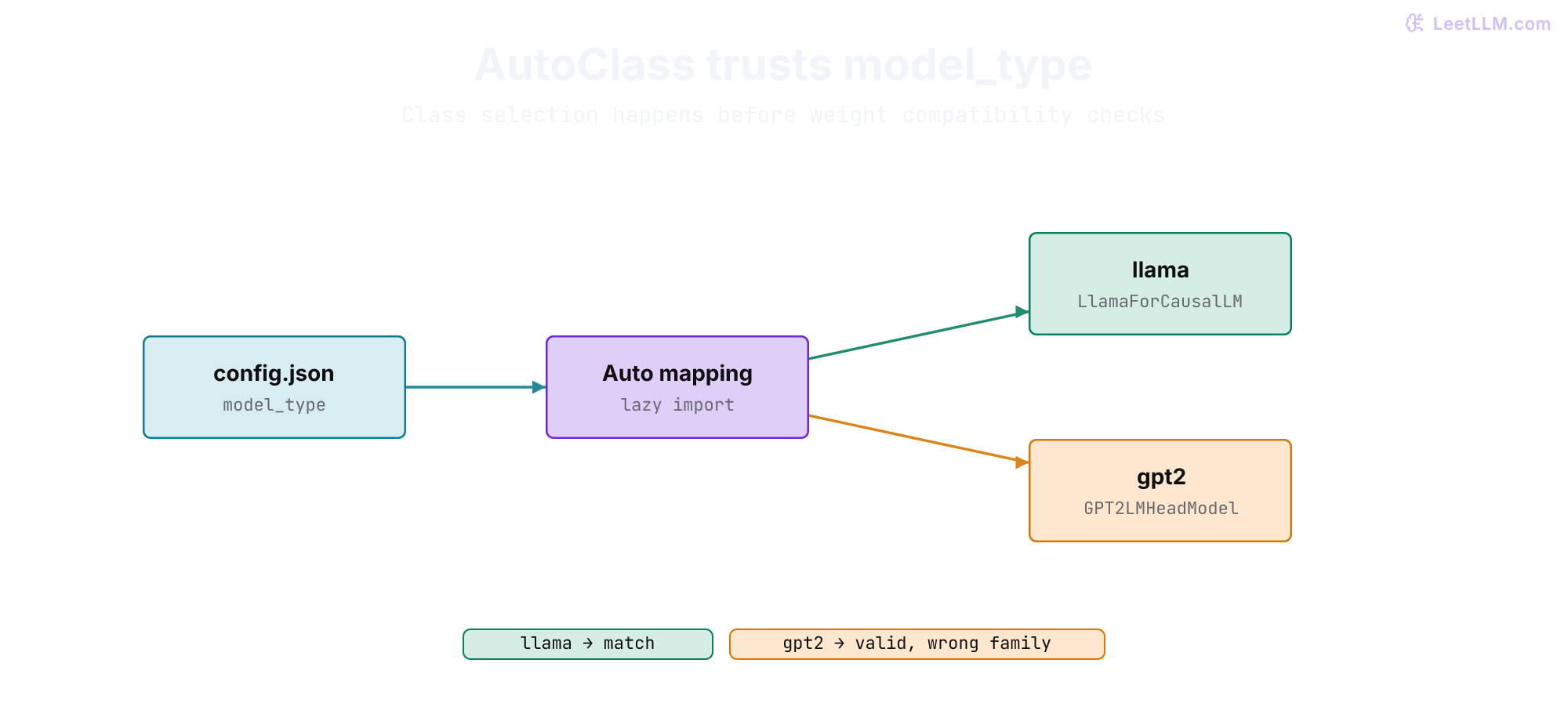
The fixture isolates one decision: config selects a class; weight compatibility comes later. This standard-library lookup mirrors only the mapping, not the complete public loader or its error types. It doesn't import Transformers.
1CONFIG_MAPPING = {"llama": "LlamaConfig", "gpt2": "GPT2Config"}
2CAUSAL_LM = {"llama": "LlamaForCausalLM", "gpt2": "GPT2LMHeadModel"}
3
4def select_causal_lm(config: dict) -> str:
5    model_type = config["model_type"]
6    if model_type not in CONFIG_MAPPING:
7        raise KeyError(model_type)
8    return CAUSAL_LM[model_type]
9
10tiny_decoder = {"model_type": "llama", "hidden_size": 1024}
11wrong_type = {**tiny_decoder, "model_type": "gpt2"}
12
13assert select_causal_lm(tiny_decoder) == "LlamaForCausalLM"
14assert select_causal_lm(wrong_type) == "GPT2LMHeadModel"
15
16try:
17    select_causal_lm({"model_type": "not-a-family"})
18except KeyError as exc:
19    assert str(exc) == "'not-a-family'"
20else:
21    raise AssertionError("unknown model_type should raise")
22
23print(select_causal_lm(tiny_decoder))
24print(select_causal_lm(wrong_type))1LlamaForCausalLM
2GPT2LMHeadModelThe gpt2 row is the trap: AutoClass can return a valid class that still isn't the class those shards belong to. Validate model_type, tensor shapes, a known input, and a known output before serving.
Tokenizers define more than integer IDs
Tokenization turns text into IDs. Before generation, predict the rest: padding, masks, truncation, special tokens, and the serialized conversation all affect the model input.[10]
- Vocabulary and merge rules determine which strings map to which IDs.
- Special tokens mark beginning, end, padding, tool calls, or image placeholders.
- Padding side affects batched decoder-only generation.
- Truncation policy decides which context disappears at a limit.
- Attention masks distinguish real tokens from padding.
- Offset mappings connect token spans back to source text for extraction tasks.
- Chat templates turn a list of roles into the exact control-token sequence a checkpoint learned.
PreTrainedTokenizerBase owns the common encoding contract. The v5 migration favors the Rust tokenizers backend while retaining alternatives for families that need them. Backend support and legacy class names vary by release; inspect the selected tokenizer rather than assuming every family uses the same implementation.[2][10]
The model doesn't know whether a token came from a user prompt or a template. It sees IDs. A chat template is model behavior, not presentation polish.
Compare the rendered string, special-token IDs, and attention mask when two clients produce different answers.
The fixture uses a small ChatML-style template so you can see the control tokens. It isn't Llama 3's production template. This local word-level tokenizer has no downloaded files; the rendering and tokenization calls use the real Transformers API. Install transformers==5.16.1 and jinja2==3.1.6 for this example. No PyTorch model is needed for tokenization.
1from tokenizers import Tokenizer
2from tokenizers.models import WordLevel
3from tokenizers.pre_tokenizers import WhitespaceSplit
4from transformers import PreTrainedTokenizerFast
5
6words = ["[UNK]", "<|im_start|>", "<|im_end|>", "system", "user", "assistant",
7         "Answer", "with", "one", "sentence.", "What", "does", "a", "revision", "pin?"]
8backend = Tokenizer(WordLevel({word: i for i, word in enumerate(words)}, unk_token="[UNK]"))
9backend.pre_tokenizer = WhitespaceSplit()
10tokenizer = PreTrainedTokenizerFast(
11    tokenizer_object=backend, unk_token="[UNK]",
12    additional_special_tokens=["<|im_start|>", "<|im_end|>"],
13)
14tokenizer.chat_template = (
15    "{% for m in messages %}{{ '<|im_start|>' + m['role'] + '\\n' + "
16    "m['content'] + '<|im_end|>\\n' }}{% endfor %}"
17    "{% if add_generation_prompt %}{{ '<|im_start|>assistant\\n' }}{% endif %}"
18)
19
20messages = [
21    {"role": "system", "content": "Answer with one sentence."},
22    {"role": "user", "content": "What does a revision pin?"},
23]
24prompt = tokenizer.apply_chat_template(messages, tokenize=False, add_generation_prompt=True)
25ids = tokenizer.apply_chat_template(
26    messages, tokenize=True, add_generation_prompt=True, return_dict=False,
27)
28
29assert prompt.startswith("<|im_start|>system\n")
30assert prompt.endswith("<|im_start|>assistant\n")
31assert ids == tokenizer(prompt, add_special_tokens=False)["input_ids"]
32assert tokenizer.unk_token_id not in ids
33print(prompt)1<|im_start|>system
2Answer with one sentence.<|im_end|>
3<|im_start|>user
4What does a revision pin?<|im_end|>
5<|im_start|>assistantWhen rendering a real template to text and tokenizing afterward, use add_special_tokens=False if the template already inserted those tokens. Otherwise a second BOS or EOS can change the prompt. Prefer apply_chat_template(..., tokenize=True) when possible.[11]
Decoder-only batched generation commonly needs left padding because the decoding loop reads logits at the final input position. An attention mask alone doesn't move that position. Reusing EOS as a pad token can work with an explicit mask, but don't erase genuine EOS training labels by masking every occurrence of that ID.
Processors make multimodal inputs explicit
tiny-decoder is text-only. The moment the checkpoint grows an image or audio tower, a tokenizer isn't enough. An image processor may resize and normalize pixels; an audio feature extractor may create log-mel features. Check the required sample rate explicitly: many extractors expect already-resampled audio and reject a mismatched rate instead of resampling it.
A ProcessorMixin composes those pieces with a tokenizer and returns a dictionary of named tensors.[12]
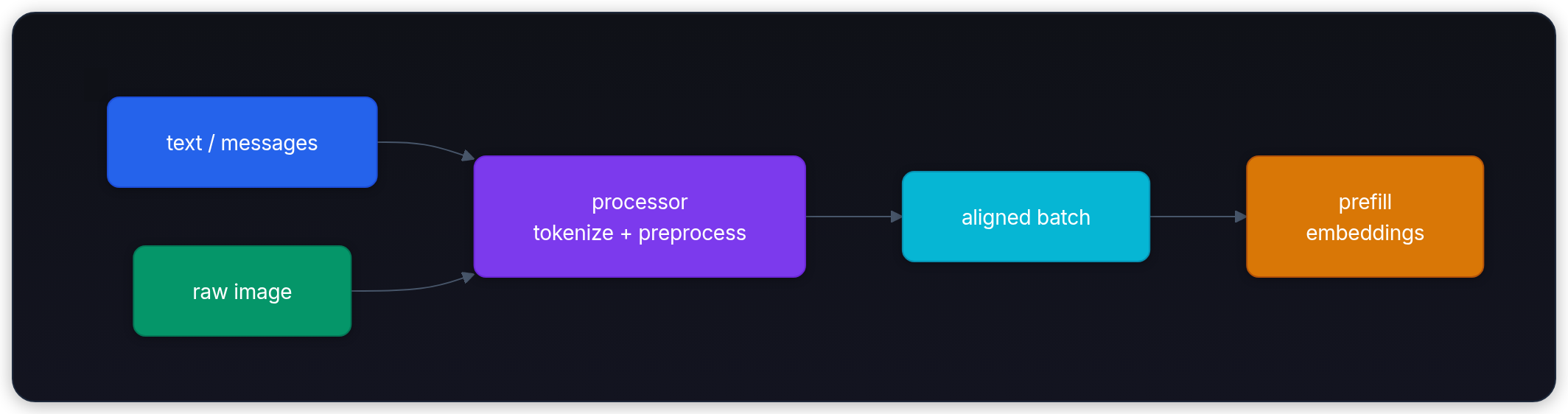
Inputs extend beyond input_ids. They can include pixel_values, image_sizes, pixel_attention_mask, input_features, or model-specific placeholder indices.
The language model must know where those features become embeddings and how many positions they occupy. A processor that emits a valid tensor with the wrong normalization or placeholder count can produce confident nonsense.
src/transformers/processing_utils.py defines common modality discovery and save/load behavior. Keep processor and model revisions aligned when a checkpoint changes image resolution, audio rate, or special-token layout.[12]
A schematic processor call looks like this. It needs Pillow, an image file, and a compatible real vision-language repo, so it isn't an executable lab. For chat checkpoints, first render that processor's multimodal chat template, including required image placeholders; raw prose alone isn't a universal image prompt.
1from PIL import Image
2from transformers import AutoProcessor
3
4processor = AutoProcessor.from_pretrained(
5    "org/vision-language-model",
6    revision="<commit-sha>",
7)
8inputs = processor(
9    text="Describe this chart.",
10    images=Image.open("chart.png"),
11    return_tensors="pt",
12)
Two clients send the same image and words, but one answer changes after a library upgrade. Which inputs should you diff first?
Answer
Diff processor and tokenizer revisions, rendered chat template, image resize and normalization, placeholder positions, tensor dtypes, and attention masks before comparing model logits.
forward and generate are different layers
Before choosing an API, ask whether the caller needs one forward pass or a decoding policy. Calling a model's forward computes one pass through the neural network. For a causal model, it takes input_ids, optional attention_mask, position_ids, past_key_values, and optional labels.
With dictionary-style outputs enabled, it returns a ModelOutput subclass such as CausalLMOutputWithPast. You can use attributes (outputs.logits, outputs.loss) or indexing over non-None fields. Call to_tuple() for a tuple; the object isn't itself an ordinary tuple, and integer index meanings can change when optional fields appear.[1]
For LlamaForCausalLM, a full-sequence forward computes logits with shape [batch, sequence, vocabulary]. Its causal-LM loss pairs position 0's logits with position 1's label, then position 1 with position 2, and so on. Pass unshifted labels; shifting them yourself would shift the target twice. Labels equal to -100 are excluded from the loss.[13]
That lets a PyTorch training loop execute loss = model(**batch).loss followed by loss.backward(). An attention mask controls attention, not which targets contribute to loss; mask unwanted labels separately. Classification heads and bare base models have different output and loss contracts. PreTrainedModel doesn't impose causal cross-entropy on all of them.
generate owns the autoregressive decoding loop. It consumes a GenerationConfig object, loaded from generation_config.json or passed as arguments, applies LogitsProcessorList transformations, evaluates StoppingCriteriaList, and orchestrates KV cache updates across iterative steps.[14]
At the pinned revision, GENERATION_MODES_MAPPING in src/transformers/generation/utils.py routes decoding modes into execution routines. Greedy mode shares _sample with sampling, but do_sample=False makes its token choice argmax.[8][14]
- Greedy search (
_samplewith sampling disabled): Selects the argmax token at each step (do_sample=False,num_beams=1). - Multinomial sampling (
_sample): Applies temperature scaling, top-k filtering, and nucleus top-p filtering before sampling from the probability distribution (do_sample=True,num_beams=1). - Beam search (
_beam_search): Keeps a bounded set of hypotheses (num_beams > 1,do_sample=False). Final ranking includes configured length penalties and constraints; pruning means it needn't find the globally most probable sequence. - Assisted decoding (
_assisted_decoding): Employs a smaller draft model or candidate generator for speculative execution, verifying candidate tokens in parallel with the target model.
The neural architecture lives in forward; generate wraps that pass with state, policy, and stopping decisions.
Once model is loaded and batch holds tokenizer tensors (input_ids, attention_mask), an explicit greedy call looks like this. This fragment needs the actual model and tokenizer; the CPU lab below supplies its own small model.
1outputs = model.generate(
2    **batch,
3    max_new_tokens=96,
4    do_sample=False,
5    num_beams=1,
6    return_dict_in_generate=True,
7    use_cache=True,
8)
9new_ids = outputs.sequences[:, batch["input_ids"].shape[1]:]
10text = tokenizer.batch_decode(new_ids, skip_special_tokens=True)
For a decoder-only model, outputs.sequences includes the input prefix. Slice it off when the caller wants only the completion. Explicit num_beams=1 also matters: do_sample=False alone can still select beam search if a saved generation config requests several beams.
max_new_tokens, stop tokens, repetition controls, and sampling parameters belong in an explicit generation configuration. A pipeline can supply defaults that hide those choices.
Capture the resolved config when comparing quality or latency across releases.
KV caches turn repeated prefix work into state
At each autoregressive step, a new token attends to all earlier keys and values. Ask what can persist before computing the next token: a KV cache stores per-layer key and value tensors, so the next forward pass projects only the new token and reads prior state.[15]
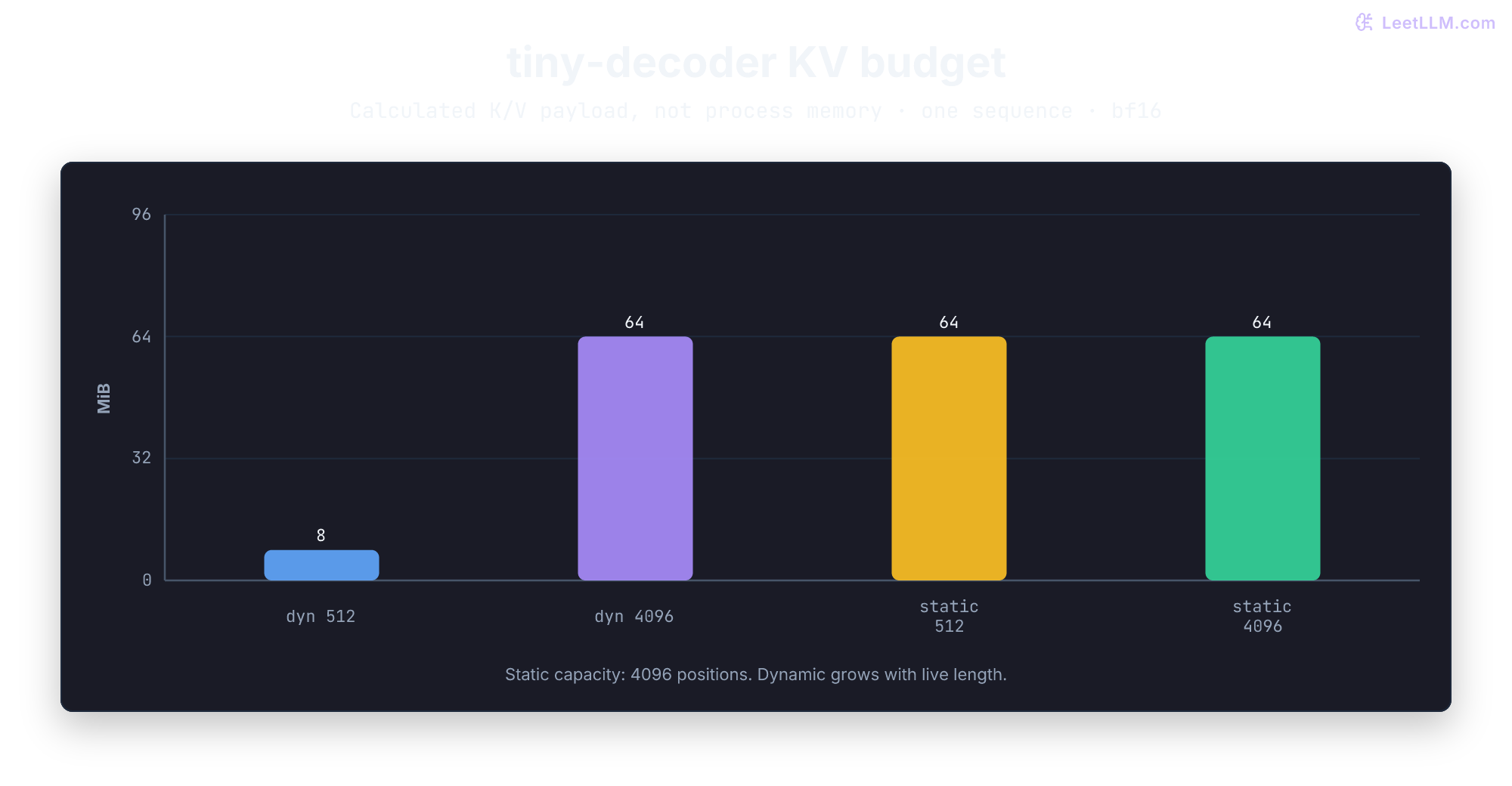
For one tiny-decoder token, a layer stores four key heads and four value heads, each containing 64 bf16 values. That's bytes per layer, or 16,384 bytes across 16 layers. At 512 cached tokens the payload is 8 MiB; at 4096 it's 64 MiB.
A conventional full-attention cache uses tensors shaped like [batch, kv_heads, sequence, head_dim]. Grouped-query or multi-query attention stores fewer key/value heads than query heads. Generalizing the calculation:
is layer count, is active sequence count, is cached sequence length, is key/value head count, and is head dimension. The leading 2 accounts for keys and values. The trailing bytes(dtype) is 2 for bfloat16.
This counts K/V tensor payload only, not weights, activations, allocator overhead, or temporary copies. Beam expansion can increase . Sliding-window layers cap their retained length; hybrid models need a per-layer sum rather than one full-context everywhere.
src/transformers/cache_utils.py defines DynamicCache, StaticCache, QuantizedCache, and EncoderDecoderCache. Many decoder models use a dynamic cache that grows as tokens arrive. A static cache allocates a maximum sequence length when initialized, often lazily on the first update, so later calls see a stable shape. Unused slots still occupy storage once allocated.
Dynamic and static caches support offloading through their cache options; quantized cache has a different support matrix. Sliding or hybrid layer types, when present in config, shrink the cached length toward a window instead of the full .[15]
The cache API is an interoperability seam, but it isn't a serving engine's paged pool. Transformers' generation loop usually owns one model call and one cache object per batch.
vLLM and SGLang add request scheduling, physical block allocation, prefix sharing, and multi-request batching around model execution.
1def kv_bytes(
2    layers: int,
3    batch: int,
4    seq_len: int,
5    kv_heads: int,
6    head_dim: int,
7    dtype_bytes: int,
8) -> int:
9    dimensions = (layers, batch, seq_len, kv_heads, head_dim, dtype_bytes)
10    if any(type(value) is not int or value < 1 for value in dimensions):
11        raise ValueError("cache dimensions and bytes per element must be positive integers")
12    return 2 * layers * batch * seq_len * kv_heads * head_dim * dtype_bytes
13
14LAYERS, BATCH, KV_HEADS, HEAD_DIM, DTYPE_BYTES = 16, 1, 4, 64, 2
15mib = 1024 * 1024
16
17assert kv_bytes(LAYERS, BATCH, 512, KV_HEADS, HEAD_DIM, DTYPE_BYTES) == 8 * mib
18assert kv_bytes(LAYERS, BATCH, 4096, KV_HEADS, HEAD_DIM, DTYPE_BYTES) == 64 * mib
19
20dynamic_512 = kv_bytes(LAYERS, BATCH, 512, KV_HEADS, HEAD_DIM, DTYPE_BYTES) // mib
21static_max = kv_bytes(LAYERS, BATCH, 4096, KV_HEADS, HEAD_DIM, DTYPE_BYTES) // mib
22print(dynamic_512)
23print(static_max)18
264Those 64 MiB describe one request's cache. They don't admit a second user, share a prefix, or page blocks the way a serving engine does.
Run a real model without a downloaded checkpoint
The arithmetic fixture has 16 layers. For an executable API check, shrink it to two Llama layers, width 32, four query heads, two KV heads, and a 32-token vocabulary. The architecture is real; the random weights haven't learned language. Fixed token IDs keep preprocessing out of this test so a failure points at model behavior rather than a tokenizer.
Save the next two blocks in one script, or run them in order in one notebook. They were checked on CPU with torch==2.12.0 and transformers==5.16.1. Neither downloads a model. First compare the model's loss with an explicit shifted, masked cross-entropy, run backward, and round-trip the weights through local safetensors.
1import tempfile
2import torch
3from transformers import AutoConfig, AutoModelForCausalLM, DynamicCache, StaticCache
4from transformers.utils import logging
5
6logging.disable_progress_bar()
7torch.manual_seed(7)
8torch.set_num_threads(1)
9config = AutoConfig.for_model(
10    "llama", vocab_size=32, hidden_size=32, intermediate_size=64,
11    num_hidden_layers=2, num_attention_heads=4, num_key_value_heads=2,
12    max_position_embeddings=32, attention_dropout=0.0,
13    bos_token_id=1, eos_token_id=None, pad_token_id=0,
14    tie_word_embeddings=True,
15)
16model = AutoModelForCausalLM.from_config(config, attn_implementation="eager").eval()
17ids = torch.tensor([[1, 7, 9, 4, 2]])
18labels = ids.clone()
19labels[:, 3] = -100
20out = model(ids, labels=labels, use_cache=False)
21expected_loss = torch.nn.functional.cross_entropy(
22    out.logits[:, :-1].reshape(-1, 32), labels[:, 1:].reshape(-1), ignore_index=-100,
23)
24torch.testing.assert_close(out.loss, expected_loss)
25out.loss.backward()
26assert model.get_input_embeddings().weight.grad.abs().sum() > 0
27assert model.get_input_embeddings().weight is model.get_output_embeddings().weight
28
29with tempfile.TemporaryDirectory() as saved:
30    model.save_pretrained(saved)
31    restored = AutoModelForCausalLM.from_pretrained(
32        saved, local_files_only=True, use_safetensors=True, dtype=torch.float32,
33        attn_implementation="eager",
34    )
35    assert not restored.training
36    with torch.no_grad():
37        torch.testing.assert_close(restored(ids).logits, out.logits)
38print(type(restored).__name__, tuple(out.logits.shape))
39print("shifted masked loss, backward, tied weights, reload: passed")1LlamaForCausalLM (1, 5, 32)
2shifted masked loss, backward, tied weights, reload: passedThe target at input position 3 is ignored, so logits at position 2 don't contribute to loss. That token can still provide attention context for later positions. Also notice that eval() didn't disable gradients: it controls training-dependent module behavior, while torch.no_grad() controls gradient recording.
Now keep the first four tokens in a cache and feed only the fifth. Its logits should agree with the last position of a full five-token forward. In float32, this reduced model stores K/V bytes dynamically. Static capacity 16 needs 4096 bytes after allocation, even though only five positions are live.
1with torch.no_grad():
2    full = model(ids, use_cache=False).logits[:, -1:]
3    for cache in [DynamicCache(config=config), StaticCache(config=config, max_cache_len=16)]:
4        model(ids[:, :-1], past_key_values=cache, use_cache=True)
5        tail = model(
6            ids[:, -1:], attention_mask=torch.ones_like(ids),
7            past_key_values=cache, use_cache=True,
8        ).logits
9        torch.testing.assert_close(tail, full, atol=1e-6, rtol=1e-5)
10        assert cache.get_seq_length() == ids.shape[1]
11        stored = sum(t.numel() * t.element_size() for layer in cache.layers
12                     for t in [layer.keys, layer.values])
13        print(type(cache).__name__, "positions", int(cache.get_seq_length()), "bytes", stored)
14
15    generated = model.generate(ids, max_new_tokens=3, do_sample=False, num_beams=1)
16    manual = ids.clone()
17    for _ in range(3):
18        next_id = model(manual, use_cache=False).logits[:, -1].argmax(-1, keepdim=True)
19        manual = torch.cat([manual, next_id], dim=1)
20    assert torch.equal(generated, manual)
21print("cached/full logits and greedy/manual tokens: passed")1DynamicCache positions 5 bytes 1280
2StaticCache positions 5 bytes 4096
3cached/full logits and greedy/manual tokens: passedEOS is disabled only to force exactly three steps in this random-model check. A deployed checkpoint needs its actual stop IDs. Cache internals such as cache.layers are version-sensitive; the important contract is agreement with the full forward, not that every backend exposes these fields.
These assertions cover loss wiring, gradients, local serialization, two cache layouts, and greedy decoding. They don't establish useful language generation, training convergence, GPU performance, multi-device dispatch, or compatibility with a particular Hub checkpoint.
Pipelines are a boundary, not a serving fleet
If the first smoke test passes but concurrent requests collapse, separate pipeline defaults from serving scheduling. pipeline(task=..., model=...) is a productive entry point: it selects task-specific preprocessing, loads an appropriate model and tokenizer or processor, batches inputs when possible, calls the model, and postprocesses outputs.
Use pipelines for a first end-to-end check, offline jobs, small evaluation fixtures, and demos where transparent defaults are acceptable.
Don't assume the default pipeline path is a production scheduler. Transformers v5 exposes paged caching, continuous batching, and transformers serve, but a plain pipeline call doesn't provide the admission policy, fault isolation, autoscaling, or GPU topology controls of a dedicated serving fleet. For high-concurrency generation, compare the native serving path with vLLM, SGLang, TensorRT-LLM, or another runtime, then validate outputs and stopping behavior against the same Transformers model definition.[2]
| Concern | Transformers pipeline | Production serving engine |
|---|---|---|
| Model definition | Broad, model-family aware | Supports a selected compatibility set |
| Input normalization | Task and modality processors | Often adapter-specific or preprocessed upstream |
| Batch behavior | Local batching and padding | Continuous batching and admission policy |
| KV memory | Model cache object | Paged or shared physical allocation |
| API | Python call | Long-lived HTTP or RPC service |
| Scale | One process or user-managed workers | Parallel replicas, ranks, routing, health checks |
When an optimized server disagrees with an eager Transformers run, compare tokenization, prompt template, logits at the first generated position, sampling seed, stop conditions, and cache implementation before comparing full text. Those intermediate receipts tell you whether the drift starts before or after model execution.
Training, serving, and the drift they introduce
Once the model definition loads, surrounding systems can specialize without owning every family:
- PyTorch supplies tensor, autograd, compiler, and distributed execution.
- FSDP and DeepSpeed wrap parameters, gradients, and optimizer state for training.
- Parameter-efficient fine-tuning (PEFT) injects adapters while the base model remains mostly frozen.
- Quantizers replace or transform weight loading paths.
- vLLM and SGLang map supported definitions into high-throughput runtimes.
- Exporters target ONNX, TensorRT, TFLite, or other formats where supported.
For training, Trainer or a custom PyTorch loop owns batching, optimization, evaluation, and checkpoint cadence. It still hands tokenizer-produced fields to the selected model class; it can't repair a mismatched config or chat template.
The catalog is a set of task contracts, not one leaderboard. The same loading ideas cover text, vision, audio, video, and multimodal systems. Hub availability doesn't mean every backend supports every task.[2]
| Application | Typical entry point | What to validate | Common production boundary |
|---|---|---|---|
| Text generation | AutoModelForCausalLM + tokenizer | Chat template, stop IDs, KV cache, decoding policy | vLLM or SGLang scheduler |
| Classification | AutoModelForSequenceClassification | Label map, pooling, threshold calibration | Batch service or feature pipeline |
| Retrieval embeddings | encoder model + pooling | Normalization, truncation, dimension | Vector index and embedding version |
| Vision-language chat | AutoProcessor + supported multimodal model class | Image tokens, template, pixel budget | Multimodal serving adapter |
A fused kernel may implement slightly different masking. A quantizer may require a calibration artifact. A serving backend may interpret a cache or RoPE scaling option differently.
Keep a small eager reference test with fixed tokens and compare logits within an agreed tolerance after every backend or library change.
Transformers' Apache-2.0 library license doesn't grant rights to Hub model weights, datasets, or remote-code modules. Inspect each repository card and license before commercial use.[16][17]
Strengths and limits
| Strength | Why it matters | Cost or limit |
|---|---|---|
| Wide model coverage | One API spans text, vision, audio, video, and multimodal families | Coverage can lag a newly released architecture |
| Shared definition | Training and serving systems can target common classes | Backend support still needs per-model work |
| Reproducible Hub loading | Revision and snapshot concepts make artifacts inspectable | Loading main or unreviewed code defeats that benefit |
| Typed preprocessing | Tokenizers and processors expose named inputs and masks | Small preprocessing changes can alter model behavior |
| Rich generation policy | Sampling, beams, assisted decoding, and cache modes are available | Defaults can hide policy and use more memory than a tuned server |
| Python-first ergonomics | A researcher can inspect and modify a model quickly | Python orchestration alone isn't a high-throughput serving design |
Breadth is the defining tradeoff. A library that supports many families must preserve old checkpoints while adding new shapes, modalities, kernels, and dispatch rules. Read the exact model and processor code for a checkpoint rather than assuming every model follows a decoder-only template.
That boundary turns a vague "the model changed" report into a sequence of checks:
Failure modes worth designing for
Revision drift
An application loads a moving branch, while its evaluation artifact records only a model name. A later run changes tokenizer or config without changing application code. Fix it with commit revisions, model cards that name revisions, and a release receipt containing model, processor, and code identities.
Silent template mismatch
Two clients use the same weights but format roles differently. The model sees different control tokens and may answer with an empty turn or tool-call text. Store the rendered template and special-token IDs in a fixture, then compare first-step logits.
Shape-compatible wrong class
A custom config can select a class that accepts tensors but applies the wrong positional or attention rule. Compare known outputs, inspect model_type, and test architecture-specific invariants such as causal masking or image-token count.
Weight conversion gaps
Converted checkpoints can contain renamed, tied, sharded, or transposed tensors. A loader can report missing keys that look harmless while a task head stays randomly initialized. Treat nonzero missing or unexpected keys as a review event unless the model card explains them.
Dtype auto-load
Omitting dtype follows the checkpoint's saved floating precision. Quality, memory, and kernel choice can move after an upgrade even when the revision didn't. Pin dtype in the load call and record it in the receipt.
Cache pressure
Long prompts, large batches, and many generated tokens grow KV memory. Dynamic caches can exhaust a process before compute saturates. Static caches can reserve a large max length for a short request. Track cache bytes and sequence lengths, cap admission, and use a runtime with an allocation policy when traffic is concurrent.
Unsafe custom code
Enabling remote code can execute repository Python during import or loading. Pin and audit code, isolate permissions, and prefer an upstream-supported model class. A successful load isn't a security review.
Processor drift
An image resize or audio sampling default changes after an upgrade. Output quality falls while text fixtures still pass. Keep representative raw inputs, processor configs, and intermediate tensor checks in multimodal evaluation.
Offload latency thrashing
Offloaded layers may need weight transfers at each decoding step. Disk reads and host-to-device transfers can then dominate token latency. Measure the actual device map, interconnect, and workload; fully resident weights avoid those transfers, but placement alone doesn't guarantee a latency target.
Project identity
Hugging Face is the company behind Transformers. Its official history says it open-sourced a PyTorch implementation of BERT in 2018, before the library expanded across model families and modalities.[18] Hugging Face engineers maintain the project with a large contributor community, while model authors and infrastructure teams contribute architecture support, conversion code, tests, and documentation.[1]
| Field | Current project fact |
|---|---|
| Origin | Hugging Face released a PyTorch BERT implementation in 2018. Thomas Wolf, Lysandre Debut, Victor Sanh, and collaborators documented the expanding library in its 2020 EMNLP demonstration paper.[18][19] |
| Stewardship | Hugging Face engineers maintain the repository with model authors, infrastructure teams, and community contributors.[1] |
| Contributor path | Public model-integration guides, issues, pull requests, tests, and maintainer review define the contribution workflow.[20] |
| Source license | Transformers library code is Apache-2.0.[16] |
| Commercial boundary | Hugging Face's hosted Hub and enterprise products are company services. They're distinct from the open-source library. |
| Asset boundary | Hub model weights, datasets, spaces, and remote code keep their own licenses and usage conditions.[17] |
The 2020 paper describes a common interface for inference and training across many NLP models. It's library history, not a claim that Hugging Face invented every architecture it implements.[19] The original Transformer, BERT, GPT-style decoders, encoder-decoder systems, vision transformers, speech encoders, and later multimodal models each contribute papers. Transformers turns those papers into maintained configuration, model, tokenizer, processor, conversion, and test code.
Current releases add cache classes, compiler-friendly paths, quantization integrations, paged caching, continuous batching, transformers serve, and modular contributor workflows. They also dropped TensorFlow and Flax as supported backends in favor of PyTorch. Check the release notes at the revision you deploy; API names and defaults move.[2]
Follow a request through the source
The source-reading path uses official commit b3a36037d3feb22e3f0174b3dd4248fcc0f0f722 (August 1, 2026), independently of the CPU lab's installed 5.16.1 release.[8] Open that revision on GitHub or in a local checkout. Follow the same request from config to generated token:
- Start with
src/transformers/models/auto/auto_mappings.pyand findCONFIG_MAPPING_NAMES. - Open
src/transformers/models/auto/configuration_auto.pyfor_LazyConfigMapping,model_type_to_module_name, andAutoConfig.from_pretrained. - Open
src/transformers/models/auto/modeling_auto.pyand findMODEL_FOR_CAUSAL_LM_MAPPING_NAMES(llama→LlamaForCausalLM). - Follow
src/transformers/models/llama/forconfiguration_llama.pyandmodeling_llama.py. - Read
src/transformers/modeling_utils.pyaroundPreTrainedModellifecycle (_init_weights,post_init,tie_weights), shard indexes, safetensors, and device or quantizer hooks. - Trace revision and file resolution in
src/transformers/utils/hub.py. - Read
src/transformers/tokenization_utils_base.pyfor padding, truncation, special tokens, and batch encodings. - Read
src/transformers/processing_utils.pyfor multimodal processor composition. - Follow
src/transformers/generation/utils.pyandsrc/transformers/generation/configuration_utils.pyforGenerationConfig,GENERATION_MODES_MAPPING, logits processors, stopping criteria, and cache updates. - Inspect
src/transformers/cache_utils.pyforDynamicCache,StaticCache,QuantizedCache, and theoffloadingflag. - Finish at
src/transformers/pipelines/base.pyto see where preprocessing, batching, model invocation, and postprocessing meet.
Keep a tiny fixture while reading. Pin one checkpoint revision, record tokenizer output, run one forward pass, save first-position logits, and test one generated sequence. That fixture tells you whether a later change moved at the identity, input, model, cache, or decoding boundary.
A release receipt for a Transformers application
Before promoting a model, predict what a future investigator will need to reproduce: identity, inputs, model class, runtime, policy, and evidence. Record:
- Hub repository and immutable revision for model, tokenizer, and processor.
- Transformers, PyTorch, tokenizer backend, and CUDA or accelerator versions.
- Config hash and model class selected by AutoClass.
- Safetensors shard index and expected parameter count.
- Prompt or chat-template rendering and special-token IDs.
- Processor settings, raw input fixture, and intermediate tensor shapes for non-text modalities.
- Dtype, quantization mode, device map, parallelism, and cache implementation.
- Generation configuration, random seed, stop IDs, and maximum token policy.
- Reference logits or outputs and tolerance for optimized backends.
- License, model-card restrictions, and custom-code review decision.
This receipt separates reproducibility from performance. A faster server that changes the prompt template isn't an equivalent deployment. A correct output from an unpinned revision isn't a reproducible release.
Test a change before trusting it
Follow-up questions
- Double the CPU lab's KV-head count from two to four while keeping query heads fixed. Predict both cache sizes, then rerun. The payload should double from 1280 to 2560 bytes dynamically and from 4096 to 8192 bytes statically.
- Change one training label to
-100. Which logits lose a target, and can that input token still affect later predictions? Check the previous position's loss term; label masking doesn't remove the token from attention. - A new backend matches full-forward logits but diverges after the second generated token. What would you compare next? Start with the first divergent token, cache positions and masks, decoding transforms, and stopping rules rather than replacing the weights.
Evaluation rubric
- Traces a pinned checkpoint through configuration, concrete model class, tensor loading, and preprocessing.
- Distinguishes causal-LM loss shifting, attention masks, label masks, and optional output fields.
- Reproduces cached/full-logit and manual/greedy agreement with an explicit tolerance and version.
- Calculates K/V payload using stored KV heads, dtype bytes, live length, and allocated capacity.
- Separates local CPU evidence from language quality, accelerator performance, and serving compatibility.