You open an AI engineering roadmap and find Python, statistics, databases, transformers, agents, cloud platforms, and a dozen frameworks. Each topic seems to require three others. It's hard to tell what to do this afternoon.
Start smaller: write a program you understand, give it one useful model-backed feature, then learn what it takes to make that feature dependable. Keep improving the same project long enough to encounter its mistakes.
Applied AI engineering means building software that uses models, from a report summarizer to a document-search tool. Building an application won't prepare you for every job with “AI” in the title. Research, model training, and infrastructure roles can require a different path.
Choose a direction without choosing your whole career
Read several current job descriptions you could realistically apply to. Look at the work, location, experience requirements, and interview process, not just the title. Highlight recurring tasks: building APIs, analyzing data, training models, running experiments, or operating services. Use those tasks to choose what to practice next.
For example, OpenAI's Research Engineer posting, checked on September 2, 2026, asks for strong programming and experience with large distributed systems.[1] A beginner chatbot doesn't demonstrate that background. This is evidence about that role, not a requirement for every AI-related job.
For now, make a provisional choice:
| Work you want to try | A useful project direction | Study it needs beyond basic programming |
|---|---|---|
| Build model-backed product features | A small app with a model call and tested failure handling | APIs, data handling, evaluation, security, deployment |
| Train and serve predictive models | A classifier compared with a simple baseline, then served through an API | Statistics, data splits, training, serving, monitoring |
| Investigate model behavior | A small reproduction of a published experiment | Math, model internals, baselines, experimental design |
These are suggested learning projects, not job qualifications. They also aren't a ladder: you don't have to deploy a web app before learning to run a controlled experiment. What Does an AI Engineer Actually Do? explores the roles in more detail.
For a concrete product project, try a small incident-report assistant. It takes a report such as “the rollback failed after a health-check timeout,” prepares a short summary for a human, and later helps find relevant operating instructions. Use fictional reports and documents, not private material from an employer.
If you've never coded, start before the model call
Your first tools are a text editor, Python, a terminal, and Git. The terminal runs your program; Git records changes so you can inspect and undo them. Learn variables, conditionals, loops, functions, files, and exceptions before trying to understand an agent framework.
Harvard's CS50 Introduction to Programming with Python is one structured option. It welcomes learners with or without prior programming experience and makes its OpenCourseWare available free.[2] Python's official tutorial is useful too, but it explicitly assumes a basic understanding of programming.[3] If that tutorial feels abrupt, the missing prerequisite may be programming practice rather than a lack of aptitude.
Alongside your course, build something tiny. For the incident assistant, version one can accept an incident ID and description, normalize whitespace, and reject missing input. It doesn't need to infer severity, diagnose an outage, or assign a confidence score.
Here is the sort of program you're working toward. Save it as incident_report.py and run python incident_report.py after installing Python. re.fullmatch checks the whole ID against a pattern: INC- followed by one or more digits. The description stays in the reporter's words.
1import json
2import re
3
4def normalize_report(incident_id: str, description: str) -> dict[str, str]:
5    incident_id = incident_id.strip().upper()
6    if not re.fullmatch(r"INC-[0-9]+", incident_id):
7        raise ValueError("Expected an incident ID such as INC-123")
8    description = " ".join(description.split())
9    if not description:
10        raise ValueError("Description is required")
11    return {"incident_id": incident_id, "description": description}
12
13report = normalize_report(" inc-123 ", "Rollback failed\n after a timeout.")
14assert report == {
15    "incident_id": "INC-123",
16    "description": "Rollback failed after a timeout.",
17}
18for bad_id, bad_description in [("", "Timeout"), ("INC-x", "Timeout"), ("INC-123", " ")]:
19    try:
20        normalize_report(bad_id, bad_description)
21    except ValueError:
22        pass
23    else:
24        raise AssertionError("Invalid input was accepted")
25print(json.dumps(report, indent=2))
26print("Valid input and three rejection cases passed.")1{
2 "incident_id": "INC-123",
3 "description": "Rollback failed after a timeout."
4}
5Valid input and three rejection cases passed.The function assumes string inputs from a form or command-line argument. It normalizes one report; it isn't a general parser or an incident-management system. Those limits make it possible to understand every branch.
Try accepting several reports from a file next. Include a malformed record and decide whether to reject the file or report the bad row separately. Keep that decision in a test. You're ready to expand when you can explain an error, locate the line that caused it, and change the program without breaking its existing behavior.
Git, Shell, Linux for AI and Python for AI Engineering connect these foundations to larger AI projects. Don't rush past them because the program isn't “AI” yet. You'll use the same debugging skills when a model call fails.
Add a model where fixed rules stop being useful
Whitespace cleanup doesn't need a model. A concise summary of a long, varied report might. Give the model that task and keep the incident ID under application control.
Define a narrow request: “Summarize the supplied report for an engineer. Preserve uncertainty. Don't invent a cause or claim a repair succeeded.” For “rollback attempted; result unknown,” a summary saying “rollback succeeded” is wrong even if it reads well.
Before trying prompts, save several reports and write what a good summary must preserve. Include a successful repair, a failed repair, an unknown outcome, and an empty report. These become your first evaluation cases: inputs with criteria for judging the output. Use some to develop the prompt and keep others untouched for comparison later.
An API is a way for one program to request work from another. Put the model API call in one function so the rest of the app doesn't depend on provider-specific response details. That function should have a timeout, limited retries for appropriate transient failures, and a clear result or error. Record the model identifier, prompt version, request duration, and token usage. Don't log secrets or raw private reports by default.
If the provider supports structured outputs, use a schema to constrain the expected response fields. OpenAI's documentation also requires handling refusals and incomplete responses; a valid shape doesn't prove the summary is accurate.[4] Test those outcomes separately from whether the text faithfully represents the report.
Start without a real model by returning a mock, a controlled substitute response. Make it return a valid summary, malformed output, and a timeout. This lets you test your error handling without network access or API charges. Later, run a small set of real calls within a budget you chose in advance. Mock tests validate your application logic, not model quality.
Calling LLM APIs in Production covers this step. You don't need several providers or the most expensive model to learn it.
Make one feature usable, then check whether it helps
Give the report assistant a form, a loading state, a result, and an error message. Connect that form to a backend route such as POST /reports/summarize. Keep the provider key on the server, not in browser code. If you save reports, use synthetic data while learning and understand who can read or delete them.
FastAPI is one Python option with typed request and response models; using it isn't a career requirement.[5] Choose a framework you can inspect and debug. First AI App End-to-End walks through the connections.
Now test the whole request. Submit a report, force the mocked provider to time out, and check that the page stops loading and explains the failure. A request ID should let you find the corresponding server event. Avoid silently replacing an error with a plausible-looking summary.
For quality, review your saved cases against explicit criteria. You can check field types with code. Faithfulness usually needs closer inspection: does the summary preserve “unknown,” or quietly turn it into “resolved”? Record the error category and the relevant input, not just a thumbs-down.
Compare a prompt revision with the baseline using the same held-out reports and model settings. Report actual results, including regressions. If you tune the prompt after inspecting a held-out failure, that case has become development data. It can remain a regression test, but you need untouched cases to assess transfer.
Don't let an aggregate score hide a serious pattern. An assistant that summarizes successful repairs well but changes every uncertain outcome into a success needs work, even if most reports look fine. A small evaluation set can reveal such a failure; it doesn't establish production reliability.
Add retrieval or tools only for a specific need
At this point, you have a complete small feature. You can stop adding features and improve its quality. A vector database, an agent loop, and a protocol server aren't compulsory portfolio decorations.
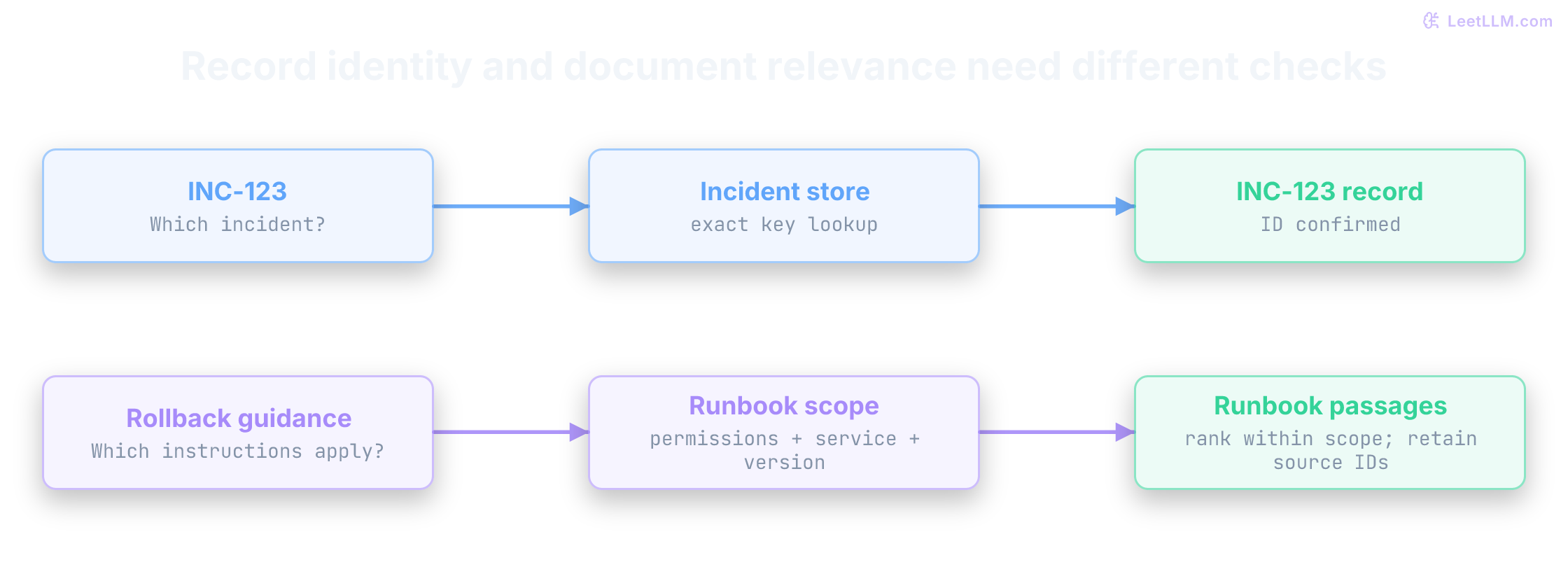
Suppose users now ask, “What should I check for incident INC-123?” There are two different information needs:
- Find the record for that exact incident.
- Find the applicable runbook, a document containing operating instructions.
Use an exact lookup for the first. For the second, start with a small folder of Markdown runbooks that you can inspect. Preserve each document's service, version, and source location. Search within the sources the caller is allowed to read, then include relevant passages with the model's request. This is retrieval-augmented generation (RAG).
Semantic search uses embeddings, numerical representations intended to put related text near one another. It can help find a relevant passage when the wording differs. It isn't a substitute for an exact incident ID or access control. Filtering before similarity ranking is supported by systems such as Weaviate; its documentation explains why post-filtering a small result set can leave too few matches.[6]
Keep incident IDs and runbook source IDs distinct. A shared runbook may apply to thousands of incidents; requiring its source ID to equal INC-123 would discard useful guidance. Test a similar incident with a different ID, an outdated runbook, and a question the documents don't answer. Check that citations identify supporting passages, not merely existing files.
Only after that works should you add difficult file formats, more advanced retrieval, or larger collections. File Ingestion for AI is the next step when extracting the source text itself becomes a problem.
Tools are another optional extension. Start with a read-only incident lookup. If the assistant later creates tickets, validate arguments, enforce the caller's permissions in application code, require approval for the write, and prevent accidental duplicates. A model's request to call a tool isn't authorization. Function Calling & Tool Use explains the boundary. Learn integration protocols after you understand that local interaction, not before.
Learn the math alongside the questions it answers
You don't need to finish a mathematics degree before making an API call. You do need enough statistics to avoid fooling yourself with your results.
Start with proportions, averages, variability, and sampling. If two prompt versions differ by one correct answer on a tiny set, ask how much confidence that difference deserves. Learn to distinguish a model's self-reported confidence from a probability validated against outcomes.
When studying retrieval, vectors, dot products, and norms explain what a similarity measure computes. When training models, add derivatives, gradients, loss functions, data splits, and overfitting. Follow the deeper math and training path if your target work needs it; don't postpone it indefinitely behind application features.
Research-oriented learners can branch here or earlier. Reproduce one small result, compare it with a baseline, and change one factor while holding the rest fixed. Save the data split, configuration, environment, and results. An experiment that disproves your initial idea can still show good work if its method and limits are clear. Capstone: Reproducible ML Study develops that approach without making a product deployment a prerequisite for research.
Deploy a small service you can turn off and recover
For the product path, try running the app outside your development session. Pick one hosting option and learn its configuration, logs, health checks, and rollback process. A container can help package the program; it doesn't replace understanding how the service starts or where its secrets come from.
Make a health route that doesn't spend money on a model call. Restrict access to the demo, limit requests, and set a spending limit where your provider supports one. Save a known-working code and prompt version, deploy a change, and practice restoring the earlier version. Test with synthetic reports throughout.
You don't need to claim “production scale.” State what you actually tested: the environment, workload, request durations, failure cases, and costs observed. If only one person has used it, say so. Model Versioning & Deployment expands the release process when you need it.
Plan around what you can do, not a countdown
A backend engineer may already know most of the application work and need more practice with data and evaluation. A data analyst may need the opposite. Someone new to programming should expect to spend substantial time writing and debugging ordinary programs. Those starting points don't fit one honest “job-ready in 12 weeks” promise.
Choose a repeatable study schedule that fits your life. For each session, name one small result: load a file, reject a malformed record, explain a failed test, or reproduce an evaluation run. End by writing the next unresolved question. If a step remains confusing, reduce the program until you can trace it by hand.
AI coding assistants can help explain errors and suggest examples, but they can also let a project outrun your understanding. Ask for a hint, predict what the suggested code will do, and test it. Periodically make a small change without generated code. Being able to explain and debug the result matters more than the amount of code in the repository.
You can begin with free learning material, local programs, and mocked model calls. Pay for a service or credential when you can explain what it enables and why you need it. Requirements vary by employer and market, so don't infer that a certificate is mandatory, or useless, from a single posting.
Apply with work you can explain
A portfolio supports an application; it doesn't guarantee an interview or offer. You don't have to add retrieval or automated actions before looking for opportunities. Compare your current skills with actual openings, including adjacent software, data, or automation work when the duties fit your interests.
Make the project easy to inspect. Its README should explain the user problem, setup, sample input, test command, and how to run without an API key. Add one short account of a failure you found: what the model did, how you detected it, what changed, and which cases still fail. Keep private data and credentials out of the repository.
Prepare to demonstrate the difference between your work and the underlying model's contribution. You designed the request path, chose what to evaluate, handled errors, and decided which outputs were safe to use. If you reused a tutorial or generated code, say what you changed and be ready to explain it.
Interview preparation still depends on the employer. OpenAI's interview guide, checked on September 2, 2026, describes team-dependent assessments such as pair coding, take-home projects, and technical tests. It also says rules for AI tools vary by interview.[7] Ask what is permitted; don't assume a portfolio demonstration replaces coding or technical fundamentals.
AI Engineer Portfolio Projects for Interviews offers other project shapes if incident reports don't interest you. Pick a problem you can explain and data you're allowed to use. For today, the first useful milestone is modest: run a program, change its input, and understand why the output changed.