On this page
A coding system gets a real GitHub issue, a checkout from just before the human fix, and no list of target files. Its answer has to be a patch that survives tests added by the original fix. That combines two different skills: writing code and finding the small change that makes a large repository behave correctly.
A headline such as "76% on SWE-bench" leaves out most of that experiment. The score belongs to a system: benchmark variant and revision, model, tools, attempt rule, and budget. Its agent scaffold controls how the model searches, edits, and retries; a separate harness runs the final grading tests. Change either and the percentage answers a different question.
A patch inside a real repository
HumanEval, a 164-function Python set, gives a model a function signature and docstring. MBPP (Mostly Basic Programming Problems) gives a short programming prompt and tests. Both mainly test small, isolated program synthesis: the coding target is already named.[1] [2]
SWE-bench starts one step earlier. It pairs a GitHub issue with the repository state from before the human fix, and asks for a patch rather than an explanation.[3] The system has to decide where to look before it can decide what to change.
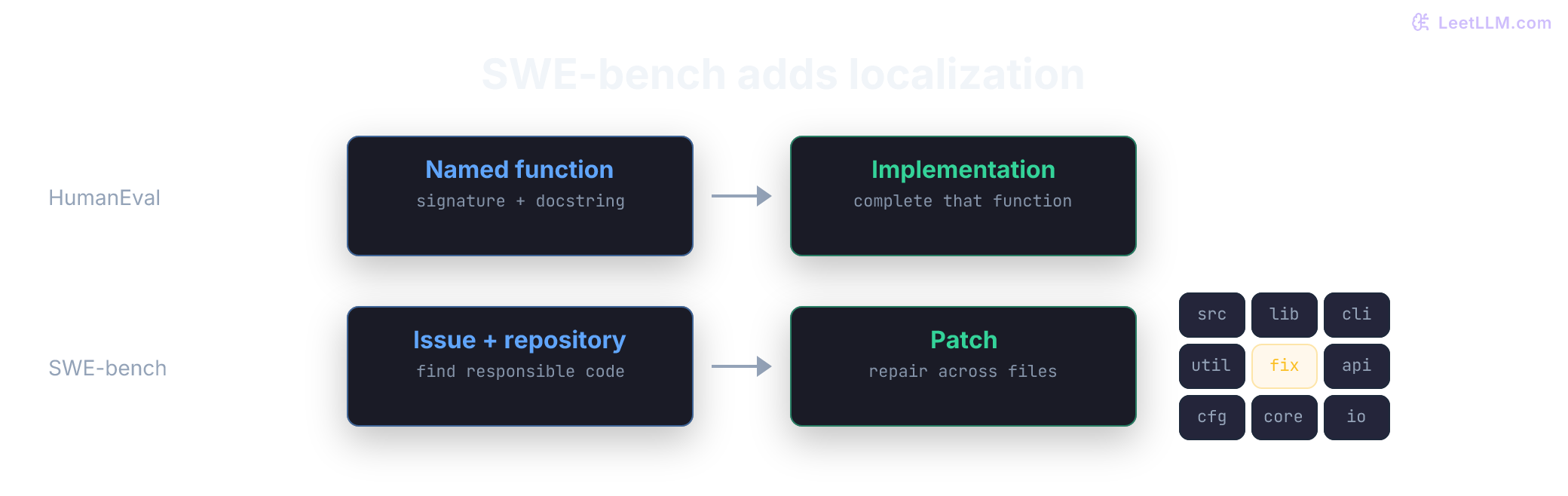
The original test split contains 2,294 instances from 12 Python repositories. Across task instances, the reference fixes average 1.7 edited files and 32.8 added or removed lines; their codebases average about 438,000 non-test lines.[3] These are task-weighted averages, not an equal-weight average of 12 repositories. Most of the tree is irrelevant to any one issue. Localization, finding the code responsible for the reported behavior, is part of the benchmark.
How a task is constructed
Each instance starts with a resolved issue and its merged pull request (PR). The dataset pins the repository's pre-fix base_commit, then splits the PR into a gold patch (the accepted non-test change) and a test patch (tests added or changed to expose the repaired behavior).[3]
The builder runs those tests against both sides of the history pair. Tests that flip from failing to passing become FAIL_TO_PASS; tests that were already green and remain green become PASS_TO_PASS. Those two hidden-test lists turn the issue into a repair gate: a patch can't "succeed" by fixing one path while breaking covered behavior.
| Artifact | Standard task input? | Evaluation job |
|---|---|---|
| Problem statement | Yes | Describes requested behavior, often from original issue text |
Repository at base_commit | Yes | Supplies broken code and existing tests |
| Gold patch | No | Reference solution for construction and analysis; not applied when grading a candidate |
| Test patch | No | Adds or updates tests from the resolving PR inside the grading environment |
FAIL_TO_PASS list | No | Names tests that must flip from fail to pass |
PASS_TO_PASS list | No | Names regression tests that must keep passing |
hints_text | No | Optional human hints from the original issue; official submissions must not use them |
Here, hidden means withheld from the candidate during inference, not secret from the public. Dataset downloads can contain patches and test lists. The runner must keep evaluator fields out of prompts, mounted files, and tool results; web access must not retrieve the original solution. Existing checkout tests provide local feedback, but final grading knowledge and hints_text aren't permitted inputs.[4] [5]
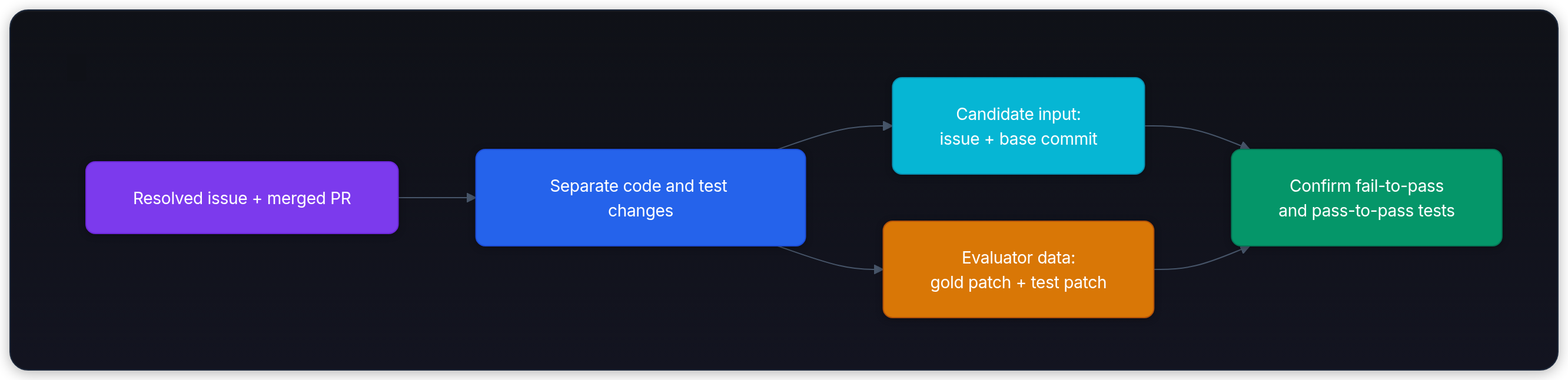
The gold patch is evidence of one accepted solution, not a required edit script. A different patch should pass when it implements the requested behavior. That promise fails when a hidden test checks an unmentioned helper name or another detail tied to the reference implementation. The 2026 audits found repeated examples of this verifier problem.[6] [7]
What a coding system must do
SWE-bench doesn't require one agent architecture. A non-interactive pipeline can retrieve files and generate a patch; an interactive agent can search, edit, run tests, and retry. Agentless showed that localization, candidate generation, and reranking can be competitive without a long autonomous loop.[8]
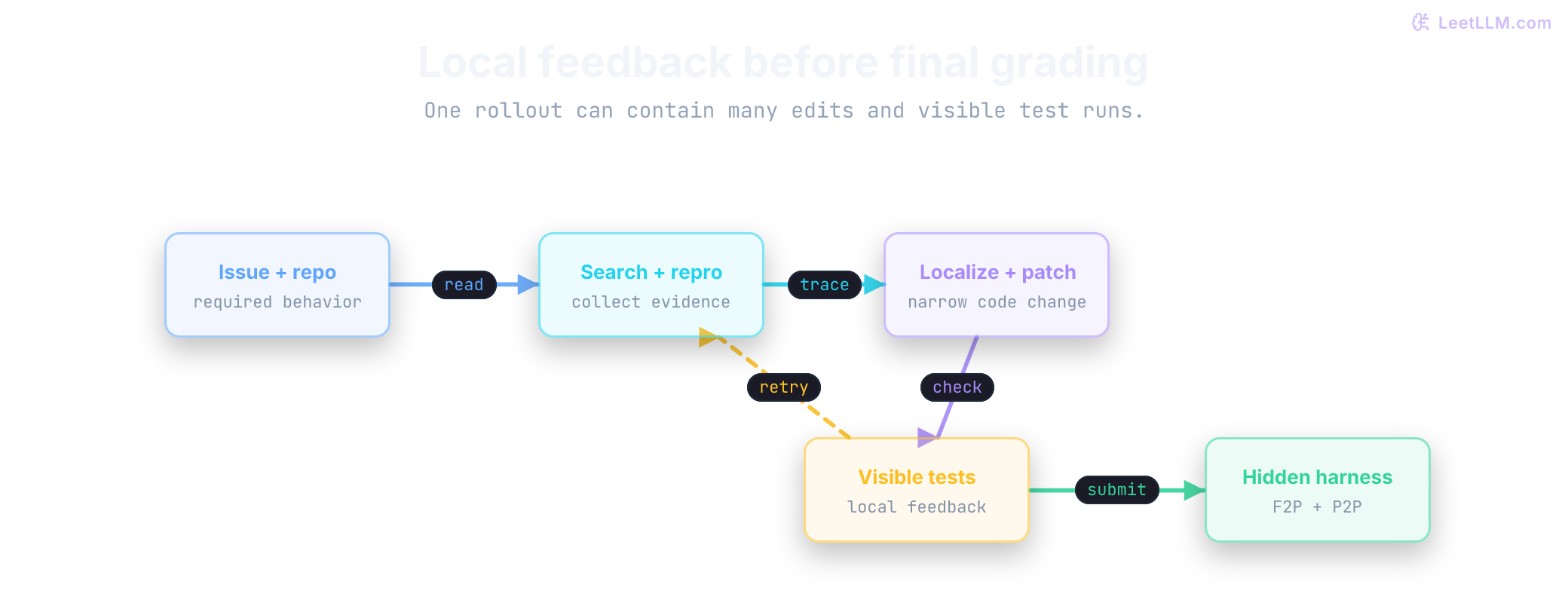
For an interactive system, the useful question is what happens between issue and submission. A compact repair cycle gives each tool call a job:
Keep this fictional issue in mind through the grading example:
mean([])must raiseStatisticsError, but the current implementation returns0.0.
A disciplined trace searches for mean, its callers, and nearby tests. It confirms that the public function returns 0.0 on an empty list, locates the empty-input branch, and changes that branch to raise the package's exception. It then checks both mean([]) and ordinary inputs such as mean([1, 2, 3]) == 2. Editing the first similarly named function without following the public call path could produce a plausible diff that changes nothing users reach.
Local green tests aren't a submission requirement or a promise of success. An agent can run out of budget and submit its best available patch; the hidden harness still grades that patch independently. The repair loop depicts how feedback should guide iteration, not an extra benchmark gate.
Tool design controls how much useful evidence that trace produces. SWE-agent calls its tool layer an agent-computer interface (ACI): commands for search, file viewing, editing, execution, and concise feedback.[9] The AI Coding Workflow with Agents lesson turns those mechanics into a bounded engineering workflow with file ownership, before-and-after evidence, and human merge authority. The Code Generation & Sandboxing lesson supplies the runtime boundary: the model proposes a patch, a trusted host admits the job, and tests run in an isolated environment.
How the harness grades a patch
Once a candidate returns a patch, the harness follows a fixed path. It starts the task-specific container, applies the candidate patch, applies the evaluator's test patch, runs the task's evaluation script, parses its output, and checks both required test sets.[4] The gold patch stays out of this path; it helped construct the task but doesn't rescue the candidate.
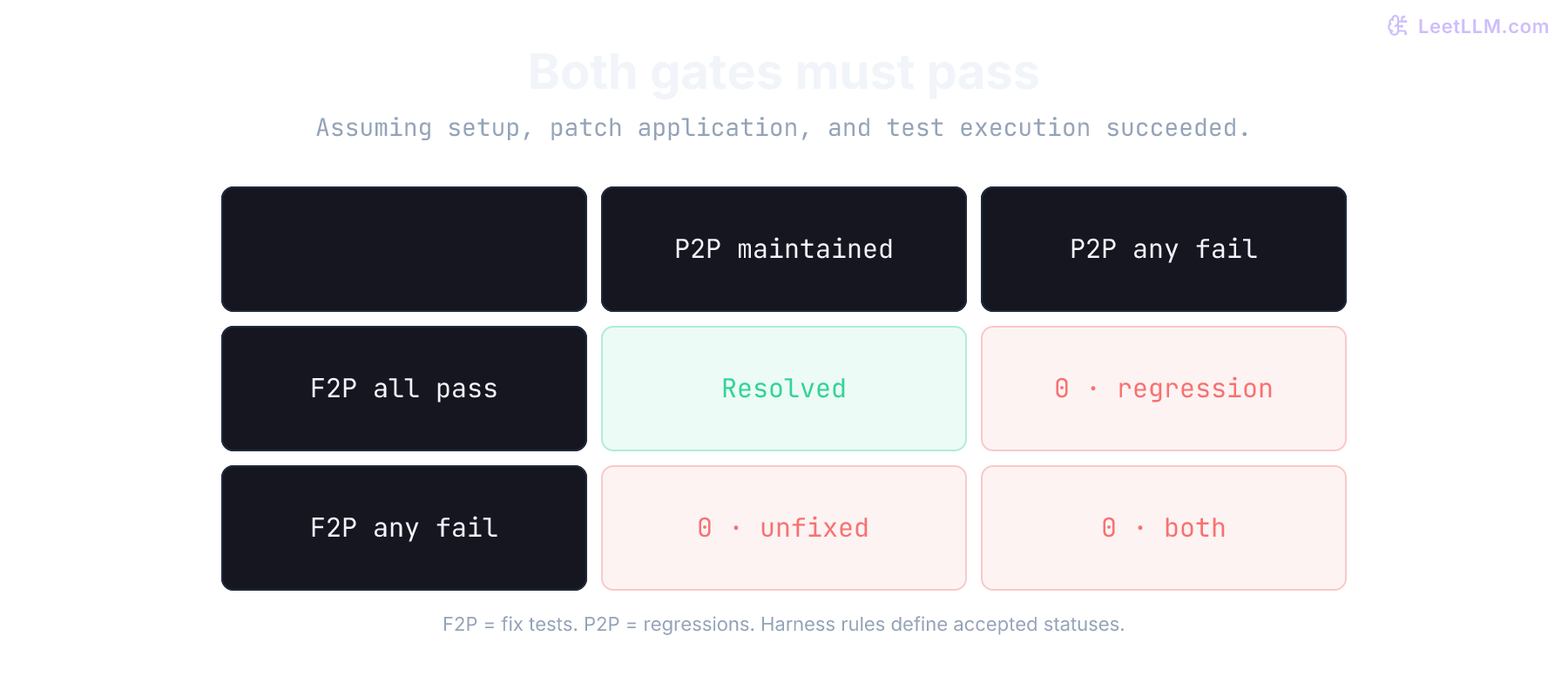
Take two task rows: one patch applies and clears both gates, while another fails one regression test. The first row contributes one resolved task; the second contributes zero. For task , write that verdict as only when patch application and test execution succeed and both required test sets satisfy the pinned harness's grading rules; otherwise . Across declared tasks:
Use the full declared split as when reading an official row. A missing prediction, patch-application error, timeout, or infrastructure failure doesn't earn a resolution. Track infrastructure failures separately and repair or rerun them under a declared policy; silently dropping them changes the denominator. For example, 60 resolved tasks out of 100 declared tasks is 60%, even if 10 other tasks failed during setup. Reporting 60/90 = 66.7% describes a different population.
The harness can record how many FAIL_TO_PASS tests passed, but that diagnostic isn't public credit. A patch that clears some fix tests and all regressions still scores zero for the task.[10]
Read the parsed statuses as well as the verdict. In the cited harness revision, rechecked October 10, 2026, a skipped FAIL_TO_PASS test doesn't count as a repair, but a skipped PASS_TO_PASS test can count as maintained. The parser's XFAIL status also counts as passing. These rules apply to the ordinary pass-and-fail grading mode; some JavaScript suites use a failure-only parser. A reported resolution therefore isn't proof that every regression assertion executed successfully. Pin the harness revision and inspect skips, expected failures, and execution logs when auditing a result.[11]
For a task with one fix test and one regression test, these parsed results illustrate the distinction:
| Fix test | Regression test | Task verdict in pass-and-fail mode |
|---|---|---|
PASSED | PASSED | Resolved |
SKIPPED | PASSED | Not resolved |
PASSED | SKIPPED | Resolved, although the regression assertion didn't execute |
XFAIL | PASSED | Resolved under this revision's status rules |
| Missing from parsed output | PASSED | Not resolved |
This is a grading trace, not permission to skip tests. If a dependency change makes a regression test skip, retain its original status and the skip reason alongside the verdict. Two runs can then have the same resolved count but different evidence of preserved behavior.
A candidate passes every FAIL_TO_PASS test but fails one PASS_TO_PASS regression test. What resolved rate should the task receive?
Answer
Zero. SWE-bench's task-level result requires all required tests, including regressions, to pass. Treat the failure as evidence about the patch or harness instead of counting partial progress as a resolved task.
That all-or-nothing gate rejects plausible-looking partial patches. It doesn't guarantee a fair grade: tests can be too narrow, too broad, underspecified, or coupled to one implementation. The score is only as meaningful as both the task and its verifier.
Choose the benchmark before reading a score
The label "SWE-bench" covers several official test sets plus a separately maintained benchmark. Their percentages aren't interchangeable because each label changes the task population. This snapshot was checked October 10, 2026 against the official leaderboard and primary dataset sources.[10] [3] [12] [13] [14]
| Set | Scored tasks | Source scope | Read as |
|---|---|---|---|
| Full (test) | 2,294 | 12 Python repositories | Original test split |
| Lite | 300 | 11 of those repositories | Filtered, cheaper subset |
| Verified | 500 | Human-reviewed slice of Full | Public comparison set |
| Multilingual | 300 | 42 repositories, 9 languages | Cross-language split |
| Multimodal v2 | 480 | Visual software issues, predominantly JavaScript | Revised image-grounded test split |
| SWE-Bench Pro | 731 public (1,865 total) | 41 repositories; public, held-out, commercial | Separate successor protocol |
Lite is cheaper for iteration because its selection removes several expensive or ambiguous shapes. It drops instances with images, external links, commit SHAs, pointers to other issues or PRs, fewer than 40 words of issue text, gold patches that edit more than one file or more than three hunks, file create/delete, and tests that check error-message strings.[12] Multi-file and visually grounded repair therefore disappear from this subset.
The project repository's current dataset guide has a conflicting Lite count, while the official Lite page and leaderboard define the public test set as 300 tasks. For historical comparisons, use that original 300-task definition; for a new run, pin the dataset revision and count the split you actually loaded.[12][4]
Verified is a 500-instance subset created after professional developers reviewed 1,699 original problems, with three experts independently reviewing each problem during construction.[13] [6] That curation improved task quality, but the set remains public and heavily studied.
Multilingual changes both language and repository mix. Multimodal adds visual evidence such as screenshots. Its original release scored 517 test issues. Multimodal v2, released September 1, 2026, retains 480 tasks after removing known flaky or ungradeable cases, rebuilds Docker environments for dependency and browser drift, and opens the complete test split and evaluation tooling.[15] A v1-to-v2 score change can reflect the revised tasks and infrastructure rather than a stronger agent. Pin both the dataset and harness revision.
SWE-Bench Pro is a separate Scale AI benchmark, not another tab on the official SWE-bench leaderboard. Its 1,865 human-verified tasks come from 41 repositories: 731 public, 858 held out, and 276 commercial.[14] The public set uses copyleft-licensed repositories by design. None of these rows is a drop-in denominator for another.
What a leaderboard row records
An unrestricted leaderboard row is a system result. It mixes the model with its scaffold, tools, prompt, budget, and retry policy, so it can compare usable systems but can't isolate model quality.
The official Verified leaderboard offers a Bash Only view to narrow that variation: model runs use mini-SWE-agent rather than separate product scaffolds.[10] That filter still doesn't establish identical release versions, prompts, sampling settings, or budgets. Inspect each row's configuration before treating it as a controlled model comparison.
Comparison rule: Compare model rows only when variant, dataset revision, scaffold version, tools, attempt policy, and budgets match. Otherwise describe a system comparison.
Even matching protocols need task-level interpretation. Suppose two fictional systems run the same 100 tasks once:
| Outcome on the same task | Tasks |
|---|---|
| Both resolve it | 60 |
| Only A resolves it | 16 |
| Only B resolves it | 15 |
| Neither resolves it | 9 |
A scores 76% and B scores 75%, but they disagree on 31 tasks. That one-point lead doesn't establish that A is reliably better on future work. Inspect the disagreements, repeat the runs, and measure uncertainty with the pairing preserved. If total inference spend was $75 for A and $7.50 for B, their observed cost per resolved task would be $75/76 ≈ $0.99 and $7.50/75 = $0.10. Include failed attempts in the spend and report environment and review costs separately.
The submission policy also separates attempt rules. Treat these as different claims, even when they use the same task set:[5]
| Reported rule | What happened | Valid official % Resolved? |
|---|---|---|
| Pass@1 / single attempt | One attempt produces one submitted patch per task | Yes, the default Bash Only reading |
| Best@k | Several attempts, then a separate selector picks one patch without using FAIL_TO_PASS / PASS_TO_PASS | Yes, if labeled 2+ attempts |
| Pass@k | Several attempts, each graded, credit if any passed | No. That inflates resolved rate |
pass@k answers a search question: did any of several sampled patches work? It isn't the single-submission SWE-bench headline. Evaluating AI Agents derives pass@k, repeatability metrics, hard gates, and cost per successful task.
For example, suppose two of five candidate patches would pass hidden grading. Choosing one uniformly at random succeeds with probability 2/5 = 40%; grading all five and accepting any success gives pass@5 = 100% for that pool. A real best@5 selector doesn't know those hidden verdicts. Its result depends on which patch it selects, and all five attempts contribute to cost. Repeated edits inside one agent rollout aren't automatically five independent attempts.
Before comparing a row, ask:
- Which variant and exact dataset revision?
- Which model snapshot and agent or retrieval scaffold?
- Which tools, system prompt, image access, and test access?
- How many attempts, steps, tokens, and retries per task?
- What selection rule turned multiple patches into one submission?
- What were total cost, latency, setup failures, and timeouts?
- Are predictions, trajectories, logs, and harness reports available?
- If the system can browse the web, what blocked it from fetching the original PR?
Leaderboard coverage also reflects eligibility. Since November 18, 2025, new Verified and Multilingual entries require an academic or research affiliation plus a public arXiv preprint or technical report. Earlier submissions remain, and Multimodal remains open to other submitters.[5] Absence from a table isn't evidence that a product failed the benchmark.
What the 2026 audits changed
Reproducibility doesn't make a benchmark valid by itself. On February 23, 2026, OpenAI announced it had stopped reporting Verified for frontier launches, citing flawed tasks and training exposure to public solutions.[6]
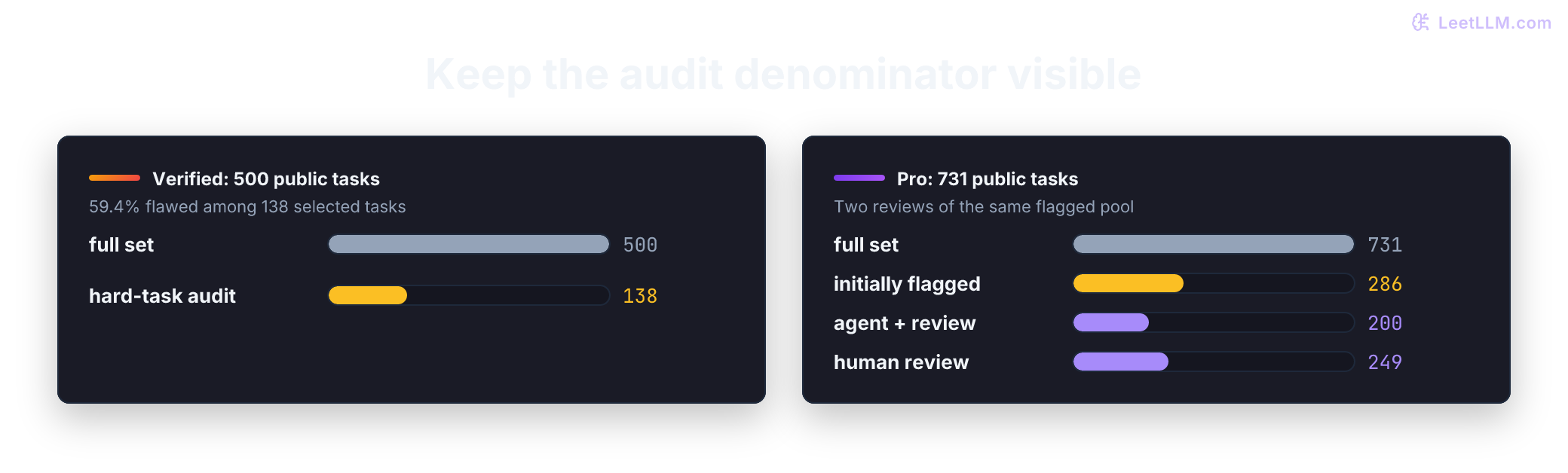
Reviewers examined 138 tasks that OpenAI o3 didn't solve consistently across 64 runs. They found material issues in 59.4% of that selected subset, not 59.4% of all 500 tasks.
For example, pylint-dev__pylint-4551 asks pyreverse to read type hints, but its tests import an unrequested get_annotation helper. A behaviorally correct implementation can fail that import.[6]
Every frontier model tested reproduced gold patches or verbatim task details in some cases. This supports contamination, not a claim that every success was memorized. Prior exposure can reveal details missing from an underspecified issue.
SWE-Bench Pro already existed when OpenAI published the Verified audit. OpenAI recommended Pro in February, then retracted that recommendation on July 8, 2026.[14] [7] Its initial filter flagged 286 of the 731 public tasks for deeper review. Agent-assisted review labeled 200 tasks broken (27.4% of 731); human review labeled 249 (34.1%). These are overlapping judgments on the flagged pool, not disjoint counts to add together. OpenAI summarized the finding as roughly 30%, citing four patterns:
- tests that require unmentioned implementation details
- prompts that omit behavior enforced by tests
- tests too weak to catch incomplete solutions
- prompts that point toward behavior inconsistent with tests
These audits don't make every public result useless. They narrow the claim. Verified remains useful for historical and reproducible system comparisons, especially when the scaffold is open, but public exposure makes it weak evidence for fine-grained frontier ranking. Pro may still diagnose systems on its surviving tasks; an aggregate score across a disputed public split needs task-level quality analysis. LLM Benchmarks & Limitations carries the broader hygiene lesson: name the split, harness, and failure mode before treating a percentage as capability.
Evidence rule: Treat a public benchmark score as screening evidence. Use task-level traces and an internal held-out suite before making a product or release decision.
Reproduce a claim before comparing it
To compare a claim, start with one leaderboard row or paper table. Save a run manifest that preserves the protocol rather than relying on a screenshot or memory:
{
  "benchmark": "<variant, split, and dataset revision>",
  "task_ids": ["<ordered task ids>"],
  "model": "<provider and immutable model version>",
  "scaffold_commit": "<git commit or release tag>",
  "harness_commit": "<git commit>",
  "container_image": "<immutable image digest>",
  "attempt_policy": "pass@1",
  "samples_per_task": 1,
  "temperature": "<recorded value or unset>",
  "max_steps": "<fixed budget>",
  "timeout_seconds": "<fixed timeout>"
}
Keep each patch, observable trace, test log, harness report, cost, and latency beside that manifest. Recompute the resolved rate over the declared task IDs, and label missing predictions or infrastructure failures instead of hiding them.
For current public submissions, the SWE-bench experiments repository holds an entry whose metadata.yaml points to the submitter's public artifact repository. Older entries can still point to S3. The swebench submit verify command re-derives grades from recorded test output; it doesn't rerun the patch or establish that the tasks are fair. Use it to check that a claimed result agrees with its logs, then reproduce execution separately when needed.[5]
Run a small fixed slice before spending on the full set. Check checkout, dependency setup, patch application, test discovery, timeout behavior, and report parsing. That smoke test validates plumbing, not the benchmark score. If dataset containers or provider endpoints have drifted, record the mismatch instead of comparing unlike runs.
For a model comparison, hold scaffold, task IDs, tools, image, prompt, attempt policy, and budgets constant. If any of those change, call it a system comparison.
What SWE-bench leaves untested
A high score is evidence of targeted repository repair under one harness. It doesn't answer whether an agent can own:
- greenfield architecture and product discovery
- multi-week migrations and coordination
- code review, security review, and performance review
- deployment, rollback, and incident ownership
- private repository conventions and weak local test suites
- your languages, frameworks, permissions, and latency budget
Build a private suite from representative repository work that wasn't used to tune the agent. Include narrow fixes, cross-file changes, ambiguous requests that should trigger clarification, unsafe instructions that should be rejected, flaky setup, and tasks where the correct response is to stop. Grade final behavior, regressions, scope, cost, latency, and review burden alongside test pass rate.
Practice: trace the verdict
Return to the fictional issue from the repair trace:
mean([])must raiseStatisticsError, but the current implementation returns0.0.
Predict the results for three implementations: one keeps the bug, one fixes empty input but breaks ordinary inputs, and one satisfies both requirements. This in-process example models a strict boolean test conjunction only, not Docker setup, patch application, or the real harness's skip and expected-failure statuses. safe_run turns an unexpected exception into a failed test. A real agent's untrusted code needs an isolated runner, not execution inside the evaluator process.
from collections.abc import Callable
from dataclasses import dataclass

class StatisticsError(ValueError):
    """Raised when statistics function receives invalid inputs."""

# Candidate patches for mean(data)
def buggy_patch_mean(data: list[float]) -> float:
    # Preserves bug: returns 0.0 instead of raising StatisticsError
    if not data:
        return 0.0
    return sum(data) / len(data)

def regressive_patch_mean(data: list[float]) -> float:
    # Fixes empty input but introduces regression on valid inputs
    if not data:
        raise StatisticsError("mean requires at least one data point")
    raise RuntimeError("unexpected regression on valid data")

def correct_patch_mean(data: list[float]) -> float:
    # Satisfies both fix test and existing behavior
    if not data:
        raise StatisticsError("mean requires at least one data point")
    return sum(data) / len(data)

@dataclass(frozen=True)
class TaskInstance:
    instance_id: str
    fail_to_pass: list[Callable[[Callable[[list[float]], float]], bool]]
    pass_to_pass: list[Callable[[Callable[[list[float]], float]], bool]]

def test_empty_raises(fn: Callable[[list[float]], float]) -> bool:
    try:
        fn([])
        return False
    except StatisticsError:
        return True

def test_single_element(fn: Callable[[list[float]], float]) -> bool:
    return fn([42.0]) == 42.0

def test_multi_element(fn: Callable[[list[float]], float]) -> bool:
    return fn([1.0, 2.0, 3.0]) == 2.0

def safe_run(test: Callable[[Callable[[list[float]], float]], bool], fn: Callable[[list[float]], float]) -> bool:
    try:
        return bool(test(fn))
    except Exception:
        return False

def evaluate_task(instance: TaskInstance, candidate_fn: Callable[[list[float]], float]) -> dict[str, bool]:
    if not instance.fail_to_pass:
        raise ValueError("A repair task needs at least one FAIL_TO_PASS test")
    # Collect all results before aggregation so a failure doesn't skip diagnostics.
    f2p_passed = all([safe_run(test, candidate_fn) for test in instance.fail_to_pass])
    p2p_passed = all([safe_run(test, candidate_fn) for test in instance.pass_to_pass])
    resolved = f2p_passed and p2p_passed
    return {
        "fail_to_pass": f2p_passed,
        "pass_to_pass": p2p_passed,
        "resolved": resolved,
    }

instance = TaskInstance(
    instance_id="math__statistics-101",
    fail_to_pass=[test_empty_raises],
    pass_to_pass=[test_single_element, test_multi_element],
)

buggy_res = evaluate_task(instance, buggy_patch_mean)
regressive_res = evaluate_task(instance, regressive_patch_mean)
correct_res = evaluate_task(instance, correct_patch_mean)

b_r, b_f, b_p = buggy_res["resolved"], buggy_res["fail_to_pass"], buggy_res["pass_to_pass"]
r_r, r_f, r_p = regressive_res["resolved"], regressive_res["fail_to_pass"], regressive_res["pass_to_pass"]
c_r, c_f, c_p = correct_res["resolved"], correct_res["fail_to_pass"], correct_res["pass_to_pass"]

print(f"Buggy patch:      resolved={b_r} (F2P={b_f}, P2P={b_p})")
print(f"Regressive patch: resolved={r_r} (F2P={r_f}, P2P={r_p})")
print(f"Correct patch:    resolved={c_r} (F2P={c_f}, P2P={c_p})")

assert not buggy_res["resolved"] and not buggy_res["fail_to_pass"]
assert not regressive_res["resolved"] and not regressive_res["pass_to_pass"]
assert correct_res["resolved"] and correct_res["fail_to_pass"] and correct_res["pass_to_pass"]Buggy patch: resolved=False (F2P=False, P2P=True)
Regressive patch: resolved=False (F2P=True, P2P=False)
Correct patch: resolved=True (F2P=True, P2P=True)Three rows tell three different failure stories. The buggy patch preserves the issue, so it fails FAIL_TO_PASS. A regressive patch raises the requested exception but breaks non-empty inputs, so it fails PASS_TO_PASS. Only the third patch clears both gates and counts as resolved.
Now remove test_empty_raises from fail_to_pass. The evaluator raises ValueError instead of claiming success: Python's all([]) is True, but an empty fix-test list offers no evidence of repair. This guard catches a malformed example task. It doesn't replace checking that the original code actually fails the declared fix tests and the reference patch passes them.
A run declares 100 tasks, resolves 60, and loses 10 others to container setup errors. Another run resolves 65 with no setup errors. Can you claim the first is better by reporting 60/90 = 66.7%?
Answer
No. The first run resolved 60% of the declared population. Diagnose or rerun its setup failures using a stated policy, but don't remove them selectively. Even 65% versus 60% needs matched task IDs, budgets, repeated runs, and task-level disagreement analysis before drawing a broad capability conclusion.
Two habits transfer to real agent work. Review a patch against exact behavior, not whether the diff looks plausible. Preserve the run context that explains every verdict. Build that workflow in AI Coding Workflow with Agents, then use Evaluating AI Agents to design private episodes, repeatability checks, and release gates around it.